Stock Analysis · Seplat Energy Plc (SEPLF)
Overview
Seplat Energy Plc is a Nigerian energy company focused on oil and gas production, processing, and domestic gas supply. It started as an independent upstream producer and has been expanding into a broader energy platform that combines crude oil production with natural gas infrastructure. Its assets are mainly located in Nigeria’s Niger Delta, and the company is listed in both Lagos and London, while SEPLF trades over the counter in the United States.
The business changed scale materially after the acquisition of Mobil Producing Nigeria Unlimited, now operated as Seplat Energy Producing Nigeria Unlimited. That deal significantly increased offshore production and made Seplat a much larger producer in Nigeria. As a result, the company now combines onshore and shallow-water operations, giving it a wider production base than it had a few years ago.
Revenue is still dominated by hydrocarbon sales, with crude oil and condensate remaining the largest contributor. Based on recent annual reporting and the post-acquisition business mix, the main revenue sources appear to be:
- Crude oil and condensate sales: approximately 70% to 80% of revenue. This includes exported crude and associated liquids from Seplat’s operated and non-operated fields.
- Natural gas sales: approximately 15% to 25% of revenue. This includes processed gas sold into Nigeria’s domestic market, where gas is used for power generation and industrial demand.
- Other energy-related income: generally below 10% of revenue. This can include natural gas liquids, processing-related income, and other field-related revenue items depending on the reporting period.
That mix matters for long-term analysis. Oil usually drives the largest share of earnings and cash generation, but gas gives Seplat an additional layer of domestic demand exposure that many pure oil producers do not have. The company’s gas business also fits Nigeria’s structural need for more reliable fuel for electricity and industry.
The financial profile has become much larger over the last few years. Revenue rose strongly from 2021 through 2025, but the cost base also moved up sharply, especially after the major acquisition. Even so, operating income expanded over that period, showing that scale has brought more earnings power, although net income has remained more volatile than revenue.
Key Figures
| Metric | Value | Sector ⓘ |
|---|---|---|
| Date | Oct 03, 2026 | |
| Context | ||
| Sector | Energy | |
| Industry | Oil & Gas E&P | |
| Market Cap ⓘ | $7.19B | |
| Beta ⓘ | 0.13 | |
Value (Cheapness) | ||
| P/E Ratio ⓘ | 23.98 | 14.47 |
| P/B Ratio ⓘ | 3.61 | 1.70 |
| FCF Yield ⓘ | 16.92% | 8.66% |
| Dividend Yield ⓘ | 1.67% | 3.77% |
| EBIT / EV ⓘ | 11.15% | 7.46% |
| PEG ⓘ | N/A | |
Growth (Business expansion) | ||
| Revenue Growth ⓘ | 66.40% | 27.35% |
| RPS Growth (5Y CAGR) ⓘ | 37.93% | 6.75% |
| EPS Growth (5Y CAGR) ⓘ | 8.13% | -15.45% |
| BVPS Growth (5Y CAGR) ⓘ | -0.03% | 5.85% |
| Margin Growth (5Y Trend) ⓘ | -3.57% | 0.75% |
| FCF Growth (5Y CAGR) ⓘ | 48.99% | 3.62% |
| DPS Growth (5Y CAGR) ⓘ | 16.79% | 16.85% |
Quality (Business durability) | ||
| ROIC (Latest) ⓘ | 21.66% | 11.33% |
| ROA (Latest) ⓘ | 3.82% | 6.03% |
| ROIC (5Y Median) ⓘ | N/A | 10.16% |
| ROA (5Y Median) ⓘ | 2.57% | 5.34% |
| Net Debt / EBIT (Latest) ⓘ | 0.48 | 1.62 |
| Net Debt / EBIT (5Y Median) ⓘ | 1.26 | 1.91 |
| Net Debt / EBITDA (Latest) ⓘ | 0.21 | 1.06 |
| Net Debt / Assets ⓘ | 6.20% | 17.29% |
| EBITDA / Interest ⓘ | 9.41 | 9.64 |
| Operating Margin (Latest) ⓘ | 26.29% | 16.32% |
| Operating Margin (5Y Median) ⓘ | 26.85% | 19.53% |
| Debt to Equity (Latest) ⓘ | N/A | 54.41% |
| Profit Margin (Latest) ⓘ | 9.40% | 8.79% |
| Free Cash Flow (Latest) ⓘ | $1.22B | |
Momentum (Price trend) | ||
| 3Y Return ⓘ | N/A | +62.93% |
| 12M Return (excl. last month) ⓘ | +294.96% | +44.83% |
| 6M Return ⓘ | +82.31% | -1.62% |
| Price vs. 200-Day MA ⓘ | +69.84% | +5.18% |
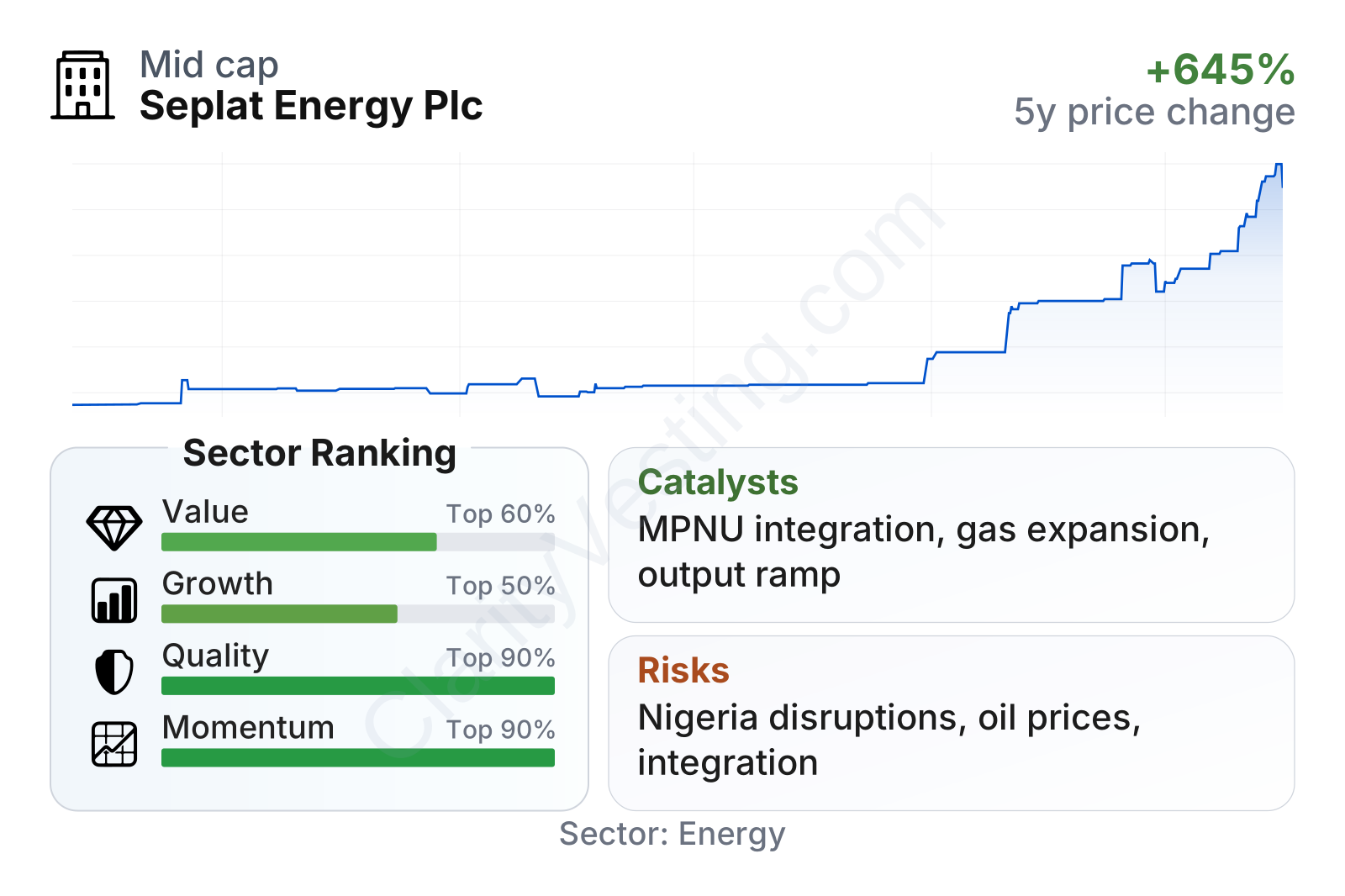
Seplat’s current profile is unusual in a good way for an exploration and production company. Growth and cash generation are strong relative to the sector, while balance-sheet pressure looks low. Free cash flow yield and EBIT relative to enterprise value are better than the sector median, but the stock also trades on higher earnings and book multiples than many peers. Quality is mixed: returns on invested capital and operating margins are solid, yet asset returns are less impressive and margin trends have not been consistently improving.
The share price has moved up dramatically over the last year, far outperforming much of the energy sector. That strong momentum suggests the market has been re-rating the company after the business transformation, but it also means expectations are no longer low.
Growth
Seplat operates in a sector that is mature globally but still important in Nigeria, where domestic energy shortages, power demand, and industrial fuel needs create room for profitable gas development. That makes the company different from producers that depend only on oil exports. In Seplat’s case, the long-term growth case is tied not only to commodity volumes, but also to gas processing, supply infrastructure, and improved utilization of acquired assets.
The company’s recent strategy makes sense on an industrial basis. The enlarged asset base gives it more production capacity, more operating leverage, and a stronger position in Nigeria’s upstream industry. The offshore acquisition added immediate scale, while Seplat’s legacy gas assets provide a domestic demand angle that could prove more durable than oil-only growth. In simple terms, the company is trying to be both a larger producer and a more diversified one within the same country.
Recent revenue growth has been very strong, although not smooth. The business posted an exceptional jump during 2025, then growth normalized, and by mid-2026 it re-accelerated again to roughly two-thirds year-over-year. That pattern suggests the company is still digesting a much larger operating footprint rather than following a steady linear path.
Cash generation is one of the clearest positive signals. Free cash flow moved sharply higher from late 2024 into 2025, and the latest trailing figure is very high for a company of this size. Over a longer period, Seplat’s five-year free-cash-flow growth rate also stands well above the sector median. That matters because long-term value in this industry usually comes from turning production into cash, not just reporting higher barrels or higher revenue.
A major catalyst is the company’s ability to keep extracting synergies and output gains from the former ExxonMobil Nigerian business. Another is gas: Nigeria continues to need domestic gas for electricity and industrial activity, and Seplat already has processing and supply infrastructure that can support that demand. If management can raise utilization, improve reliability, and control costs across the larger portfolio, growth can come from both volume and efficiency rather than oil prices alone.
Recent company updates have also highlighted continued operational ramp-up and integration progress after the transformational acquisition. That is important because the market is now watching whether the enlarged Seplat can convert scale into sustainable earnings and cash flow, not just one-time expansion.
Risks
This article is for informational purposes only and does not constitute financial advice. Some content is AI-generated. See Disclaimer