Stock Analysis · Solaris Energy Infrastructure Inc (SEI)
Overview
Solaris Energy Infrastructure Inc operates in energy services, with roots in logistics and equipment support for oil and gas well completions. In recent years, the company has been expanding beyond its original niche and increasingly positioning itself as a broader infrastructure platform tied to energy and power demand. That shift matters for long-term analysis because it changes the business from a more cyclical service provider into a company trying to capture demand from both traditional energy activity and newer power-related infrastructure needs.
The company’s historical base business has been mobile equipment and logistics services used at the wellsite, especially for handling proppant and related materials in hydraulic fracturing operations. Public company materials also point to a growing emphasis on distributed power and related infrastructure solutions, which helps explain the recent jump in revenue and the heavier use of debt and capital.
Based on the latest public filings and company disclosures, revenue appears to come primarily from the following areas:
- Wellsite logistics and equipment services: likely still the largest revenue source, incorporating systems, rentals, and service activity tied to completion operations in U.S. shale basins.
- Power and infrastructure solutions: a rapidly growing business line tied to temporary or distributed power, electrical equipment, and related infrastructure support for energy and industrial customers.
- Other service and support revenue: a smaller contribution that can include ancillary field services, transportation-related activity, and customer support offerings.
Precise segment percentages are not reliably available from the material reviewed here in a way that supports a clean current-year split, but the broad direction is clear: the legacy oilfield service base remains important, while the newer power-oriented platform is becoming a much larger part of the company’s economic profile.
The financial profile also shows a major scale change. Annual revenue rose from about $159 million in 2021 to about $622 million in 2025, while operating income improved sharply over that period. At the same time, interest expense climbed materially, showing that growth has come with a much heavier financing burden.
The business has moved from a small, lightly levered operator into a much larger company with stronger gross profit and operating income, but also meaningfully higher capital demands and financing costs.
Key Figures
| Metric | Value | Sector ⓘ |
|---|---|---|
| Date | Oct 17, 2026 | |
| Context | ||
| Sector | Energy | |
| Industry | Oil & Gas Equipment & Services | |
| Market Cap ⓘ | $7.83B | |
| Beta ⓘ | 1.28 | |
Value (Cheapness) | ||
| P/E Ratio ⓘ | 97.29 | 15.44 |
| P/B Ratio ⓘ | 8.52 | 1.73 |
| FCF Yield ⓘ | -9.29% | 8.20% |
| Dividend Yield ⓘ | 0.61% | 3.59% |
| EBIT / EV ⓘ | 2.26% | 7.46% |
| PEG ⓘ | 0.94 | |
Growth (Business expansion) | ||
| Revenue Growth ⓘ | 46.90% | 26.90% |
| RPS Growth (5Y CAGR) ⓘ | 24.85% | 6.90% |
| EPS Growth (5Y CAGR) ⓘ | 2.02% | -15.73% |
| BVPS Growth (5Y CAGR) ⓘ | -2.00% | 6.07% |
| Margin Growth (5Y Trend) ⓘ | 16.42% | 0.58% |
| FCF Growth (5Y CAGR) ⓘ | N/A | 1.86% |
| DPS Growth (5Y CAGR) ⓘ | -0.06% | 16.79% |
Quality (Business durability) | ||
| ROIC (Latest) ⓘ | 5.11% | 11.40% |
| ROA (Latest) ⓘ | 1.90% | 6.06% |
| ROIC (5Y Median) ⓘ | N/A | 10.30% |
| ROA (5Y Median) ⓘ | 1.99% | 5.42% |
| Net Debt / EBIT (Latest) ⓘ | 12.21 | 1.64 |
| Net Debt / EBIT (5Y Median) ⓘ | 2.62 | 1.83 |
| Net Debt / EBITDA (Latest) ⓘ | 6.80 | 1.08 |
| Net Debt / Assets ⓘ | 40.13% | 17.29% |
| EBITDA / Interest ⓘ | 7.13 | 9.64 |
| Operating Margin (Latest) ⓘ | 18.17% | 16.27% |
| Operating Margin (5Y Median) ⓘ | 15.56% | 20.39% |
| Debt to Equity (Latest) ⓘ | 278.79% | 54.76% |
| Profit Margin (Latest) ⓘ | 7.19% | 8.82% |
| Free Cash Flow (Latest) ⓘ | -$727.80M | |
Momentum (Price trend) | ||
| 3Y Return ⓘ | +632.83% | +67.38% |
| 12M Return (excl. last month) ⓘ | +98.68% | +49.19% |
| 6M Return ⓘ | +7.07% | +7.07% |
| Price vs. 200-Day MA ⓘ | +11.16% | +9.56% |
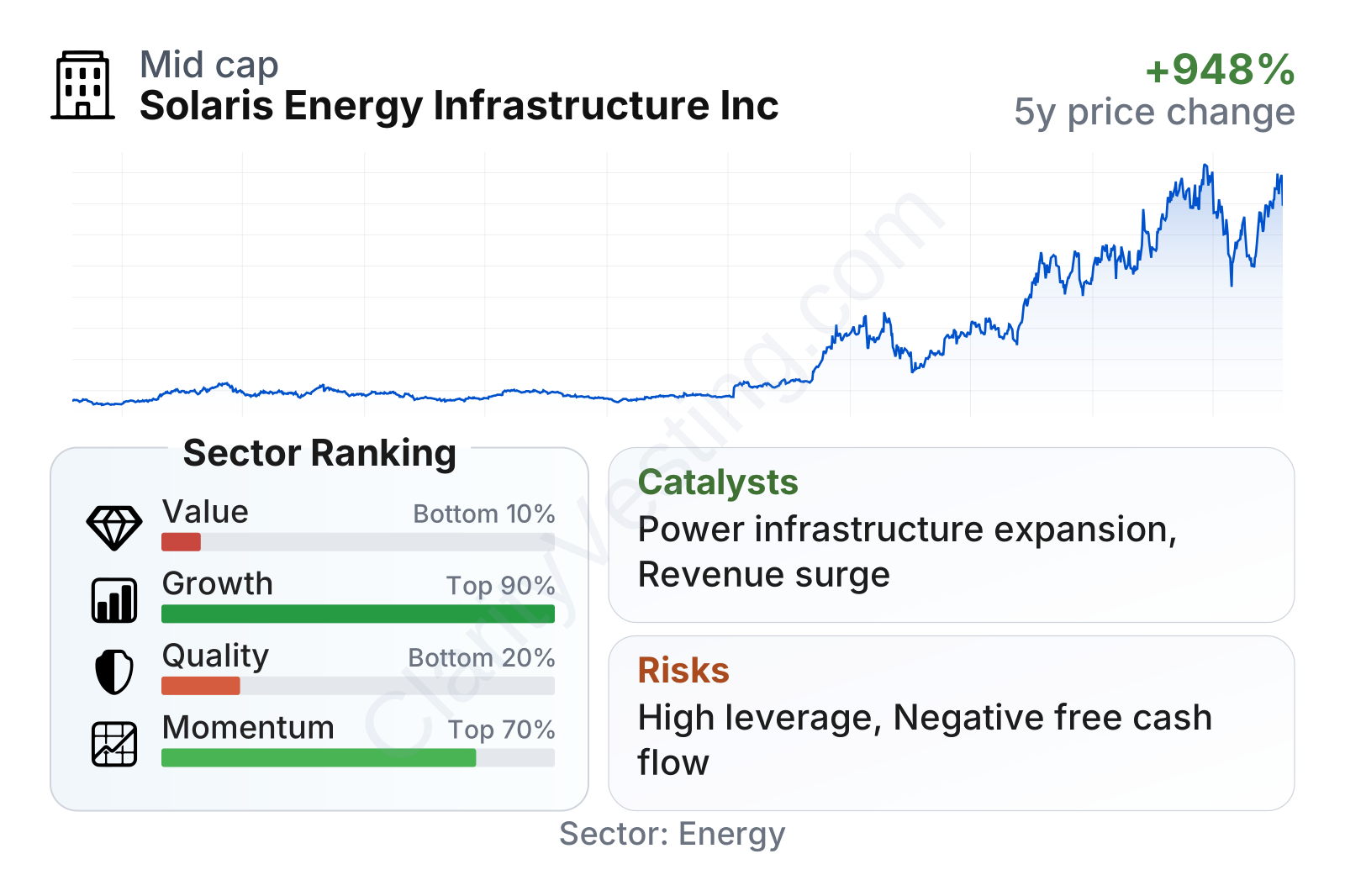
SEI is now a mid-sized company by energy service standards, with above-average share-price momentum but a mixed fundamental profile. Growth ranks near the top of the sector, helped by revenue expansion of roughly 47% year over year and a strong five-year increase in revenue per share. However, quality and balance-sheet measures are much weaker: debt has risen far above the sector norm, free cash flow is negative, and returns on capital remain below industry medians. Valuation metrics also screen as expensive versus peers, with a very high earnings multiple and a low EBIT-to-enterprise-value yield.
Growth
SEI operates in parts of the energy market that still have room to expand. Its legacy business benefits from U.S. shale activity, where operators continue to seek efficiency, lower labor intensity, and better logistics at the wellsite. The more important long-term angle, though, is the company’s move into power and infrastructure. Demand for distributed power has been rising across oilfield operations, data center development, industrial sites, and grid-constrained locations. If management executes well, this gives the company exposure to a broader and potentially faster-growing market than traditional completion services alone.
The company’s strategy appears logical on paper. It builds on field relationships and operating experience, then adds higher-value infrastructure offerings that can deepen customer ties and support larger contracts. That can improve revenue durability over time, especially if the company shifts from spot service work toward more integrated solutions.
Revenue growth has been volatile, which is normal for a business tied to project timing and acquisitions, but the recent pattern is hard to ignore. After a weak stretch in 2023 and early 2024, growth reaccelerated strongly and remained elevated into 2026. That suggests the company is no longer relying only on a mature legacy business and is benefiting from newer demand drivers.
The main growth caveat is cash generation. Free cash flow has swung from modestly positive to deeply negative, which usually means expansion is consuming large amounts of capital. That does not automatically make the strategy unattractive, but it raises the standard for execution. For the recent growth to translate into durable shareholder value, future profits will need to convert into cash much more consistently.
A meaningful catalyst is the broader U.S. power shortage theme. Industries that need fast access to electricity are increasingly turning to temporary, modular, or distributed solutions. If SEI can secure larger multi-year infrastructure contracts in that environment, the market opportunity could be considerably larger than what its historical oilfield identity would suggest.
Risks
This article is for informational purposes only and does not constitute financial advice. Some content is AI-generated. See Disclaimer


