Stock Analysis · Segro Plc (SEGXF)
Overview
Segro Plc is a large European real estate company focused on modern warehouses, industrial space, and logistics-related property. It operates as a real estate investment trust, or REIT, which means its business is built around owning, developing, and managing income-producing properties. The company’s portfolio is concentrated in the United Kingdom and continental Europe, with a clear emphasis on locations close to large cities, major transport routes, and important population centers.
Its properties are mainly used by customers involved in distribution, parcel delivery, light industrial activity, data-linked operations, and urban logistics. In practical terms, Segro benefits when businesses need well-located space to store goods, process orders, or move products quickly to customers.
Based on the company’s recent reporting structure, its revenue sources are broadly divided as follows:
- Rental income from standing assets: roughly 80% to 90% of revenue. This is the recurring income collected from tenants leasing existing warehouse and industrial properties.
- Development and related property income: roughly 10% to 20% of revenue. This includes gains and income associated with completing, leasing, and occasionally disposing of developed space.
- Other property-related income: a small residual share. This can include service recoveries and ancillary income tied to operating the portfolio.
That mix matters because it means the business is driven first by recurring rent, while development adds an extra layer of growth when market demand is strong. Over the last several years, revenue has generally moved upward even though accounting profit has been more volatile because property values, financing costs, and revaluation movements can significantly affect reported earnings for REITs.
There is also a visible pattern of resilient property-level economics: gross profit has remained high relative to revenue, and operating margins have stayed strong by sector standards. That supports the idea that Segro’s core assets are productive and that the business is not relying only on asset value swings to create results.
The long-term picture shows a business with a high share of recurring rent and strong operating profitability, but with bottom-line results that can swing sharply from year to year as property valuations and financing conditions change.
Key Figures
| Metric | Value | Sector ⓘ |
|---|---|---|
| Date | Oct 17, 2026 | |
| Context | ||
| Sector | Real Estate | |
| Industry | REIT - Industrial | |
| Market Cap ⓘ | $16.64B | |
| Beta ⓘ | 1.13 | |
Value (Cheapness) | ||
| P/E Ratio ⓘ | 41.00 | 17.38 |
| P/B Ratio ⓘ | 1.86 | 0.85 |
| FCF Yield ⓘ | 4.44% | 7.38% |
| Dividend Yield ⓘ | 2.56% | 4.85% |
| EBIT / EV ⓘ | N/A | 3.78% |
| PEG ⓘ | 2.11 | |
Growth (Business expansion) | ||
| Revenue Growth ⓘ | 5.40% | 5.30% |
| RPS Growth (5Y CAGR) ⓘ | -3.30% | 6.02% |
| EPS Growth (5Y CAGR) ⓘ | -25.74% | -11.37% |
| BVPS Growth (5Y CAGR) ⓘ | -11.96% | 0.45% |
| Margin Growth (5Y Trend) ⓘ | 26.57% | -0.22% |
| FCF Growth (5Y CAGR) ⓘ | 4.82% | 5.40% |
| DPS Growth (5Y CAGR) ⓘ | 10.29% | 5.02% |
Quality (Business durability) | ||
| ROIC (Latest) ⓘ | N/A | 5.69% |
| ROE (Latest) ⓘ | 7.68% | 7.56% |
| ROA (Latest) ⓘ | 5.19% | 2.85% |
| ROIC (5Y Median) ⓘ | 2.98% | 4.22% |
| ROE (5Y Median) ⓘ | 4.53% | 6.03% |
| ROA (5Y Median) ⓘ | 3.08% | 2.44% |
| Net Debt / EBIT (Latest) ⓘ | 5.74 | 7.59 |
| Net Debt / EBIT (5Y Median) ⓘ | 7.54 | 8.40 |
| Net Debt / EBITDA (Latest) ⓘ | 5.56 | 5.27 |
| Net Debt / Assets ⓘ | 28.31% | 37.76% |
| EBITDA / Interest ⓘ | 4.27 | 4.10 |
| Operating Margin (Latest) ⓘ | 61.16% | 35.29% |
| Operating Margin (5Y Median) ⓘ | 63.37% | 37.31% |
| Debt to Equity (Latest) ⓘ | 44.06% | 88.87% |
| Profit Margin (Latest) ⓘ | 40.00% | 19.61% |
| Free Cash Flow (Latest) ⓘ | $738.53M | |
Momentum (Price trend) | ||
| 3Y Return ⓘ | +56.68% | +30.75% |
| 12M Return (excl. last month) ⓘ | +56.05% | +4.36% |
| 6M Return ⓘ | +25.85% | -2.52% |
| Price vs. 200-Day MA ⓘ | +18.01% | -2.34% |
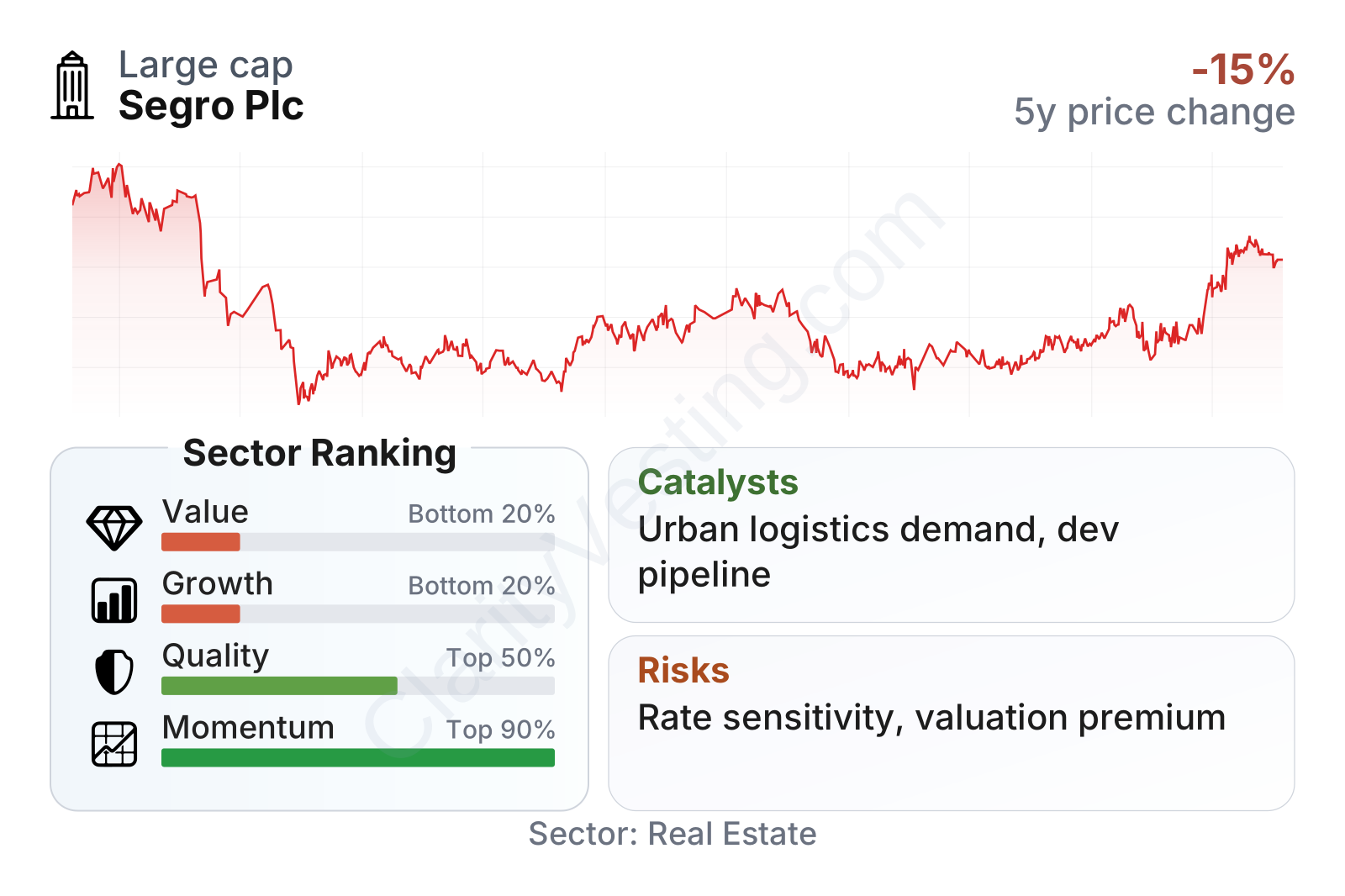
Segro is a large industrial REIT with market value in the large-cap range and share-price volatility that is slightly above the broader market. The stock has rebounded strongly from its earlier downturn, and recent price momentum has clearly been stronger than the sector median.
The quality profile looks solid. Profitability metrics are generally above sector norms, with return on assets, return on equity, profit margin, and operating margin all standing at healthy levels for a property company. Leverage looks manageable rather than stretched: debt-to-equity is well below the sector median, net debt relative to assets is moderate, and interest coverage is slightly better than the sector norm.
The weaker area is valuation and longer-term growth. The shares trade on higher earnings and book multiples than many peers, while the dividend yield and free cash flow yield are below sector medians. Revenue growth over the last year has been acceptable, but the five-year record for revenue per share, earnings per share, and book value per share has been less impressive.
Growth
Segro operates in a part of real estate that has stronger structural support than many traditional property categories. Warehousing and logistics facilities have benefited from e-commerce, faster delivery expectations, supply-chain redesign, and the need to place inventory closer to end customers. Urban logistics in particular tends to face land scarcity, which can support rents and occupancy over time.
The company’s strategy is aligned with these trends. Rather than owning a broad mix of real estate types, it focuses on logistics and industrial assets in constrained, economically active locations. That specialization can be important because tenants often value location, access to labor, and transport links more than simply finding the lowest rent.
Another growth lever is development. Segro has historically used development to add new space where customer demand is visible, which can create higher returns than simply buying completed properties at full market prices. In a sector where replacement cost and planning constraints matter, a landlord with land options, development capability, and customer relationships can create a meaningful advantage.
Revenue per share has been uneven recently, which shows that growth has not translated cleanly on a per-share basis. That does not automatically weaken the business case, but it does mean future expansion needs to come with disciplined capital allocation and attractive returns on new projects.
The dividend trend has been more encouraging, with per-share distributions generally rising over the last five years despite some fluctuations. That points to a business that has kept cash generation resilient enough to support a growing payout base, even through a period of higher interest rates and softer property valuations.
Recent company updates have pointed to continued leasing activity, a substantial development pipeline, and a focus on markets where supply is limited and tenant demand remains comparatively healthy. If financing conditions continue to stabilize and tenant demand for modern logistics space remains firm, those factors could support rental growth, improved development returns, and stronger asset values.
Risks
This article is for informational purposes only and does not constitute financial advice. Some content is AI-generated. See Disclaimer


