Stock Analysis · Securitize Corp (SECZ)
Overview
Securitize Corp operates in digital securities and tokenized real-world assets. In simple terms, it helps companies, asset managers, and other issuers create, manage, and distribute financial products on blockchain-based infrastructure while remaining within securities rules. Its platform is designed to handle the full lifecycle of tokenized assets, including issuance, investor onboarding, compliance, transfer management, and reporting. The company has also expanded into fund administration and transfer-agent capabilities, which makes it more than just a software provider.
For long-term analysis, the important point is that Securitize sits at the intersection of financial infrastructure and blockchain adoption. That can be attractive if tokenization becomes a larger part of mainstream capital markets, but it also means the business depends on an industry that is still developing and still shaped by regulation.
Based on the company’s public disclosures and business description, revenue appears to come from a mix of platform services and regulated financial services. Exact segment percentages are not clearly disclosed in the material publicly available, so a precise split is not reliable. The main sources appear to include:
- Tokenization and issuance platform fees — software and service fees tied to launching digital securities, private market offerings, and tokenized funds.
- Compliance, investor onboarding, and transfer-agent services — recurring fees for managing investor records, identity checks, eligibility rules, and asset transfers.
- Fund administration and related servicing — operational support for private funds and tokenized investment vehicles.
- Other service revenue — advisory, structuring, and ecosystem-related services connected to digital asset issuance and management.
The business model has shown a sharp rise in reported revenue from 2024 to 2025, but the cost base also expanded materially. Revenue moved from about $19 million to about $62 million, while operating losses widened significantly. That suggests the company is scaling activity, but has not yet translated that scale into durable profitability.
The financial flow illustrates a company in rapid buildout mode. Revenue increased strongly in 2025 and gross profit turned positive, which is an encouraging operational step. However, operating costs, selling expenses, and interest expense remained heavy enough to push net losses much deeper, so the central question is not demand alone but whether this higher level of activity can eventually support profitable economics.
Key Figures
| Metric | Value | Sector ⓘ |
|---|---|---|
| Date | Nov 21, 2026 | |
| Context | ||
| Sector | Technology | |
| Industry | Software - Application | |
| Market Cap ⓘ | $1.20B | |
| Beta ⓘ | N/A | |
Value (Cheapness) | ||
| P/E Ratio ⓘ | N/A | 26.18 |
| FCF Yield ⓘ | -2.56% | 3.74% |
| Dividend Yield ⓘ | N/A | 1.32% |
| EBIT / EV ⓘ | N/A | 3.92% |
| PEG ⓘ | N/A | |
Growth (Business expansion) | ||
| Revenue Growth ⓘ | -5.40% | 17.95% |
| RPS Growth (5Y CAGR) ⓘ | N/A | 8.44% |
| EPS Growth (5Y CAGR) ⓘ | N/A | -6.06% |
| Margin Growth (5Y Trend) ⓘ | N/A | 0.56% |
| FCF Growth (5Y CAGR) ⓘ | N/A | 9.84% |
| DPS Growth (5Y CAGR) ⓘ | N/A | 7.96% |
Quality (Business durability) | ||
| ROIC (Latest) ⓘ | N/A | 10.05% |
| ROIC (5Y Median) ⓘ | N/A | 8.19% |
| Net Debt / EBIT (Latest) ⓘ | N/A | 0.61 |
| Net Debt / EBIT (5Y Median) ⓘ | N/A | 0.48 |
| Net Debt / EBITDA (Latest) ⓘ | N/A | 0.33 |
| Net Debt / Assets ⓘ | -63.86% | 4.20% |
| EBITDA / Interest ⓘ | N/A | 13.53 |
| Operating Margin (Latest) ⓘ | N/A | 10.59% |
| Operating Margin (5Y Median) ⓘ | N/A | 8.53% |
| Debt to Equity (Latest) ⓘ | -3741.16% | 34.34% |
| Profit Margin (Latest) ⓘ | -100.05% | 7.54% |
| Free Cash Flow (Latest) ⓘ | -$30.73M | |
Momentum (Price trend) | ||
| 3Y Return ⓘ | -52.71% | +26.20% |
| 12M Return (excl. last month) ⓘ | N/A | +11.65% |
| 6M Return ⓘ | N/A | -4.21% |
| Price vs. 200-Day MA ⓘ | N/A | -4.34% |
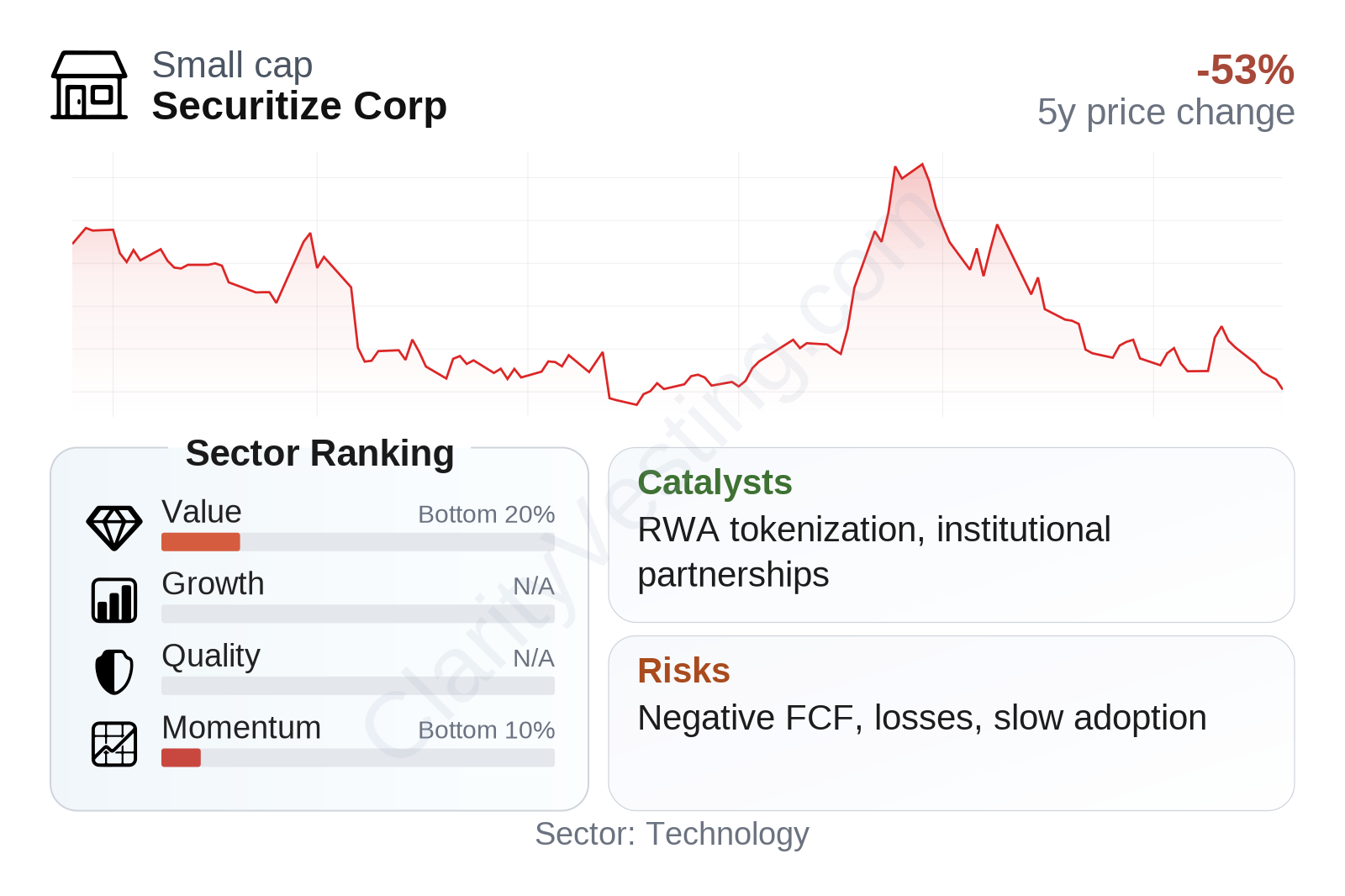
The market profile points to a small-cap company with a weak recent stock trend and limited support from current fundamentals. On valuation, Securitize ranks in the bottom tier of its sector, largely because it is not producing positive free cash flow and profitability remains negative. Growth metrics are also under pressure, with recent year-over-year revenue change below the sector median. Quality indicators are difficult to read in the usual way because the balance sheet structure now includes negative equity, which can distort ratios such as debt-to-equity. On the positive side, the company appears to hold net cash rather than heavy net debt, but that does not offset the fact that margins and cash generation remain weak. Price momentum has also been very poor compared with the broader software group, reflecting market skepticism about execution and the timing of any path to profits.
Growth
Securitize operates in a sector with real long-term potential. Tokenization aims to bring traditional assets such as private equity, credit, funds, and other securities onto digital rails that can improve settlement speed, ownership tracking, compliance automation, and investor access. Large financial institutions have been exploring this area, and the broader direction of travel in capital markets infrastructure favors more automation and more digital recordkeeping. That gives Securitize exposure to a theme that could grow over many years if adoption keeps expanding.
The company’s strategy also makes sense on paper. Rather than focusing only on crypto-native issuance, it has positioned itself as regulated infrastructure for mainstream finance. That matters because large institutions usually need legal compliance, transfer controls, and integration with existing fund structures. By combining tokenization tools with transfer-agent and fund servicing functions, Securitize is trying to become part software platform, part regulated financial utility. If successful, that could create stickier customer relationships than a narrower technology product would.
A significant catalyst is the broader institutional push into tokenized real-world assets, especially tokenized funds and private market products. Securitize has been active in partnerships and product launches tied to large asset managers and digital-asset ecosystems, which helps validate its relevance in a market where trust and regulatory credibility are important. If major fund sponsors continue to use tokenized wrappers, the company could benefit from both issuance activity and recurring servicing revenue.
Recent business progress needs to be viewed with caution, though. The surge in annual revenue suggests demand and deal activity improved materially in 2025. The challenge is that growth has not yet flowed through to better earnings. A company can be in an attractive market and still struggle if costs rise as fast as revenue.
Cash flow remains one of the most important indicators here. Recent trailing figures still show negative free cash flow, although the quarterly level of cash burn improved between the March and June 2026 periods. That is a constructive sign, but not yet evidence of self-funding operations. For a long-term view, sustained improvement in cash generation would likely matter more than top-line expansion alone.
Risks
This article is for informational purposes only and does not constitute financial advice. Some content is AI-generated. See Disclaimer