Stock Analysis · Serco Group plc (SECCF)
Overview
Serco Group plc is a government services contractor. It helps public-sector clients run complex operations that are important but often not visible to the public, such as defense support, immigration and justice services, transportation operations, citizen services, and parts of healthcare administration. The company works mainly under long-term contracts and earns revenue by providing staff, technology-enabled services, program management, and operational support.
Its customer base is heavily concentrated in governments, especially in the United Kingdom, the United States, Canada, Europe, the Middle East, and Asia Pacific. That gives Serco exposure to public budgets rather than to consumer demand, which can make revenue more stable than in many private-sector service businesses. At the same time, it also means the company depends on winning, renewing, and properly executing large contracts.
Based on recent annual reporting, Serco’s revenue mix is largely organized by geography rather than by product line.
- North America: approximately 38% of revenue. This mainly includes U.S. and Canadian government work across defense, space, citizen services, and transport-related programs.
- UK & Europe: approximately 37% of revenue. This covers defense support, justice and immigration services, transport operations, and other government outsourcing work.
- Asia Pacific: approximately 14% of revenue. Activities include defense, maritime, and public service contracts, particularly in Australia and nearby markets.
- Middle East: approximately 11% of revenue. This area includes public services, transport, and facilities-related government contracts.
By end market rather than geography, the largest activities are usually defense, immigration/justice, transport, and citizen services, although exact percentages are less consistently disclosed at that level. The general picture is clear: Serco is a diversified public-services operator, but government-facing mission-critical work is the core of the business.
The business model has shown moderate revenue growth over the last several years, with revenue moving from about $4.4 billion in 2021 to just under $5.0 billion in 2025. The more notable feature is margin volatility: operating profit and net income have been uneven, which highlights how contract timing, one-off charges, financing costs, and execution quality can have a meaningful effect on earnings even when sales remain fairly stable.
Key Figures
| Metric | Value | Sector ⓘ |
|---|---|---|
| Date | Oct 17, 2026 | |
| Context | ||
| Sector | Industrials | |
| Industry | Specialty Business Services | |
| Market Cap ⓘ | $3.29B | |
| Beta ⓘ | 0.52 | |
Value (Cheapness) | ||
| P/E Ratio ⓘ | 17.10 | 22.10 |
| P/B Ratio ⓘ | 3.97 | 1.97 |
| FCF Yield ⓘ | 23.71% | 6.38% |
| Dividend Yield ⓘ | 1.83% | 1.94% |
| EBIT / EV ⓘ | N/A | 4.79% |
| PEG ⓘ | N/A | |
Growth (Business expansion) | ||
| Revenue Growth ⓘ | 3.70% | 9.30% |
| RPS Growth (5Y CAGR) ⓘ | 7.71% | 7.81% |
| EPS Growth (5Y CAGR) ⓘ | 112.66% | -13.06% |
| BVPS Growth (5Y CAGR) ⓘ | 1.06% | 6.14% |
| Margin Growth (5Y Trend) ⓘ | 1.02% | 0.88% |
| FCF Growth (5Y CAGR) ⓘ | 6.28% | 11.01% |
| DPS Growth (5Y CAGR) ⓘ | 18.38% | 9.48% |
Quality (Business durability) | ||
| ROIC (Latest) ⓘ | 28.22% | 10.84% |
| ROA (Latest) ⓘ | 7.28% | 5.41% |
| ROIC (5Y Median) ⓘ | 15.27% | 9.38% |
| ROA (5Y Median) ⓘ | 5.67% | 4.95% |
| Net Debt / EBIT (Latest) ⓘ | 1.54 | 2.08 |
| Net Debt / EBIT (5Y Median) ⓘ | 2.89 | 2.27 |
| Net Debt / EBITDA (Latest) ⓘ | 0.79 | 1.39 |
| Net Debt / Assets ⓘ | 25.33% | 19.28% |
| EBITDA / Interest ⓘ | 12.67 | 9.58 |
| Operating Margin (Latest) ⓘ | 4.79% | 10.50% |
| Operating Margin (5Y Median) ⓘ | 4.87% | 10.29% |
| Debt to Equity (Latest) ⓘ | 104.16% | 65.48% |
| Profit Margin (Latest) ⓘ | 3.08% | 6.67% |
| Free Cash Flow (Latest) ⓘ | $779.91M | |
Momentum (Price trend) | ||
| 3Y Return ⓘ | +105.16% | +61.68% |
| 12M Return (excl. last month) ⓘ | +12.84% | +12.58% |
| 6M Return ⓘ | -6.05% | 0.00% |
| Price vs. 200-Day MA ⓘ | +24.89% | +0.02% |
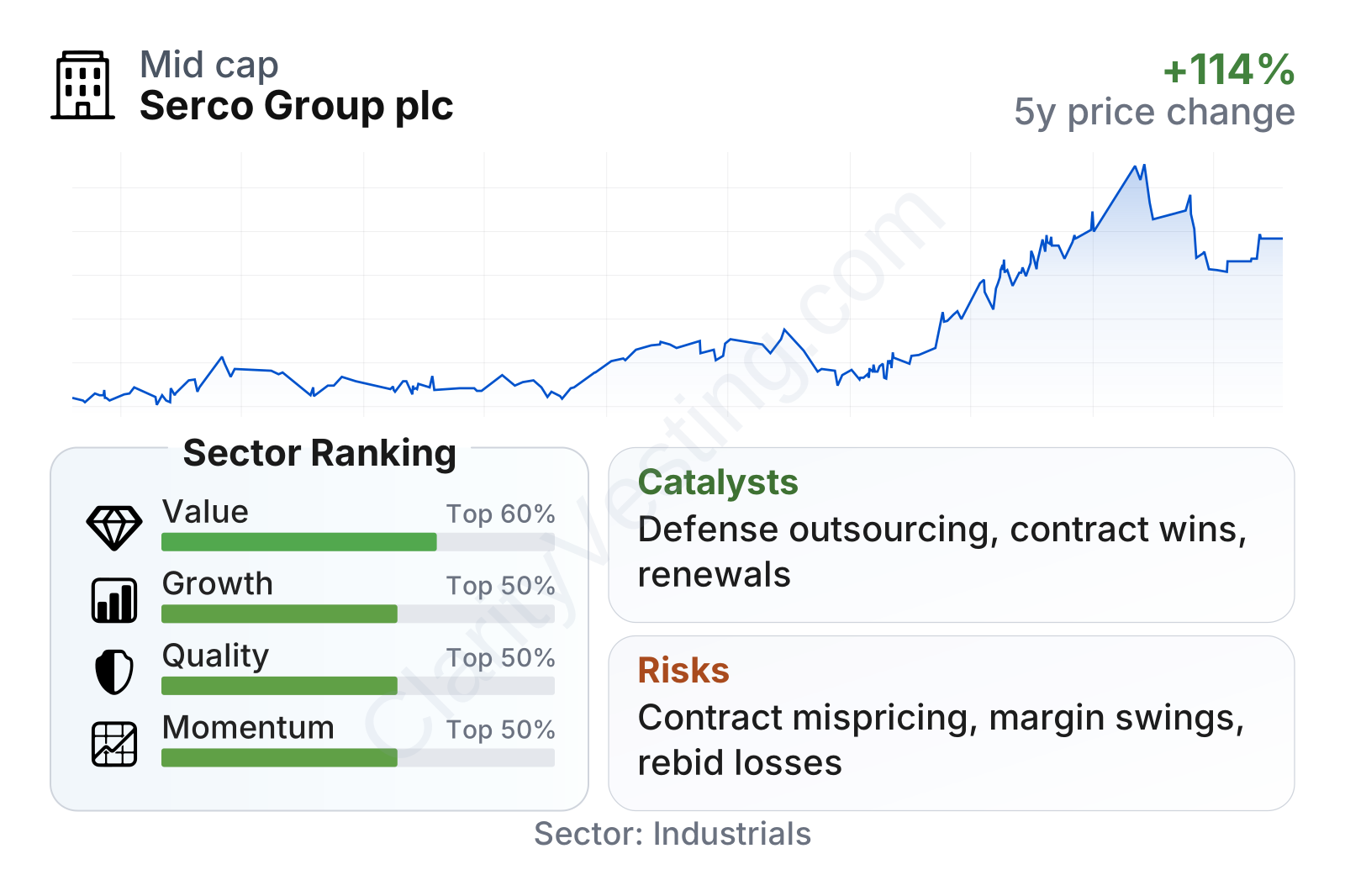
Serco looks like a mid-sized company with relatively low share-price volatility, as shown by a beta near 0.5. On valuation, the earnings multiple is below the sector median, while free cash flow yield stands out as unusually strong. Quality metrics are mixed in an important way: returns on capital are strong and current leverage versus EBITDA looks manageable, but operating and profit margins remain clearly below the sector median. Growth sits around the middle of the sector overall. Long-term earnings growth has been strong, yet recent revenue growth has been slower than many peers. Price performance has been excellent over three years, but the shorter-term trend has cooled after that strong run.
Growth
Serco operates in a sector with durable long-term demand. Governments continue to outsource selected services to specialist providers when they want scale, technical expertise, or operational flexibility. Areas such as defense readiness, border management, digital public services, nuclear support, and transport infrastructure remain active spending priorities in many of Serco’s markets. That does not make the sector fast-growing in the way software or semiconductors can be, but it does support a steady flow of contract opportunities.
The company’s strategy broadly makes sense for that environment. Serco focuses on contracts that are operationally complex and difficult to replace quickly, which can strengthen customer retention. It has also built a wide geographic footprint, reducing dependence on any one department or single country. In addition, government demand in defense and security has become more resilient in recent years, particularly in the U.S., UK, Canada, and Australia. That backdrop can support both renewals and new bids.
A practical catalyst is the company’s pipeline of government outsourcing opportunities and its ability to convert that into order intake. For Serco, future growth is less about launching a new product and more about winning a larger share of long-duration public contracts, extending existing relationships, and adding adjacent work for the same customers. Acquisitions can also play a role when they add capabilities in defense, technology-enabled services, or regulated public operations.
Recent company updates have continued to emphasize demand tied to defense, immigration, citizen services, and other mission-critical government work. The key opportunity is that these activities are usually less discretionary than many corporate service budgets. If Serco continues to improve execution while keeping its contract portfolio aligned with priority spending areas, growth can remain supported even without rapid economic expansion.
Risks
This article is for informational purposes only and does not constitute financial advice. Some content is AI-generated. See Disclaimer


