Stock Analysis · Seaboard Corporation (SEB)
Overview
Seaboard Corporation is a diversified business with operations centered on agriculture, food production, and ocean transportation. Although it is often grouped under conglomerates, the company is much more specific than that label suggests: its largest activities are pork production and processing, grain and commodity merchandising, and marine shipping. It also has smaller businesses tied to power generation, sugar and alcohol production, and turkey products.
Its revenue base is spread across several operating segments, which helps reduce dependence on a single end market, but most of the business still comes from areas exposed to commodity cycles. Based on Seaboard’s recent annual reporting, the main sources of revenue are approximately:
- Pork: about 50% of total revenue. This includes hog production and pork processing, mainly through Seaboard Foods.
- Commodity Merchandising: about 30%. This segment handles grain trading, milling, logistics, and related agricultural commodity activities in multiple regions.
- Marine: about 15%. This business provides cargo shipping services, with a strong presence in the U.S.-Caribbean, Central America, and South America trade lanes.
- Other segments combined: about 5%. This includes power, sugar and alcohol, turkey, and smaller investments or corporate activities.
That mix makes Seaboard unusual: it combines food production and transportation under one corporate structure. The trade-off is that earnings can move sharply depending on hog margins, freight rates, crop markets, input costs, and regional demand conditions. Over the last several years, revenue has remained very large, but profit conversion has been less stable, showing that scale alone does not guarantee smooth results.
The long-term pattern also shows a business with very high cost of sales relative to revenue. This is common in commodity-heavy operations, where raw materials, feed, livestock, fuel, and freight costs absorb most of each sales dollar. Profitability improved from the weak 2023-2024 period into 2025, but margins still look structurally thin compared with many industrial companies.
Key Figures
| Metric | Value | Sector ⓘ |
|---|---|---|
| Date | Oct 17, 2026 | |
| Context | ||
| Sector | Industrials | |
| Industry | Conglomerates | |
| Market Cap ⓘ | $3.80B | |
| Beta ⓘ | 0.21 | |
Value (Cheapness) | ||
| P/E Ratio ⓘ | 6.05 | 22.10 |
| P/B Ratio ⓘ | 0.71 | 1.97 |
| FCF Yield ⓘ | -0.60% | 6.38% |
| Dividend Yield ⓘ | 0.23% | 1.94% |
| EBIT / EV ⓘ | 9.06% | 4.79% |
| PEG ⓘ | 0.65 | |
Growth (Business expansion) | ||
| Revenue Growth ⓘ | 17.80% | 9.30% |
| RPS Growth (5Y CAGR) ⓘ | 6.19% | 7.81% |
| EPS Growth (5Y CAGR) ⓘ | -13.99% | -13.06% |
| BVPS Growth (5Y CAGR) ⓘ | 9.17% | 6.14% |
| Margin Growth (5Y Trend) ⓘ | -1.87% | 0.88% |
| FCF Growth (5Y CAGR) ⓘ | N/A | 11.01% |
| DPS Growth (5Y CAGR) ⓘ | 2.03% | 9.48% |
Quality (Business durability) | ||
| ROIC (Latest) ⓘ | 7.88% | 10.84% |
| ROA (Latest) ⓘ | 7.62% | 5.41% |
| ROIC (5Y Median) ⓘ | 5.57% | 9.38% |
| ROA (5Y Median) ⓘ | 6.23% | 4.95% |
| Net Debt / EBIT (Latest) ⓘ | 3.40 | 2.08 |
| Net Debt / EBIT (5Y Median) ⓘ | 4.73 | 2.27 |
| Net Debt / EBITDA (Latest) ⓘ | 1.93 | 1.39 |
| Net Debt / Assets ⓘ | 16.70% | 19.28% |
| EBITDA / Interest ⓘ | 10.46 | 9.58 |
| Operating Margin (Latest) ⓘ | 4.16% | 10.50% |
| Operating Margin (5Y Median) ⓘ | 2.97% | 10.29% |
| Debt to Equity (Latest) ⓘ | 29.07% | 65.48% |
| Profit Margin (Latest) ⓘ | 6.17% | 6.67% |
| Free Cash Flow (Latest) ⓘ | -$23.00M | |
Momentum (Price trend) | ||
| 3Y Return ⓘ | +16.83% | +61.68% |
| 12M Return (excl. last month) ⓘ | +8.38% | +12.58% |
| 6M Return ⓘ | -29.77% | 0.00% |
| Price vs. 200-Day MA ⓘ | -15.98% | +0.02% |
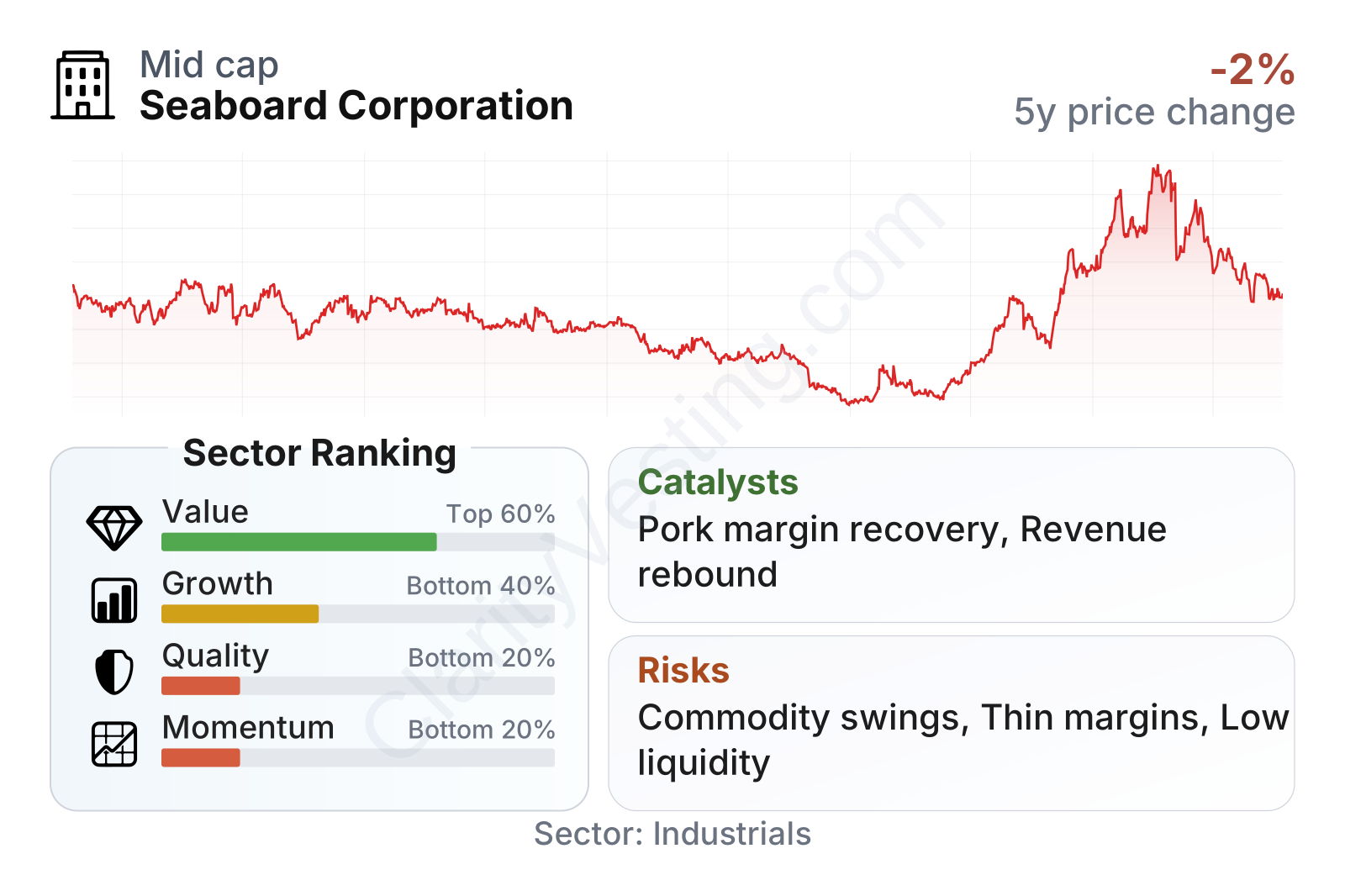
Seaboard is a mid-sized public company with a notably low share-price volatility profile, as reflected by a beta well below 1. In valuation terms, it screens as inexpensive compared with the broader industrial sector: both its earnings multiple and price-to-book ratio sit far below sector norms. At the same time, the table shows why the market may be cautious. Growth is mixed rather than consistently strong, profitability sits below sector medians, free cash flow is currently negative, and recent share-price momentum has been weak despite a rebound from earlier lows.
Growth
Seaboard operates in sectors that are mature but still essential. People continue to consume protein, agricultural trade remains necessary, and regional cargo shipping is a critical service. That means the company is not positioned in a high-growth niche, but it does participate in industries with lasting demand and global relevance. For long-term analysis, the key question is less about rapid expansion and more about whether Seaboard can turn its scale and integration into steadier earnings over time.
Its strategy has a practical logic. In pork, Seaboard is vertically integrated across hog production and processing, which can improve control over supply and operating efficiency. In commodity merchandising, scale and logistics capabilities can matter during periods of dislocation in grain and feed markets. In marine, established regional routes and port relationships can provide recurring business. These are not explosive growth engines, but they can support durable operations if execution remains disciplined.
Recent revenue trends suggest the business has moved out of the contraction seen through much of 2023 and parts of 2024. Year-over-year sales growth turned positive again and accelerated into 2026, which points to improving conditions across parts of the portfolio. Still, the longer five-year picture remains more moderate, showing that Seaboard’s growth path is uneven and heavily shaped by market cycles rather than by a simple volume expansion story.
Cash generation is a more cautious point. Free cash flow has swung between positive and negative territory, and the latest trailing figure remains slightly negative. For a company in cyclical, capital-intensive businesses, that matters because reported earnings do not always translate cleanly into cash available for debt reduction, reinvestment, or shareholder returns. A stronger and more sustained recovery in free cash flow would make the growth profile look more durable.
A meaningful catalyst is the recovery in pork profitability after a difficult period for the industry. Another is the broad normalization in operating results after the weakness of 2023 and 2024. Because Seaboard’s businesses are closely tied to commodity spreads and logistics conditions, even moderate improvements in pricing, freight utilization, or input costs can have an outsized effect on earnings. The company’s asset base also gives it operating leverage if conditions remain constructive.
Risks
This article is for informational purposes only and does not constitute financial advice. Some content is AI-generated. See Disclaimer


