Stock Analysis · Sandoz Group AG (SDZXF)
Overview
Sandoz Group AG is a global medicines company focused on lower-cost alternatives to branded drugs. Its core business is generics, which are medicines made after the original patent expires, and biosimilars, which are highly similar versions of complex biologic drugs. After its separation from Novartis, Sandoz has become a pure-play company in this part of healthcare, which makes its business easier to understand than that of large diversified pharmaceutical groups.
The company sells products across many therapeutic areas and geographies, with Europe and the United States standing out as important markets. Its business model depends on launching new generic and biosimilar products, maintaining efficient manufacturing, and competing on reliability, scale, and cost. That matters because customers in this market, such as pharmacies, hospitals, and health systems, want affordable medicines but also need steady supply.
Based on recent company reporting, Sandoz’s revenue mix is centered on two main product categories:
- Generics: about 80% to 85% of revenue. This includes standard off-patent medicines across a broad range of treatments, including oral solids, injectables, and other established products.
- Biosimilars: about 15% to 20% of revenue. This segment includes more complex medicines that are harder to develop and manufacture, often with better pricing and higher barriers to entry than traditional generics.
Geographically, Europe is the company’s largest region, followed by North America, with International markets contributing the rest. The exact split can move from year to year, but Sandoz remains broadly diversified rather than dependent on a single country.
Financially, the broad picture has improved. Revenue rose from roughly $9.3 billion in 2022 to about $11.2 billion in 2025, while operating income rebounded strongly in 2025 after a weak 2023 and 2024 period. Gross profit has also expanded over that time, suggesting that growth has not come only from volume, but also from a somewhat better business mix and operating execution.
The business flow shows a useful improvement: revenue and gross profit have both trended upward over the last several years, while 2025 stands out as a much stronger profit year than 2023 or 2024. Research and development spending has also remained significant, which is important in biosimilars where future launches depend on a continuing pipeline rather than simple price competition alone.
Key Figures
| Metric | Value | Sector ⓘ |
|---|---|---|
| Date | Oct 31, 2026 | |
| Context | ||
| Sector | Healthcare | |
| Industry | Drug Manufacturers - Specialty & Generic | |
| Market Cap ⓘ | $41.26B | |
| Beta ⓘ | 0.46 | |
Value (Cheapness) | ||
| P/E Ratio ⓘ | 64.86 | 24.88 |
| P/B Ratio ⓘ | 4.83 | 3.16 |
| FCF Yield ⓘ | N/A | 2.92% |
| Dividend Yield ⓘ | 1.01% | 1.78% |
| EBIT / EV ⓘ | 2.49% | 0.56% |
| PEG ⓘ | 1.20 | |
Growth (Business expansion) | ||
| Revenue Growth ⓘ | 9.90% | 7.50% |
| RPS Growth (5Y CAGR) ⓘ | 6.09% | 8.46% |
| EPS Growth (5Y CAGR) ⓘ | N/A | -17.36% |
| BVPS Growth (5Y CAGR) ⓘ | N/A | 3.71% |
| Margin Growth (5Y Trend) ⓘ | -0.52% | -0.61% |
| FCF Growth (5Y CAGR) ⓘ | 0.58% | 1.10% |
| DPS Growth (5Y CAGR) ⓘ | N/A | 6.66% |
Quality (Business durability) | ||
| ROIC (Latest) ⓘ | N/A | 5.22% |
| ROA (Latest) ⓘ | N/A | 3.01% |
| ROIC (5Y Median) ⓘ | N/A | 4.52% |
| ROA (5Y Median) ⓘ | 0.79% | 1.85% |
| Net Debt / EBIT (Latest) ⓘ | 3.96 | 1.34 |
| Net Debt / EBIT (5Y Median) ⓘ | 5.97 | 1.84 |
| Net Debt / EBITDA (Latest) ⓘ | N/A | 0.98 |
| Net Debt / Assets ⓘ | 20.19% | 4.48% |
| EBITDA / Interest ⓘ | N/A | 9.65 |
| Operating Margin (Latest) ⓘ | N/A | 9.44% |
| Operating Margin (5Y Median) ⓘ | 8.06% | 7.33% |
| Debt to Equity (Latest) ⓘ | N/A | 27.22% |
| Profit Margin (Latest) ⓘ | 5.53% | 3.41% |
| Free Cash Flow (Latest) ⓘ | N/A | |
Momentum (Price trend) | ||
| 3Y Return ⓘ | +295.39% | +55.86% |
| 12M Return (excl. last month) ⓘ | +43.37% | +16.75% |
| 6M Return ⓘ | +25.64% | +14.89% |
| Price vs. 200-Day MA ⓘ | +21.90% | +7.77% |
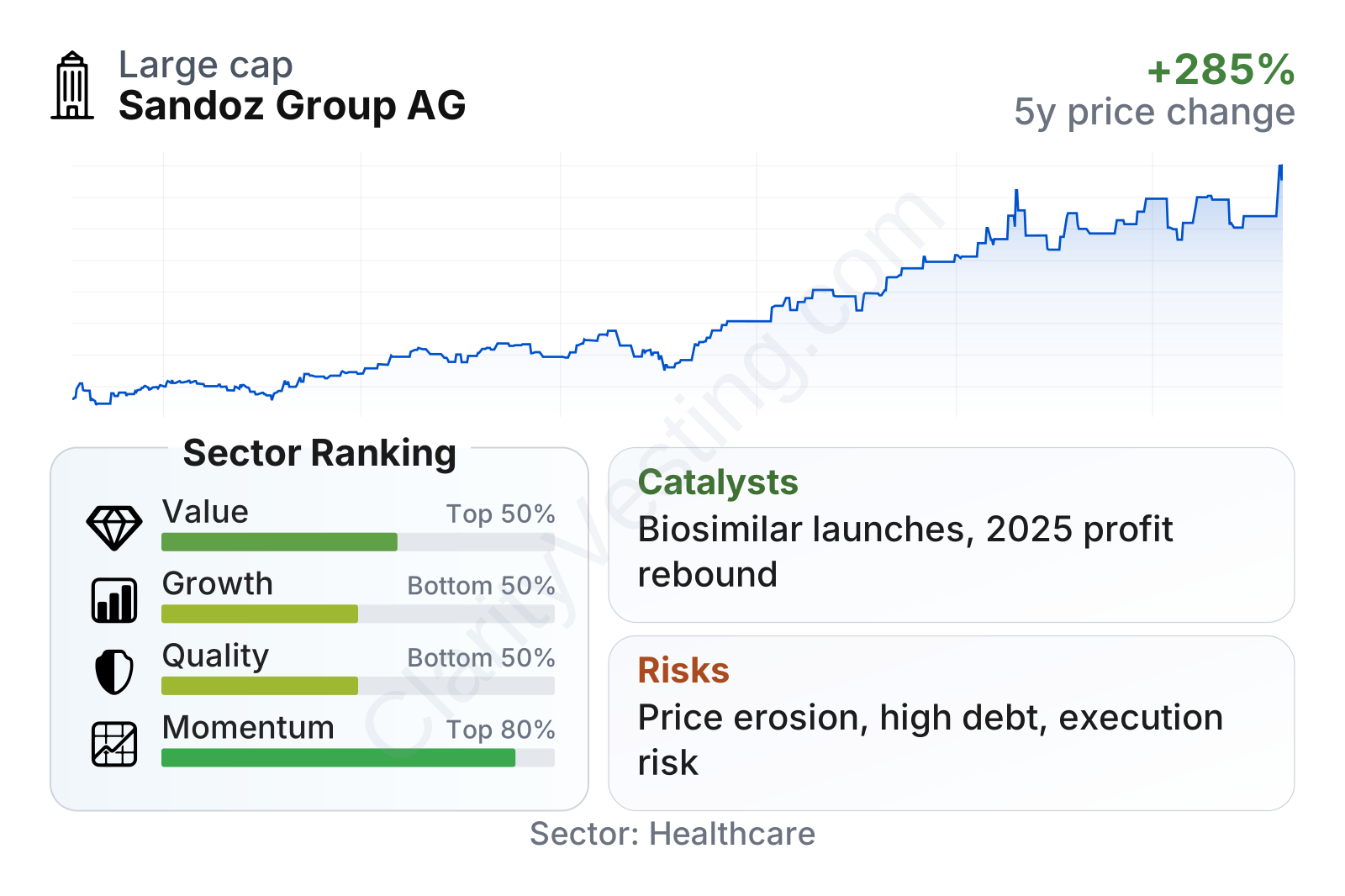
Sandoz combines some attractive and some less comfortable characteristics. On the positive side, recent revenue growth is running above the sector median, profit margin is stronger than many peers, and market performance has been very strong over the past one, three, and six-month comparison periods. The company also has a relatively low beta, which suggests that the stock has been less volatile than the broader market.
The weaker side is balance-sheet pressure and valuation. Net debt relative to earnings is well above the sector median, and debt as a share of equity is also elevated. Quality metrics overall sit in the lower half of the sector, even though profitability has improved. The valuation picture is mixed: earnings and book multiples are above sector medians, but operating earnings relative to enterprise value looks more favorable than many healthcare peers. In simple terms, the market is paying up for improving execution, but that leaves less room for disappointment.
Growth
Sandoz operates in a sector with durable long-term demand. Aging populations, rising healthcare costs, and government pressure to reduce spending all support the use of generics and biosimilars. This is especially relevant for biosimilars, where healthcare systems can save meaningful amounts when expensive biologic medicines face competition. That makes the company’s market structurally attractive even if pricing pressure remains part of the business.
The strategy also makes sense. Sandoz is no longer one division inside a larger pharmaceutical group; it is now fully focused on scale, launches, manufacturing, and commercial execution in off-patent medicines. That sharper focus can help management allocate capital more directly toward pipeline development, production capacity, and selected acquisitions or partnerships. In biosimilars in particular, scale and technical know-how matter because development is costly, approval is slower than for normal generics, and not every competitor can participate.
A strong catalyst is the company’s biosimilars pipeline and launch cycle. As major biologic drugs lose exclusivity, Sandoz has opportunities to bring lower-cost versions to market. These products usually face fewer competitors than standard generics, which can support better economics. At the same time, the core generics business benefits from a broad installed base, customer relationships, and recurring demand for essential medicines.
Another positive recent signal is the company’s earnings recovery in 2025. Revenue moved above $11 billion, operating income rose sharply, and net income improved to roughly $914 million after much weaker results in the prior two years. That does not remove execution risk, but it suggests the post-spin business is becoming more stable and more capable of translating sales into profits.
The stock’s strong upward trend since late 2023 also reflects that the market has recognized this improvement. That does not prove future results, but it usually means expectations now depend more heavily on continued clean execution, further launches, and steady margins.
Risks
This article is for informational purposes only and does not constitute financial advice. Some content is AI-generated. See Disclaimer


