Stock Analysis · Sodexo SA (SDXOF)
Overview
Sodexo SA is a French services company best known for running food services and a wide range of workplace, healthcare, and education support activities on behalf of other organizations. Instead of selling branded consumer products, Sodexo typically works through multi-year contracts with clients such as corporations, hospitals, schools, universities, prisons, defense sites, and sports or leisure venues. Its role can include preparing meals, managing cafeterias, cleaning facilities, maintaining buildings, handling reception services, and improving the day-to-day experience of employees, students, patients, and visitors.
The business is largely organized around on-site services, with food remaining the core activity and facilities management adding scale and recurring contract revenue. Based on recent annual reporting, the main revenue sources can be summarized as follows:
- Food services: about 70% to 75% of revenue. This includes employee restaurants, school and university catering, hospital meals, senior living dining, and food operations at remote or specialized sites.
- Facilities management and other support services: about 25% to 30% of revenue. This includes cleaning, technical maintenance, front-of-house services, waste management, and other outsourced site services.
- By client segment, the largest exposures are generally Business & Administrations, followed by Healthcare & Seniors, then Education. These categories cut across both food and facilities activities.
- By geography, North America and Europe account for the majority of group revenue, with additional operations in Latin America, Asia-Pacific, and other international markets.
Sodexo’s revenue model is attractive in one important way for long-term analysis: demand is tied more to essential daily operations than to one-off discretionary purchases. Schools still need meals, hospitals still need support services, and large employers still need site management even when economic conditions are uneven. At the same time, margins are naturally thin because labor, food ingredients, and contract execution costs consume most of the revenue base.
The financial flow over the last few years shows a company with steadily rising sales after the pandemic recovery, while profitability has been more uneven. Revenue moved from a little above €20 billion in fiscal 2022 to around €24 billion in fiscal 2025, but net income was far more volatile, showing how sensitive the model can be to contract mix, labor costs, restructuring items, and other non-operating charges.
The broad picture is that Sodexo is a very large outsourced-services operator with resilient demand and recurring contracts, but one that must execute carefully because a small shift in operating margin can have an outsized effect on final earnings.
Key Figures
| Metric | Value | Sector ⓘ |
|---|---|---|
| Date | Oct 17, 2026 | |
| Context | ||
| Sector | Industrials | |
| Industry | Specialty Business Services | |
| Market Cap ⓘ | $9.19B | |
| Beta ⓘ | 0.25 | |
Value (Cheapness) | ||
| P/E Ratio ⓘ | 17.96 | 22.10 |
| P/B Ratio ⓘ | 2.58 | 1.97 |
| FCF Yield ⓘ | 14.90% | 6.38% |
| Dividend Yield ⓘ | 4.28% | 1.94% |
| EBIT / EV ⓘ | N/A | 4.79% |
| PEG ⓘ | 3.41 | |
Growth (Business expansion) | ||
| Revenue Growth ⓘ | -3.70% | 9.30% |
| RPS Growth (5Y CAGR) ⓘ | 8.35% | 7.81% |
| EPS Growth (5Y CAGR) ⓘ | N/A | -13.06% |
| BVPS Growth (5Y CAGR) ⓘ | 4.50% | 6.14% |
| Margin Growth (5Y Trend) ⓘ | 1.46% | 0.88% |
| FCF Growth (5Y CAGR) ⓘ | -2.12% | 11.01% |
| DPS Growth (5Y CAGR) ⓘ | 7.13% | 9.48% |
Quality (Business durability) | ||
| ROIC (Latest) ⓘ | 16.46% | 10.84% |
| ROA (Latest) ⓘ | 7.54% | 5.41% |
| ROIC (5Y Median) ⓘ | 7.05% | 9.38% |
| ROA (5Y Median) ⓘ | 3.48% | 4.95% |
| Net Debt / EBIT (Latest) ⓘ | 2.21 | 2.08 |
| Net Debt / EBIT (5Y Median) ⓘ | 4.11 | 2.27 |
| Net Debt / EBITDA (Latest) ⓘ | 1.46 | 1.39 |
| Net Debt / Assets ⓘ | 28.50% | 19.28% |
| EBITDA / Interest ⓘ | 9.61 | 9.58 |
| Operating Margin (Latest) ⓘ | 4.00% | 10.50% |
| Operating Margin (5Y Median) ⓘ | 4.15% | 10.29% |
| Debt to Equity (Latest) ⓘ | 149.89% | 65.48% |
| Profit Margin (Latest) ⓘ | 1.90% | 6.67% |
| Free Cash Flow (Latest) ⓘ | $1.37B | |
Momentum (Price trend) | ||
| 3Y Return ⓘ | -27.59% | +61.68% |
| 12M Return (excl. last month) ⓘ | +19.71% | +12.58% |
| 6M Return ⓘ | +34.10% | 0.00% |
| Price vs. 200-Day MA ⓘ | -0.54% | +0.02% |
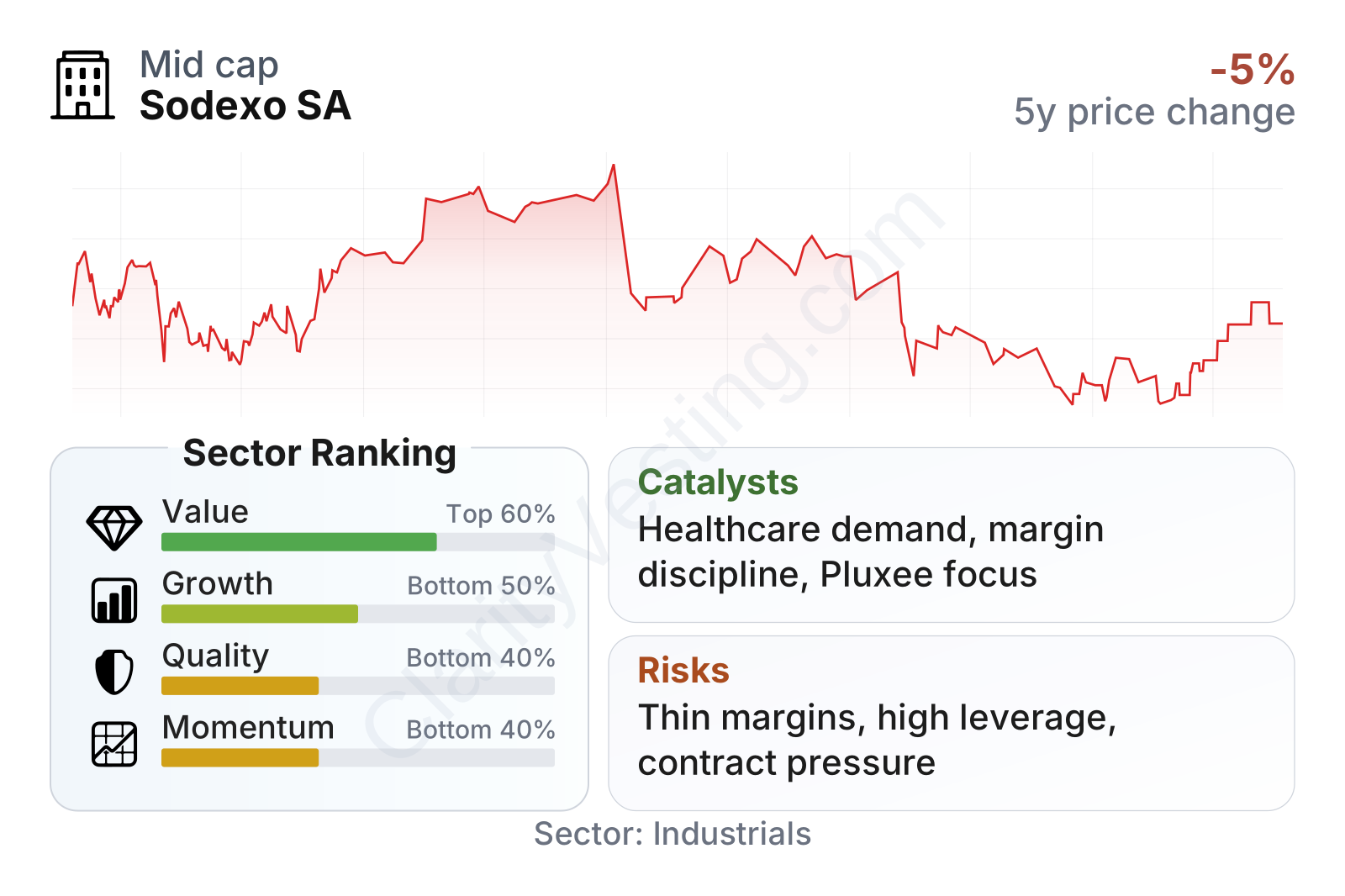
Sodexo stands out as a large company in its industry with unusually low share-price volatility, as shown by its beta near 0.25. On valuation and cash generation, the profile looks more favorable than many peers: free cash flow yield and dividend yield are both clearly above sector norms, while the earnings multiple sits below the broader industry median. The weaker areas are growth, margin level, and balance-sheet leverage. Returns on capital are solid recently, but operating and profit margins remain well below the sector median, which is typical of labor-intensive contract services. Recent share performance has improved over the last 6 to 12 months, although the longer three-year record still trails much of the sector.
Growth
Sodexo operates in a sector with durable long-term demand. Outsourcing of food and facilities services continues to make sense for many institutions because it can reduce internal complexity, improve compliance, and help clients manage labor shortages. Healthcare, senior living, education, and large workplaces all provide structural demand for the company’s offerings. This is not a fast-moving technology market, but it is a large and persistent one.
The company’s strategy also fits that environment. Sodexo has increasingly emphasized disciplined contract selection, pricing, operational efficiency, and growth in integrated service packages rather than relying only on meal volumes. That matters because clients often prefer fewer vendors and broader bundled contracts. A provider that can deliver both food and facilities services can deepen relationships and improve retention.
Another useful growth lever is the mix of end markets. Healthcare and seniors can benefit from aging populations, while education tends to be relatively stable. Business and administrative sites are more cyclical, but they also create opportunities when employers redesign workplaces and outsource more support tasks. The medium-term opportunity is less about explosive expansion and more about winning more wallet share from large institutions.
Recent corporate developments have also reshaped the group. Sodexo completed the spin-off of Pluxee, separating its employee benefits and engagement activities from the core food and facilities business. This makes the remaining group simpler to understand: it is now more directly tied to contract catering and site services. That clearer structure may help management focus on operational improvement, margin discipline, and contract execution.
There are visible positives in the operating trend. Revenue has climbed over the last several fiscal years, and operating income recovered meaningfully from 2022 through 2024 before softening somewhat afterward. Over a five-year view, revenue per share growth has been slightly ahead of the sector median, and the trend in operating margin has improved faster than the sector median, even though the absolute margin remains modest.
Risks
This article is for informational purposes only and does not constitute financial advice. Some content is AI-generated. See Disclaimer


