Stock Analysis · Seadrill Limited (SDRL)
Overview
Seadrill Limited is an offshore drilling contractor. In simple terms, it owns and operates large drilling rigs that oil and gas companies rent when they want to explore for or produce hydrocarbons offshore. Seadrill does not usually sell oil itself; its business is to provide the rig, crew, equipment, and related services under contracts with energy producers.
The company’s fleet is focused on higher-specification offshore assets, especially drillships, semi-submersible rigs, and jack-up rigs. These rigs are used in different water depths and field conditions, with the most advanced units generally serving deepwater and ultra-deepwater projects. That makes Seadrill highly exposed to offshore exploration and development spending, particularly in markets where complex wells require premium equipment.
Based on company reporting, Seadrill’s revenue mainly comes from dayrate-based rig contracts and closely related operating services. Public filings do not always break revenue into a clean percentage by rig type in every period, but the business mix is centered on offshore drilling contracts, with deepwater assets carrying a large economic weight because they typically command higher rates.
- Offshore drilling contract revenue: approximately 90%+ of total revenue. This is the core business and includes the daily fees paid by customers for using Seadrill’s rigs and crews.
- Reimbursable and other operating revenue: typically a small single-digit percentage of revenue. This can include customer reimbursements and ancillary contract-related items.
- Management or other service income: generally limited compared with drilling revenue, where applicable.
What stands out is that Seadrill is a fairly concentrated business. It is not a diversified energy company with refining, pipelines, or retail operations to offset drilling swings. Its performance depends heavily on rig utilization, dayrates, contract renewals, and the overall appetite of oil companies to fund offshore projects.
The long-term financial path has been uneven but notable: revenue improved sharply from 2021 to 2023, stayed elevated in 2024, and was slightly higher again in 2025, while profitability moved from severe weakness to recovery and then softened again more recently. That pattern is typical of a cyclical contractor exposed to a small number of high-value assets.
The longer view shows a company that rebuilt earnings power after a difficult period, but with margins still moving around materially from year to year. Revenue has held above pre-recovery levels, yet the latest period suggests that stronger sales have not fully translated into steady cash generation.
Key Figures
| Metric | Value | Sector ⓘ |
|---|---|---|
| Date | Oct 17, 2026 | |
| Context | ||
| Sector | Energy | |
| Industry | Oil & Gas Drilling | |
| Market Cap ⓘ | $3.06B | |
| Beta ⓘ | 1.40 | |
Value (Cheapness) | ||
| P/E Ratio ⓘ | N/A | 15.44 |
| P/B Ratio ⓘ | 1.02 | 1.73 |
| FCF Yield ⓘ | -8.48% | 8.20% |
| Dividend Yield ⓘ | N/A | 3.59% |
| EBIT / EV ⓘ | 2.77% | 7.46% |
| PEG ⓘ | N/A | |
Growth (Business expansion) | ||
| Revenue Growth ⓘ | 19.10% | 26.90% |
| RPS Growth (5Y CAGR) ⓘ | 26.38% | 6.90% |
| EPS Growth (5Y CAGR) ⓘ | N/A | -15.73% |
| BVPS Growth (5Y CAGR) ⓘ | N/A | 6.07% |
| Margin Growth (5Y Trend) ⓘ | 51.74% | 0.58% |
| FCF Growth (5Y CAGR) ⓘ | -6.81% | 1.86% |
| DPS Growth (5Y CAGR) ⓘ | -2.37% | 16.79% |
Quality (Business durability) | ||
| ROIC (Latest) ⓘ | 0.85% | 11.40% |
| ROA (Latest) ⓘ | 0.02% | 6.06% |
| ROIC (5Y Median) ⓘ | 12.74% | 10.30% |
| ROA (5Y Median) ⓘ | 8.55% | 5.42% |
| Net Debt / EBIT (Latest) ⓘ | 4.35 | 1.64 |
| Net Debt / EBIT (5Y Median) ⓘ | 0.18 | 1.83 |
| Net Debt / EBITDA (Latest) ⓘ | 1.10 | 1.08 |
| Net Debt / Assets ⓘ | 9.74% | 17.29% |
| EBITDA / Interest ⓘ | 5.84 | 9.64 |
| Operating Margin (Latest) ⓘ | 6.05% | 16.27% |
| Operating Margin (5Y Median) ⓘ | 23.06% | 20.39% |
| Debt to Equity (Latest) ⓘ | 25.73% | 54.76% |
| Profit Margin (Latest) ⓘ | 0.07% | 8.82% |
| Free Cash Flow (Latest) ⓘ | -$260.00M | |
Momentum (Price trend) | ||
| 3Y Return ⓘ | +8.88% | +67.38% |
| 12M Return (excl. last month) ⓘ | +42.98% | +49.19% |
| 6M Return ⓘ | +2.11% | +7.07% |
| Price vs. 200-Day MA ⓘ | +6.39% | +9.56% |
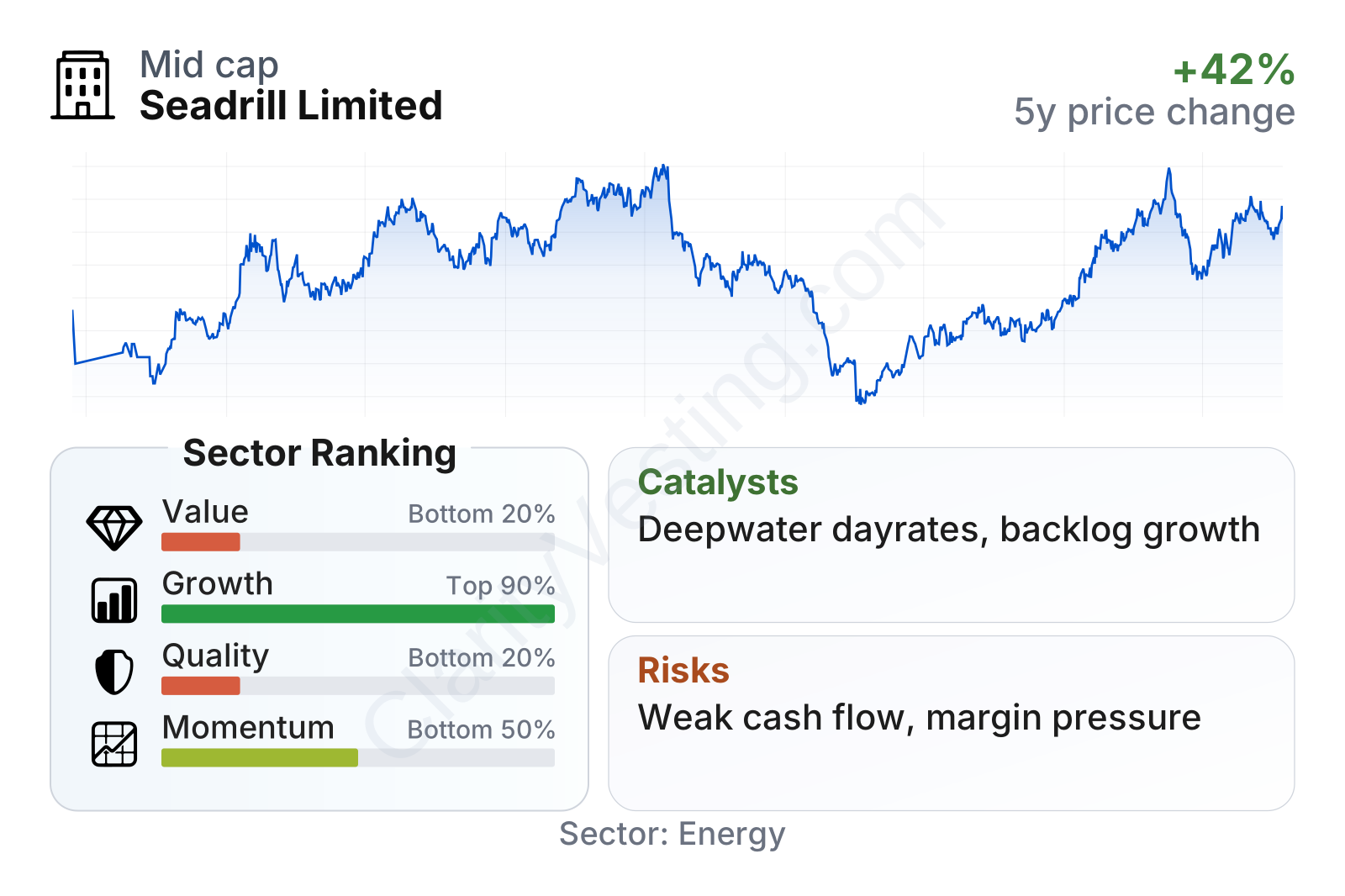
Seadrill’s profile is mixed. Growth ranks strongly against the broader energy sector, supported by multi-year expansion in revenue per share and a major improvement in operating profitability from depressed levels. However, current quality and value metrics are weak: recent returns on capital are low, free cash flow is negative, and earnings-based valuation measures are not very helpful at the moment because profitability has been thin. The company is mid-sized within energy, and its share price has been volatile, with a strong rebound over the last year but a much less impressive picture over a longer three-year span.
Growth
Offshore drilling is part of a sector that can still grow, but not in a straight line. The main support comes from the long life of offshore reservoirs, the need for large-scale supply projects, and the industry’s gradual shift toward disciplined investment in assets that can produce for many years. Deepwater developments often remain attractive to major oil companies when commodity prices are supportive, especially compared with short-cycle projects that decline quickly.
Seadrill’s strategy broadly fits that backdrop. The company is concentrated in modern offshore rigs, particularly higher-end assets that are harder to replace and more relevant for technically demanding wells. In a favorable cycle, that positioning can improve contract coverage and dayrates faster than in lower-specification parts of the market. The challenge is that this is still a narrow strategy: when offshore activity cools, there is not much else inside the business to absorb the shock.
Recent revenue momentum has turned positive again after a softer stretch through much of 2024 and parts of 2025. Year-over-year growth was very strong in earlier recovery periods, then weakened, and has improved again in 2026. That suggests the company is still benefiting from contract timing and fleet activity, but not yet in a smooth, uninterrupted uptrend.
Cash generation is the more important caution flag. Free cash flow moved into positive territory during the recovery, but it later fell back below zero and remains negative on a trailing basis. For a capital-intensive driller, this matters because growth is most valuable when it eventually converts into cash after maintenance, upgrades, and operating needs. Until free cash flow stabilizes, the growth profile looks more operational than financial.
Potential catalysts are tied to the offshore cycle rather than a single consumer product or technology launch. The biggest ones include higher deepwater dayrates, improved utilization for premium rigs, additional contract awards with large exploration and production companies, and longer contract duration that gives better revenue visibility. Company updates in 2026 have continued to emphasize backlog development and fleet employment, which is usually the clearest signal of future earnings potential for an offshore driller.
A significant opportunity for Seadrill is that modern deepwater rigs remain relatively scarce compared with the technical requirements of many offshore projects. If customers continue prioritizing reliable, high-specification units, companies like Seadrill can benefit disproportionately, especially when idle capacity across the industry stays limited.
Risks
This article is for informational purposes only and does not constitute financial advice. Some content is AI-generated. See Disclaimer


