Stock Analysis · Schrodinger Inc (SDGR)
Overview
Schrodinger Inc is a drug discovery and materials science company built around advanced computational modeling. In simple terms, it develops software that helps scientists simulate how molecules behave, and it also uses that same platform internally and with partners to discover new medicines. The business therefore sits at the intersection of software, biology, chemistry, and pharmaceutical research.
The company has two main activities. One is selling software to pharmaceutical companies, biotechnology firms, academic institutions, and industrial customers. The other is generating revenue from drug discovery collaborations, milestone payments, and related programs tied to its proprietary pipeline and partnered assets. This structure makes Schrodinger different from a typical software company because part of its value depends on scientific and clinical progress, not just recurring subscriptions.
Based on the latest full-year revenue mix disclosed in recent company reporting, Schrodinger’s revenue is roughly divided as follows:
- Drug discovery revenue: about 65% of total revenue in 2025. This includes collaboration revenue, milestone payments, and work tied to partnered and proprietary therapeutic programs.
- Software revenue: about 35% of total revenue in 2025. This includes licenses and related software offerings used in drug discovery and materials research.
That mix can move meaningfully from year to year because collaboration payments are often uneven. In 2025, total revenue rose to roughly $256 million, after about $208 million in 2024, showing that the business can post solid top-line growth even while profitability remains volatile. A notable operating pattern is that research spending remains very high relative to revenue, reflecting the company’s choice to invest heavily in both platform development and its therapeutic pipeline.
The broad financial picture shows a business with improving scale over several years, but one where expenses, especially research and development, still absorb more than gross profit in most periods. That is typical of a platform biotech model, but it also means revenue growth does not automatically translate into stable earnings.
Key Figures
| Metric | Value | Sector ⓘ |
|---|---|---|
| Date | Oct 17, 2026 | |
| Context | ||
| Sector | Healthcare | |
| Industry | Health Information Services | |
| Market Cap ⓘ | $1.87B | |
| Beta ⓘ | 1.62 | |
Value (Cheapness) | ||
| P/E Ratio ⓘ | N/A | 24.79 |
| P/B Ratio ⓘ | 5.87 | 3.08 |
| FCF Yield ⓘ | -1.73% | 3.15% |
| Dividend Yield ⓘ | N/A | 1.94% |
| EBIT / EV ⓘ | -2.76% | 0.57% |
| PEG ⓘ | N/A | |
Growth (Business expansion) | ||
| Revenue Growth ⓘ | 7.50% | 7.45% |
| RPS Growth (5Y CAGR) ⓘ | 15.56% | 8.61% |
| EPS Growth (5Y CAGR) ⓘ | -21.22% | -17.81% |
| BVPS Growth (5Y CAGR) ⓘ | -10.97% | 3.72% |
| Margin Growth (5Y Trend) ⓘ | N/A | -0.62% |
| FCF Growth (5Y CAGR) ⓘ | N/A | 1.04% |
| DPS Growth (5Y CAGR) ⓘ | N/A | 6.77% |
Quality (Business durability) | ||
| ROIC (Latest) ⓘ | -10.08% | 3.24% |
| ROA (Latest) ⓘ | -8.40% | 3.01% |
| ROIC (5Y Median) ⓘ | -20.32% | 4.60% |
| ROA (5Y Median) ⓘ | -13.36% | 1.89% |
| Net Debt / EBIT (Latest) ⓘ | N/A | 1.34 |
| Net Debt / EBIT (5Y Median) ⓘ | N/A | 1.84 |
| Net Debt / EBITDA (Latest) ⓘ | N/A | 1.00 |
| Net Debt / Assets ⓘ | -28.09% | 5.45% |
| EBITDA / Interest ⓘ | N/A | 9.64 |
| Operating Margin (Latest) ⓘ | -20.05% | 9.27% |
| Operating Margin (5Y Median) ⓘ | -73.09% | 7.38% |
| Debt to Equity (Latest) ⓘ | 32.83% | 28.58% |
| Profit Margin (Latest) ⓘ | -20.98% | 3.59% |
| Free Cash Flow (Latest) ⓘ | -$32.46M | |
Momentum (Price trend) | ||
| 3Y Return ⓘ | +4.47% | +42.80% |
| 12M Return (excl. last month) ⓘ | +25.95% | +18.50% |
| 6M Return ⓘ | +105.48% | +7.57% |
| Price vs. 200-Day MA ⓘ | +55.62% | +5.12% |
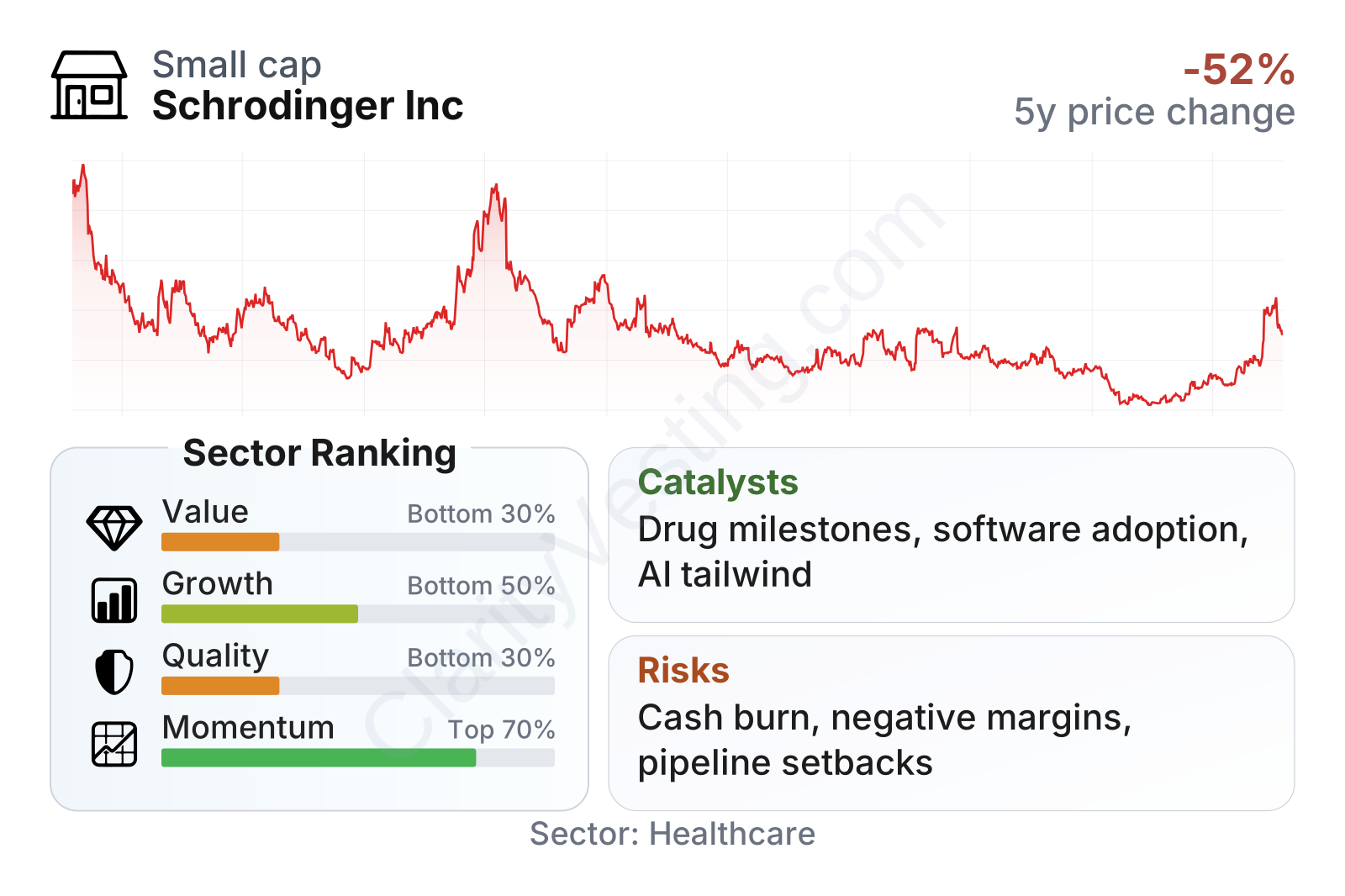
Schrodinger is a mid-sized healthcare technology and drug discovery company with a stock that has been highly volatile over the past several years. The latest factor snapshot points to a mixed profile: momentum has recently improved sharply, but value, quality, and growth rankings remain weak relative to much of the healthcare sector. The main reason is straightforward: the company has attractive long-term revenue expansion, but current profitability and cash generation are still negative. Book value multiples are also above sector norms, which suggests the market continues to assign meaningful value to the platform and pipeline despite uneven financial returns.
Growth
Schrodinger operates in an area with favorable long-term tailwinds. Pharmaceutical companies are under pressure to make drug discovery faster, cheaper, and more productive, and software-guided molecular design is becoming more important in that effort. The same logic also applies to materials science, where simulation can reduce trial-and-error work in the lab. This does not guarantee fast commercialization, but it supports continued demand for computational tools that can improve research efficiency.
The company’s strategy is coherent. It monetizes its platform in two ways at once: software sales create a more recurring commercial base, while internal and partnered drug programs offer larger upside if projects succeed. That dual model is attractive in theory because software can validate the platform commercially, and successful drug discovery outcomes can validate it scientifically. The challenge is that the second engine is much less predictable.
Revenue growth has been positive over long periods, but the quarterly pattern is uneven. That inconsistency is not surprising for a company receiving milestone and collaboration payments, which tend to arrive in lumps rather than in smooth monthly streams. Over a five-year view, revenue per share growth has been meaningfully stronger than the sector median, which supports the idea that Schrodinger is building a larger business even if annual comparisons can look noisy.
Cash generation remains an important test. Free cash flow has swung between improvement and renewed outflows, showing that the business has not yet crossed into self-funding mode. For long-term analysis, this matters because the company is still relying on future commercial progress rather than present financial efficiency to justify continued investment.
A meaningful catalyst is the company’s expanding set of collaborations with large pharmaceutical partners and the progress of programs discovered using its computational platform. Another catalyst is wider adoption of physics-based modeling and artificial intelligence tools in drug design. Schrodinger has positioned itself as a platform enabler in that trend rather than as a single-asset biotech, which gives it more shots on goal. Recent company communications have also continued to emphasize advancement in partnered programs and internal pipeline development, keeping open the possibility of future milestones or value-creating clinical updates.
Risks
This article is for informational purposes only and does not constitute financial advice. Some content is AI-generated. See Disclaimer


