Stock Analysis · Vicat SA (SDCVF)
Overview
Vicat SA is a French building materials group that produces and sells the core ingredients used in construction. Its business is centered on heavy materials that are difficult to replace in large infrastructure, housing, and commercial projects. The company operates across Europe, the Americas, Africa, Asia, and the Mediterranean region, with a mix of mature markets and faster-growing emerging economies.
The group’s revenue mainly comes from selling cement and concrete-related products, with aggregates adding a smaller but still important contribution. Based on the latest annual reporting structure, revenue is roughly divided as follows:
- Cement: about 56% of revenue. This is the company’s largest activity and includes clinker and cement sold to construction companies, distributors, and industrial customers.
- Concrete and aggregates: about 35% of revenue combined. Ready-mixed concrete is used directly on construction sites, while aggregates include sand, gravel, and crushed stone.
- Other products and services: about 9% of revenue. This includes transport, precast products, paper, and related industrial activities depending on the country.
Geographically, Vicat is not a single-country business. France remains important, but the company also has meaningful exposure to the United States, India, Brazil, Turkey, Egypt, Kazakhstan, Senegal, Mali, and Switzerland. That diversity matters because construction cycles do not move in the same direction everywhere at the same time.
Over the last several years, the business has shown a useful pattern for a materials producer: revenue expanded from roughly €3.1 billion in 2021 to around €3.9 billion in 2024, while operating income also improved. That suggests pricing discipline and cost control helped offset a volatile energy and freight environment. The latest flow of results also shows net income holding up better than many investors might expect from such a cyclical industry.
The long-term picture is that Vicat remains a mid-sized international cement producer with a broad industrial footprint, meaningful vertical integration, and exposure to essential construction demand rather than niche building trends.
Key Figures
| Metric | Value | Sector ⓘ |
|---|---|---|
| Date | Oct 24, 2026 | |
| Context | ||
| Sector | Basic Materials | |
| Industry | Building Materials | |
| Market Cap ⓘ | $3.27B | |
| Beta ⓘ | 0.73 | |
Value (Cheapness) | ||
| P/E Ratio ⓘ | 9.74 | 16.92 |
| P/B Ratio ⓘ | 1.21 | 1.66 |
| FCF Yield ⓘ | 20.62% | 5.83% |
| Dividend Yield ⓘ | 2.72% | 2.07% |
| EBIT / EV ⓘ | N/A | 6.38% |
| PEG ⓘ | N/A | |
Growth (Business expansion) | ||
| Revenue Growth ⓘ | 8.00% | 11.25% |
| RPS Growth (5Y CAGR) ⓘ | 4.95% | 4.49% |
| EPS Growth (5Y CAGR) ⓘ | -30.51% | -15.24% |
| BVPS Growth (5Y CAGR) ⓘ | 2.49% | 5.49% |
| Margin Growth (5Y Trend) ⓘ | 0.99% | -1.54% |
| FCF Growth (5Y CAGR) ⓘ | 56.38% | 0.37% |
| DPS Growth (5Y CAGR) ⓘ | 11.45% | 5.91% |
Quality (Business durability) | ||
| ROIC (Latest) ⓘ | 15.66% | 9.59% |
| ROA (Latest) ⓘ | 8.59% | 4.92% |
| ROIC (5Y Median) ⓘ | 7.39% | 7.91% |
| ROA (5Y Median) ⓘ | 4.05% | 3.92% |
| Net Debt / EBIT (Latest) ⓘ | 1.37 | 1.36 |
| Net Debt / EBIT (5Y Median) ⓘ | 3.12 | 1.69 |
| Net Debt / EBITDA (Latest) ⓘ | 0.83 | 0.93 |
| Net Debt / Assets ⓘ | 20.07% | 13.69% |
| EBITDA / Interest ⓘ | 11.29 | 12.38 |
| Operating Margin (Latest) ⓘ | 12.39% | 13.24% |
| Operating Margin (5Y Median) ⓘ | 11.74% | 11.82% |
| Debt to Equity (Latest) ⓘ | 60.34% | 40.30% |
| Profit Margin (Latest) ⓘ | 7.23% | 6.38% |
| Free Cash Flow (Latest) ⓘ | $674.32M | |
Momentum (Price trend) | ||
| 3Y Return ⓘ | +334.73% | +73.47% |
| 12M Return (excl. last month) ⓘ | +19.87% | +27.59% |
| 6M Return ⓘ | -8.97% | -4.02% |
| Price vs. 200-Day MA ⓘ | -9.51% | -0.65% |
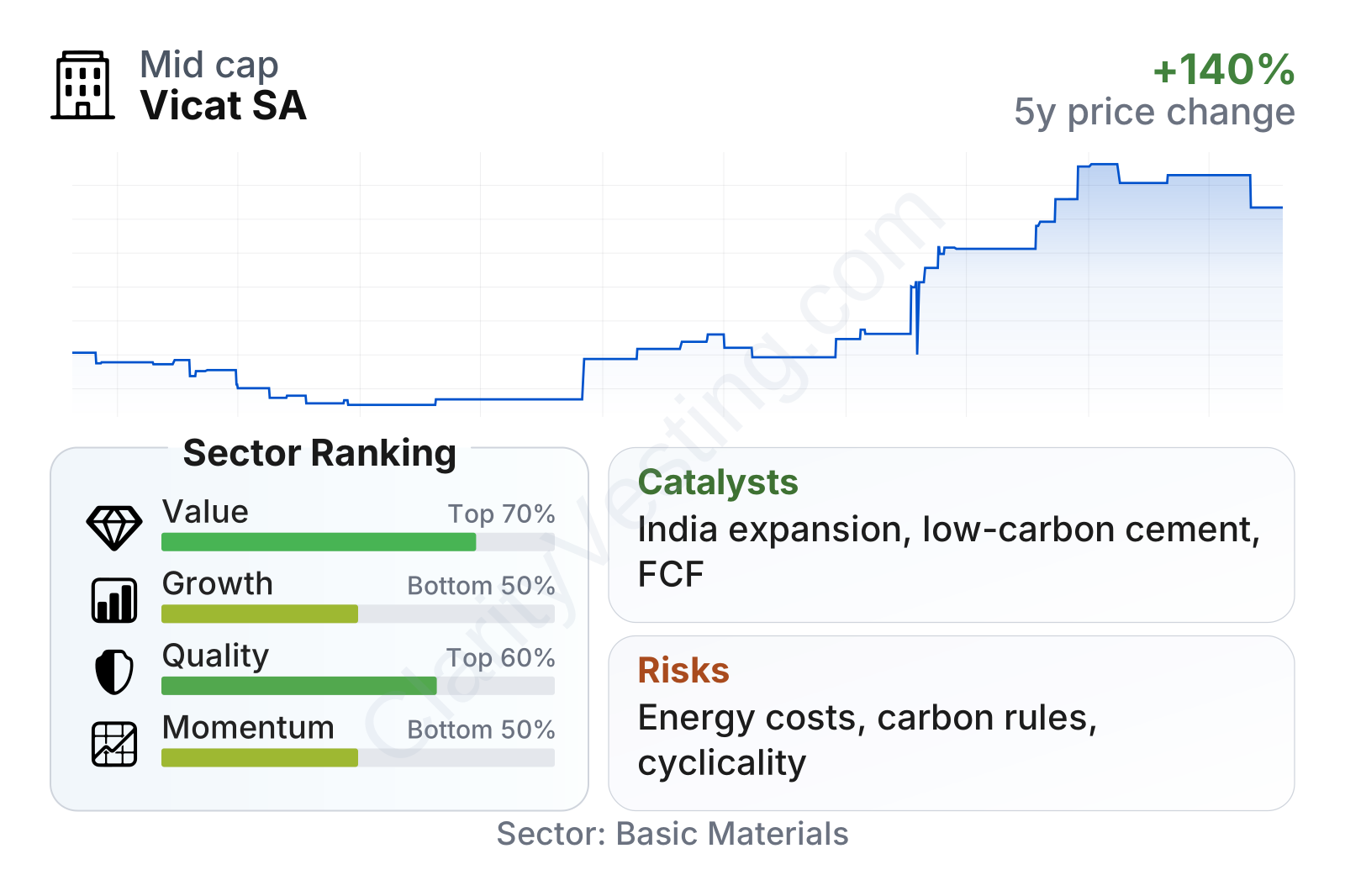
Vicat currently looks stronger on valuation and operating quality than on headline growth or recent share-price momentum. The stock trades on earnings and book value multiples below the sector median, while free cash flow yield stands far above typical peers. Profitability is solid rather than exceptional, with returns on capital and assets ahead of many companies in the sector and margins close to industry norms.
Balance-sheet risk appears manageable. Net debt to EBITDA is below 1x, and interest coverage is near 12x, which is comfortable for a cyclical industrial company. Debt to equity is higher than the sector median, so leverage is not negligible, but recent cash generation makes the capital structure look more resilient than the raw debt ratio alone would suggest.
The market performance profile is mixed. The stock has delivered a very strong three-year gain, but shorter-term momentum has cooled, with the shares trading below their 200-day average. That combination often reflects a company whose fundamentals improved significantly and whose market rerating may now be pausing.
Growth
Vicat operates in a sector that is mature in developed countries but still supported by long-duration demand drivers globally. Cement, aggregates, and concrete are basic inputs for roads, bridges, urban housing, industrial facilities, logistics platforms, and public works. In that sense, the company is tied less to short-lived consumer trends and more to population growth, urbanization, infrastructure renewal, and local industrial development.
The growth case is not based on rapid disruption or technology breakthroughs. It is based on capacity discipline, pricing, industrial efficiency, and the company’s ability to direct capital toward markets where cement consumption still has room to grow. India is particularly important here. It is one of the world’s most attractive cement markets over the long run because of urban expansion, transport infrastructure, and housing needs. Vicat has continued investing there, which gives it exposure to one of the clearest structural growth pockets in the industry.
Another strategic pillar is decarbonization. Cement producers face pressure to cut emissions, but this can also create opportunity for companies able to modernize plants, increase alternative fuels, lower clinker intensity, and offer lower-carbon products. Vicat has been active in this area through kiln upgrades, alternative fuel usage, and carbon-reduction projects. In a sector where environmental constraints are rising, being ahead on adaptation can protect margins, preserve operating permits, and support future market share.
The company also benefits from its geographic spread. When construction weakens in one country, stronger pricing or demand elsewhere can help stabilize group results. That does not eliminate cyclicality, but it can reduce dependence on a single national market.
Recent performance supports the idea that the strategy has been coherent. Revenue growth in the latest period is positive, though not especially high relative to the broader materials sector. What stands out more is the improvement in free cash flow and the ability to maintain operating margins despite a challenging cost environment in recent years. For a capital-intensive producer, that matters more than top-line growth alone.
Risks
This article is for informational purposes only and does not constitute financial advice. Some content is AI-generated. See Disclaimer


