Stock Analysis · Stepan Company (SCL)
Overview
Stepan Company is a specialty chemicals manufacturer. It develops and produces ingredients used by other businesses rather than selling branded consumer products directly to households. Its materials go into cleaning products, personal care items, agricultural formulations, food and beverage uses, oilfield applications, construction materials, insulation, and a range of industrial products.
The business is organized into three main operating segments. Based on the latest annual filing, revenue is led by surfactants, followed by polymers, then specialty products. Approximate segment mix for 2025 was:
- Surfactants: about 68% of revenue. These are cleaning and foaming agents used in laundry detergents, dishwashing liquids, shampoos, disinfectants, industrial cleaners, agricultural chemicals, and oilfield formulations.
- Polymers: about 25% of revenue. This segment includes polyurethane polyols used in rigid foam insulation, refrigeration, construction panels, and coatings.
- Specialty Products: about 7% of revenue. This includes ingredients such as flavors, emulsifiers, and nutritional oils serving food, beverage, and other niche applications.
Geographically, Stepan is a global but still mid-sized chemical company, with production and sales spread across North America, Latin America, Europe, and Asia. That diversification helps reduce dependence on a single end market, but the company remains exposed to industrial cycles and swings in raw-material costs. Over the last several years, revenue has moved up and down more than profits, showing that sales volume and pricing have not always translated into strong margins.
One notable pattern in the business mix is that gross profit has stayed far below peak 2022 levels even as revenue recovered in 2025, which suggests margin pressure has been the central issue rather than demand alone. Interest expense has also climbed meaningfully since 2021, adding another drag on earnings.
Key Figures
| Metric | Value | Sector ⓘ |
|---|---|---|
| Date | Oct 17, 2026 | |
| Context | ||
| Sector | Basic Materials | |
| Industry | Specialty Chemicals | |
| Market Cap ⓘ | $1.41B | |
| Beta ⓘ | 0.95 | |
Value (Cheapness) | ||
| P/E Ratio ⓘ | N/A | 16.90 |
| P/B Ratio ⓘ | 1.17 | 1.65 |
| FCF Yield ⓘ | -2.40% | 5.76% |
| Dividend Yield ⓘ | 2.58% | 2.13% |
| EBIT / EV ⓘ | 1.48% | 6.30% |
| PEG ⓘ | 1.75 | |
Growth (Business expansion) | ||
| Revenue Growth ⓘ | 15.00% | 11.10% |
| RPS Growth (5Y CAGR) ⓘ | 0.28% | 4.49% |
| EPS Growth (5Y CAGR) ⓘ | -31.31% | -13.47% |
| BVPS Growth (5Y CAGR) ⓘ | 4.18% | 5.51% |
| Margin Growth (5Y Trend) ⓘ | -3.96% | -1.54% |
| FCF Growth (5Y CAGR) ⓘ | N/A | 0.37% |
| DPS Growth (5Y CAGR) ⓘ | 6.14% | 6.08% |
Quality (Business durability) | ||
| ROIC (Latest) ⓘ | 1.17% | 9.26% |
| ROA (Latest) ⓘ | -0.11% | 4.91% |
| ROIC (5Y Median) ⓘ | 3.68% | 7.70% |
| ROA (5Y Median) ⓘ | 2.16% | 3.86% |
| Net Debt / EBIT (Latest) ⓘ | 19.68 | 1.40 |
| Net Debt / EBIT (5Y Median) ⓘ | 6.48 | 1.70 |
| Net Debt / EBITDA (Latest) ⓘ | 3.72 | 0.95 |
| Net Debt / Assets ⓘ | 24.81% | 13.69% |
| EBITDA / Interest ⓘ | 6.88 | 12.34 |
| Operating Margin (Latest) ⓘ | 1.24% | 13.20% |
| Operating Margin (5Y Median) ⓘ | 3.69% | 11.80% |
| Debt to Equity (Latest) ⓘ | 58.36% | 40.56% |
| Profit Margin (Latest) ⓘ | -0.11% | 6.43% |
| Free Cash Flow (Latest) ⓘ | -$33.85M | |
Momentum (Price trend) | ||
| 3Y Return ⓘ | +5.11% | +68.89% |
| 12M Return (excl. last month) ⓘ | +30.94% | +30.21% |
| 6M Return ⓘ | +21.64% | -4.16% |
| Price vs. 200-Day MA ⓘ | +12.21% | -1.27% |
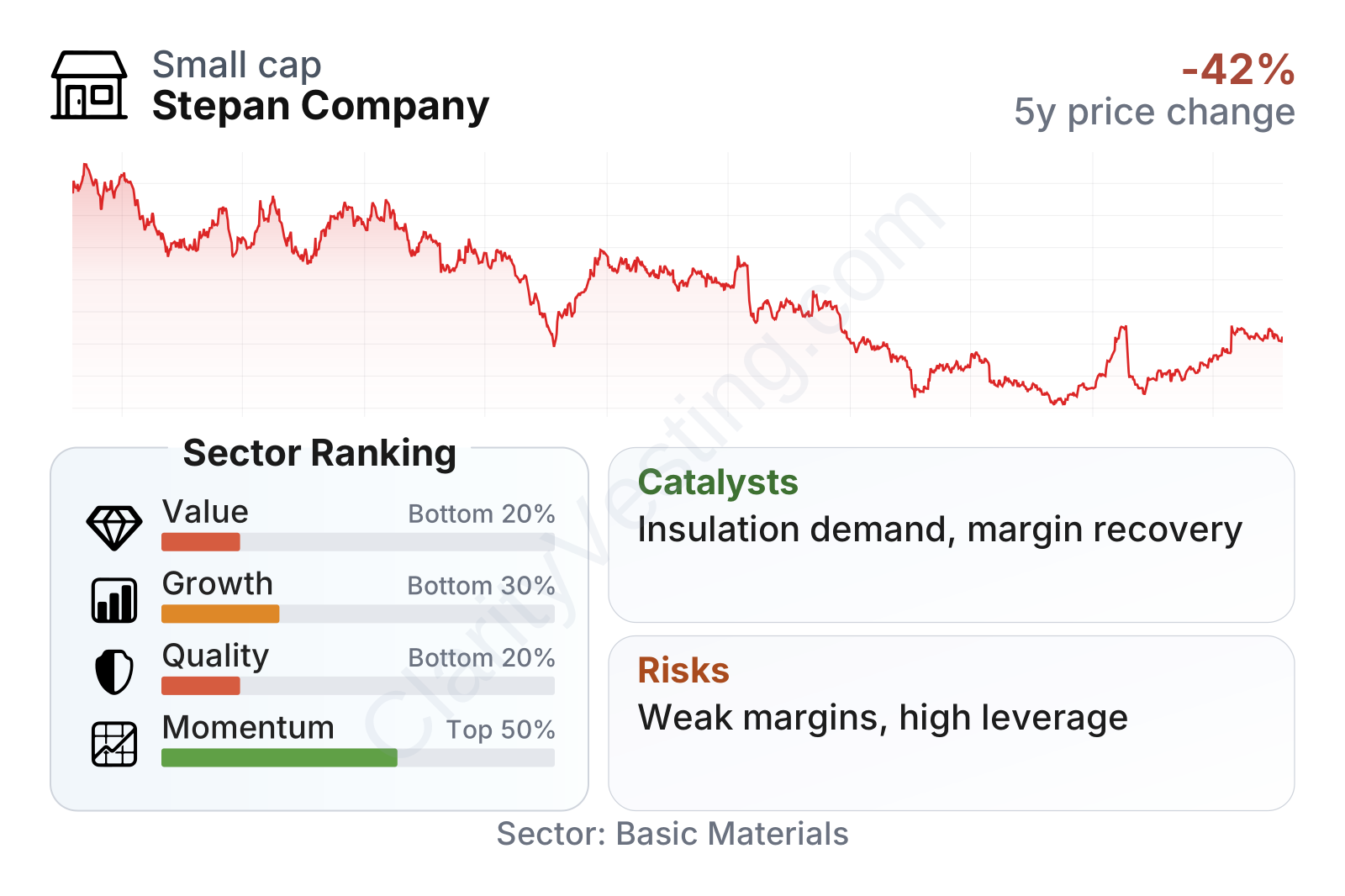
Stepan sits in the smaller end of the public specialty chemicals space, with a market value around $1.4 billion and a beta just under 1, meaning the stock has generally moved in line with the broader market rather than behaving like an extreme high-volatility name. The factor breakdown is mixed at best: value metrics look weak relative to the sector because earnings and cash flow are currently depressed, growth ranks in the lower part of the group despite a recent sales rebound, and quality stands out as the weakest area. The more favorable points are a low price-to-book ratio versus the sector median, a dividend yield slightly above the sector median, and better short-term share-price momentum than the sector over the last six months. Those positives are offset by negative free cash flow, very low returns on capital, and leverage measures that look stretched against peers.
Growth
Stepan operates in markets that have long-term relevance. Demand for cleaning ingredients, personal care formulations, agricultural adjuvants, and insulation materials is supported by structural needs rather than short-lived trends. In particular, insulation-related polymer demand can benefit from stricter building-efficiency standards, while surfactants are tied to everyday consumer and industrial use. So the company is not in a declining field; the bigger question is whether it can convert that end-market exposure into durable profit growth.
The recent revenue trend has improved after a difficult downturn. Sales growth turned negative through 2023 and much of 2024, then returned to positive territory in 2025, with the latest year-over-year growth running in the mid-teens. That is better than the sector median on the most recent reading, but the longer view is less impressive: five-year revenue-per-share growth has been close to flat, and five-year EPS growth has been deeply negative. In other words, Stepan has recently shown demand recovery, but not yet a convincing record of compounding earnings.
Management’s strategy remains logical for a specialty chemical company of this size: focus on formulation-heavy businesses, keep investing in research and development, expand products with better differentiation, and support customers through local manufacturing. Stepan has also emphasized surfactant innovation tied to cleaning and agricultural uses, and polymers tied to insulation and energy efficiency. These are sensible categories because customers often value product performance, regulatory compliance, and supply reliability, not just price.
Cash generation, however, has been uneven. Free cash flow was strongly negative in 2022 and 2023, improved materially in 2024 and 2025, and then slipped back below zero on the latest trailing measure. That makes the current recovery less robust than a simple revenue chart might suggest. For long-term business progress, margin normalization and steadier cash conversion matter more than a short sales rebound.
Recent company updates have pointed to continuing efforts to improve volume, mix, and operating efficiency. A meaningful catalyst would be a broader recovery in polymer demand tied to construction and insulation, combined with better utilization in surfactants. If that happens while raw-material spreads become more favorable, Stepan’s earnings could improve faster than revenue because its current profit base is starting from a low level.
Risks
This article is for informational purposes only and does not constitute financial advice. Some content is AI-generated. See Disclaimer


