Stock Analysis · Serco Group PLC (SCGPY)
Overview
Serco Group PLC is a government services contractor. It runs essential public services on behalf of national and local governments, agencies, and public bodies. Its work ranges from defense support and military base services to immigration facilities, prisons, transport operations, health-related administration, and citizen services. In simple terms, Serco is not mainly selling products to consumers; it is selling long-term operational expertise to governments that want outside partners to run complex services.
The business is geographically diversified, with major operations in the United Kingdom, North America, Europe, the Middle East, and the Asia-Pacific region. Government customers dominate its revenue base, which can make demand more stable than in many private-sector markets, but it also means performance depends heavily on contract wins, renewals, and political spending priorities.
Based on the company’s recent annual reporting, revenue is mainly split by region rather than by product line. Approximate revenue sources are:
- North America: about 39% of revenue. This includes defense, space, citizen services, and federal government support work, especially in the United States and Canada.
- United Kingdom & Europe: about 37% of revenue. This covers justice, immigration, transport, defense, environmental services, and other public-sector outsourcing contracts.
- Asia Pacific: about 16% of revenue. This includes defense, health, justice, and community services, with Australia as the key market.
- Middle East: about 8% of revenue. This largely reflects transport, facilities management, and government service contracts in the Gulf region.
Across the income structure, Serco appears to be a high-volume, low-margin operator. Revenue has trended upward over the last several years, but profitability has been uneven, with operating income and net income moving around more than sales. That is typical for a contractor exposed to contract mix, mobilization costs, and one-off charges.
The long-term pattern is that sales stayed close to the upper end of the company’s recent range while gross profit remained relatively steady. The more important swing factor has been below the gross profit line: administrative costs, financing costs, and exceptional items can materially change reported earnings from one year to another.
Key Figures
| Metric | Value | Sector ⓘ |
|---|---|---|
| Date | Oct 17, 2026 | |
| Context | ||
| Sector | Industrials | |
| Industry | Specialty Business Services | |
| Market Cap ⓘ | $2.88B | |
| Beta ⓘ | 0.52 | |
Value (Cheapness) | ||
| P/E Ratio ⓘ | 14.95 | 22.10 |
| P/B Ratio ⓘ | 3.49 | 1.97 |
| FCF Yield ⓘ | 27.35% | 6.38% |
| Dividend Yield ⓘ | 2.09% | 1.94% |
| EBIT / EV ⓘ | N/A | 4.79% |
| PEG ⓘ | N/A | |
Growth (Business expansion) | ||
| Revenue Growth ⓘ | 3.70% | 9.30% |
| RPS Growth (5Y CAGR) ⓘ | 7.29% | 7.81% |
| EPS Growth (5Y CAGR) ⓘ | 4.46% | -13.06% |
| BVPS Growth (5Y CAGR) ⓘ | 1.02% | 6.14% |
| Margin Growth (5Y Trend) ⓘ | 0.98% | 0.88% |
| FCF Growth (5Y CAGR) ⓘ | 5.70% | 11.01% |
| DPS Growth (5Y CAGR) ⓘ | 17.74% | 9.48% |
Quality (Business durability) | ||
| ROIC (Latest) ⓘ | 22.74% | 10.84% |
| ROA (Latest) ⓘ | 7.34% | 5.41% |
| ROIC (5Y Median) ⓘ | 15.16% | 9.38% |
| ROA (5Y Median) ⓘ | 5.67% | 4.95% |
| Net Debt / EBIT (Latest) ⓘ | 1.88 | 2.08 |
| Net Debt / EBIT (5Y Median) ⓘ | 2.89 | 2.27 |
| Net Debt / EBITDA (Latest) ⓘ | 0.87 | 1.39 |
| Net Debt / Assets ⓘ | 25.33% | 19.28% |
| EBITDA / Interest ⓘ | 9.53 | 9.58 |
| Operating Margin (Latest) ⓘ | 3.89% | 10.50% |
| Operating Margin (5Y Median) ⓘ | 4.87% | 10.29% |
| Debt to Equity (Latest) ⓘ | 104.16% | 65.48% |
| Profit Margin (Latest) ⓘ | 3.08% | 6.67% |
| Free Cash Flow (Latest) ⓘ | $786.44M | |
Momentum (Price trend) | ||
| 3Y Return ⓘ | +78.95% | +61.68% |
| 12M Return (excl. last month) ⓘ | +12.08% | +12.58% |
| 6M Return ⓘ | -19.76% | 0.00% |
| Price vs. 200-Day MA ⓘ | +19.98% | +0.02% |
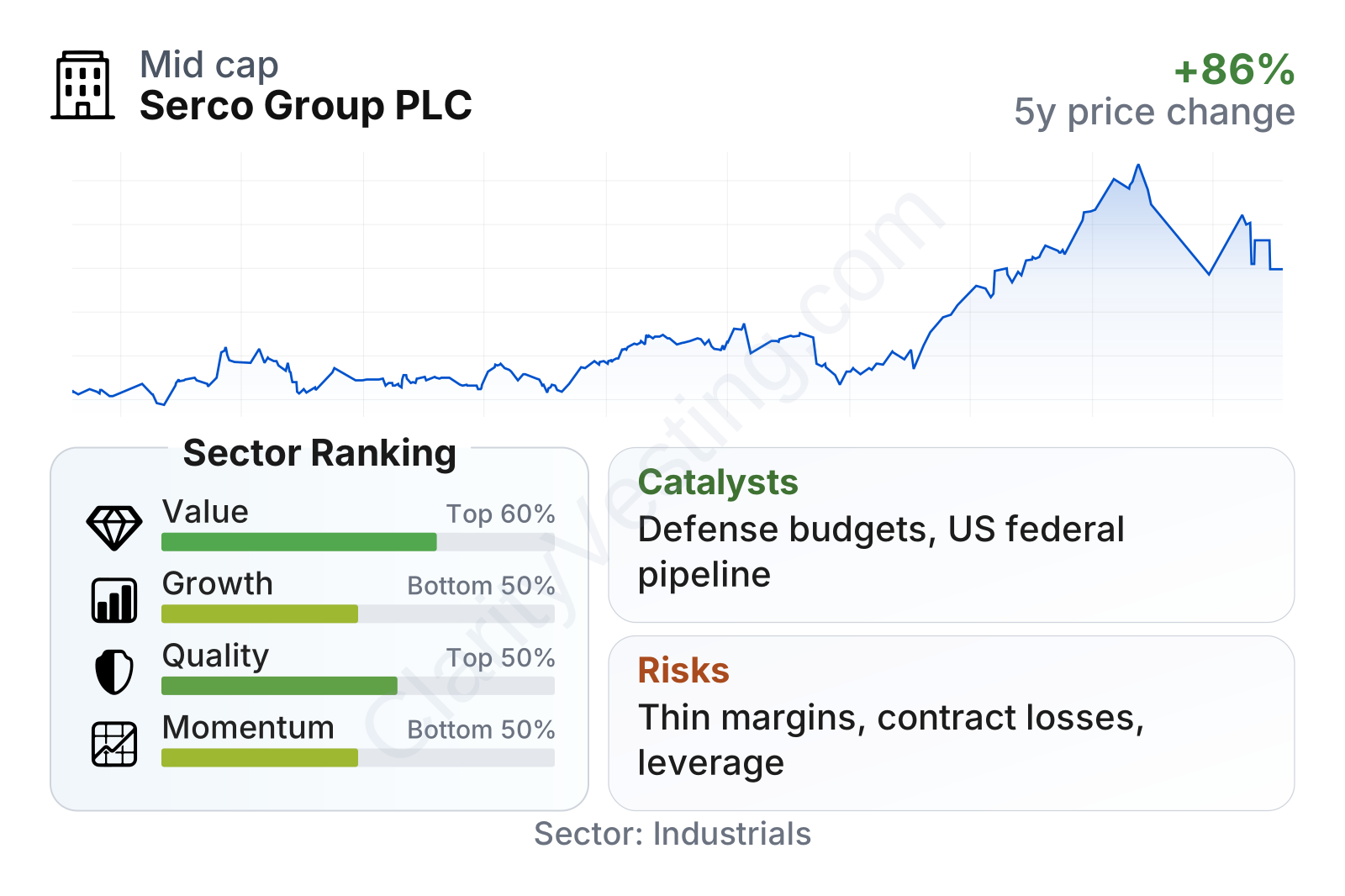
Serco sits in the mid-cap range and its share-price volatility has been relatively low, as reflected by a beta well below 1. In the factor table, the most notable strengths are cash generation and returns on capital. Free cash flow yield is far above the sector median, and return on invested capital is also comfortably ahead of many peers. Growth is less impressive: recent revenue growth is slower than the sector median, even though five-year earnings growth has still been positive. Quality is mixed rather than uniformly strong, because good capital efficiency comes with modest operating margins and above-median leverage. Momentum has weakened recently after a strong multiyear stock move.
Growth
Serco operates in parts of the economy that should remain relevant for a long time: defense support, border management, public transport operations, justice services, and administrative outsourcing. These are not fast-moving consumer markets, but they are areas where governments often prefer continuity, scale, compliance expertise, and proven execution. That creates a market with durable demand, even if yearly growth is not always rapid.
The company’s strategy is broadly coherent for this type of business. It focuses on complex, mission-critical contracts where failure is costly for the customer and where prior experience matters in the bidding process. That tends to raise switching frictions and can support repeat business. Serco has also expanded through acquisitions over time to deepen its position in defense, immigration, and government services, especially in North America, where spending trends have been relatively supportive.
A major long-term catalyst is defense and national security spending. Many Western governments are increasing budgets tied to military readiness, naval support, infrastructure resilience, and secure public operations. Serco is not a weapons manufacturer, but it benefits from the wider ecosystem around defense and government operations. Another catalyst is the steady outsourcing of public services when governments want cost control, specialist labor, or operational modernization without building everything internally.
There is also a meaningful opportunity in space-related and federal services in the United States, where the company has built a presence in support activities rather than pure manufacturing. That can provide a more specialized niche with less direct exposure to the largest defense primes.
Recent company updates have continued to point to a healthy pipeline of bid opportunities and book-to-bill support from government demand, particularly in defense-related and citizen-services areas. That does not guarantee high growth, but it supports the view that Serco remains positioned in a sector with structural demand rather than cyclical consumer exposure.
Risks
This article is for informational purposes only and does not constitute financial advice. Some content is AI-generated. See Disclaimer


