Stock Analysis · Sabra Healthcare REIT Inc (SBRA)
Overview
Sabra Health Care REIT, Inc. is a real estate investment trust focused on healthcare properties. In simple terms, it owns buildings used for senior housing, skilled nursing, behavioral health, and other healthcare-related services, then earns rent or operating income from those properties. The company’s portfolio is spread across the United States and also includes some exposure to Canada, giving it a broad footprint in areas tied to aging and long-term care demand.
Its revenue comes mainly from rent and property-level income generated by healthcare real estate. Based on recent company disclosures, the portfolio is concentrated in a few major categories:
- Skilled nursing / transitional care properties: approximately 55% to 60% of annualized cash NOI. These facilities provide nursing care, rehabilitation, and post-acute services.
- Senior housing communities: approximately 30% to 35%. This includes assisted living, memory care, and independent living communities. Part of this segment is run through operating structures where Sabra participates more directly in property-level results.
- Behavioral health facilities: approximately 5% to 10%. These properties serve mental health and specialty treatment needs.
- Other healthcare real estate: a smaller share, generally under 5%, including specialty hospitals and other care-related properties.
This mix matters because skilled nursing remains the company’s largest earnings engine, while senior housing gives it exposure to a part of healthcare real estate that can benefit from improving occupancy and pricing over time.
Over the last several years, revenue has risen steadily and profitability has improved materially after a weaker period earlier in the decade. The business has moved from losses to positive net income, while operating income has expanded faster than revenue. That suggests the portfolio has been producing better rent collection, stronger asset performance, or a more favorable mix of properties.
Key Figures
| Metric | Value | Sector ⓘ |
|---|---|---|
| Date | Oct 17, 2026 | |
| Context | ||
| Sector | Real Estate | |
| Industry | REIT - Healthcare Facilities | |
| Market Cap ⓘ | $4.93B | |
| Beta ⓘ | 0.62 | |
Value (Cheapness) | ||
| P/E Ratio ⓘ | 77.16 | 17.38 |
| P/B Ratio ⓘ | 1.77 | 0.85 |
| FCF Yield ⓘ | 7.03% | 7.38% |
| Dividend Yield ⓘ | 6.26% | 4.85% |
| EBIT / EV ⓘ | 2.44% | 3.78% |
| PEG ⓘ | 5.28 | |
Growth (Business expansion) | ||
| Revenue Growth ⓘ | 25.30% | 5.30% |
| RPS Growth (5Y CAGR) ⓘ | 5.07% | 6.02% |
| EPS Growth (5Y CAGR) ⓘ | N/A | -11.37% |
| BVPS Growth (5Y CAGR) ⓘ | -7.01% | 0.45% |
| Margin Growth (5Y Trend) ⓘ | 37.08% | -0.22% |
| FCF Growth (5Y CAGR) ⓘ | 1.94% | 5.40% |
| DPS Growth (5Y CAGR) ⓘ | -0.34% | 5.02% |
Quality (Business durability) | ||
| ROIC (Latest) ⓘ | 3.29% | 5.69% |
| ROE (Latest) ⓘ | 2.35% | 7.56% |
| ROA (Latest) ⓘ | 1.18% | 2.85% |
| ROIC (5Y Median) ⓘ | 2.08% | 4.22% |
| ROE (5Y Median) ⓘ | 0.47% | 6.03% |
| ROA (5Y Median) ⓘ | 0.25% | 2.44% |
| Net Debt / EBIT (Latest) ⓘ | 13.30 | 7.59 |
| Net Debt / EBIT (5Y Median) ⓘ | 14.25 | 8.40 |
| Net Debt / EBITDA (Latest) ⓘ | 6.17 | 5.27 |
| Net Debt / Assets ⓘ | 43.78% | 37.76% |
| EBITDA / Interest ⓘ | 3.31 | 4.10 |
| Operating Margin (Latest) ⓘ | 21.11% | 35.29% |
| Operating Margin (5Y Median) ⓘ | 19.88% | 37.31% |
| Debt to Equity (Latest) ⓘ | 96.16% | 88.87% |
| Profit Margin (Latest) ⓘ | 7.58% | 19.61% |
| Free Cash Flow (Latest) ⓘ | $346.41M | |
Momentum (Price trend) | ||
| 3Y Return ⓘ | +63.61% | +30.75% |
| 12M Return (excl. last month) ⓘ | +12.20% | +4.36% |
| 6M Return ⓘ | -3.06% | -2.52% |
| Price vs. 200-Day MA ⓘ | -1.37% | -2.34% |
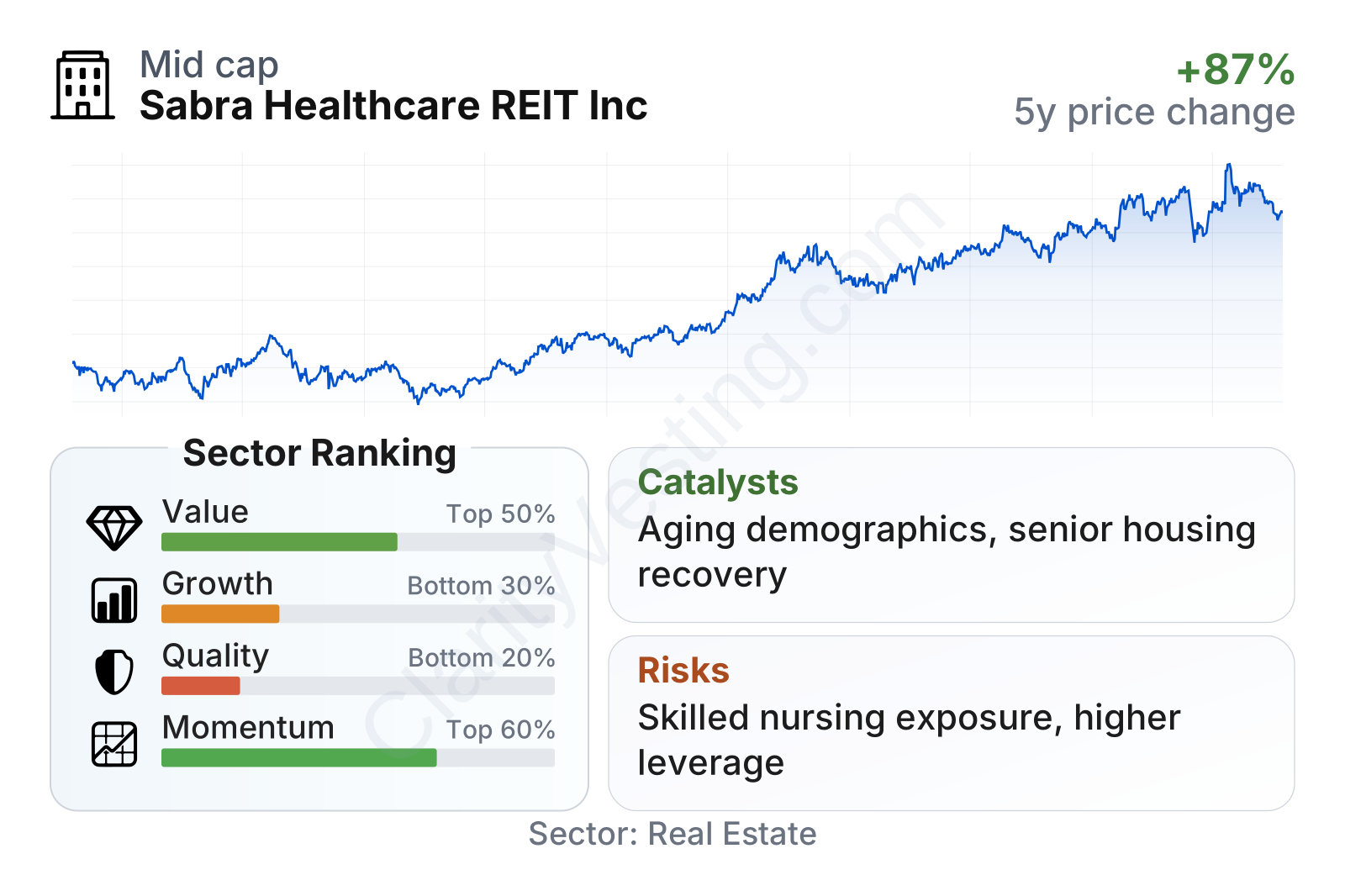
Sabra is a mid-sized healthcare REIT with a market value a little above $5 billion and a stock that has shown lower volatility than the broader market. Recent share performance has been solid, with gains over one, three, and six months and a strong three-year return compared with the sector median.
The overall picture is mixed. Income-oriented metrics remain notable, especially a dividend yield around 6%, but valuation is no longer especially cheap relative to the real estate sector. At the same time, quality measures such as returns on assets, returns on equity, margins, and interest coverage remain weaker than many peers. Growth has improved recently, but the longer five-year profile is still modest in several areas.
Growth
Healthcare real estate is linked to one of the clearest long-term demographic trends in the economy: aging populations. Demand for senior housing, rehabilitation, skilled nursing, and memory care tends to rise as the number of older adults increases. That does not guarantee smooth results, but it creates a favorable background for owners of well-located care facilities.
Sabra’s strategy is sensible for this environment. The company has maintained a meaningful base in skilled nursing, where demand is tied to medical necessity, while also keeping exposure to senior housing, which can benefit from occupancy recovery and rent growth. This balanced approach can reduce dependence on any single operating dynamic, even though skilled nursing still dominates the portfolio.
Revenue per share has trended upward consistently over the last five years, rising from roughly $2.6 to more than $3.1. That kind of progression is important for long-term analysis because it shows that growth has not come only from issuing more shares; it has also translated into more revenue attributable to each share.
The dividend per share has been broadly stable, staying close to $1.18 to $1.20 over the same period. That stability can be read in two ways: it shows resilience in cash distributions, but it also shows that dividend growth has been limited. For a REIT, a flat dividend is often a sign that management is being careful with leverage, tenant health, or funding needs rather than aggressively raising payouts.
A meaningful catalyst is continued normalization in senior housing operations. If occupancy and resident rates keep improving, that segment could become a stronger growth contributor. Another positive driver is the broader recovery in earnings already visible over the last few years, with revenue, operating income, and net income all moving in the right direction. Recent company updates have also pointed to ongoing investment activity and portfolio management, which can support future rent growth if acquisitions are disciplined and funded prudently.
Risks
This article is for informational purposes only and does not constitute financial advice. Some content is AI-generated. See Disclaimer


