Stock Analysis · Sabine Royalty Trust (SBR)
Overview
Sabine Royalty Trust is not a typical oil and gas company. It does not drill wells, run refineries, or build pipelines. Instead, it is a royalty trust that owns royalty and mineral interests in producing properties across the United States. Its role is mainly to collect its share of proceeds from oil and natural gas production operated by other companies, pay trust expenses, and distribute most of the remaining cash to unitholders.
This structure makes the business simple to understand: Sabine’s results depend mainly on how much oil and gas is produced from its underlying properties and on commodity prices. Because the trust has no operating business in the usual sense, its cost base is very low, which explains why reported margins are unusually high compared with most energy companies.
According to the trust’s filings, revenue comes from royalties on oil and natural gas properties, with production spread across several states and managed by many third-party operators. Sabine does not publish a detailed product-by-product revenue split every period in a way that supports a precise, up-to-date percentage breakdown for all revenue sources, but the business can be understood through the following main streams:
- Oil royalties — cash received from crude oil produced on properties where the trust owns royalty interests.
- Natural gas royalties — payments tied to natural gas output from the same broad portfolio of properties.
- NGL-related proceeds and other minor items — in some cases, proceeds can reflect natural gas liquids or small adjustments related to marketing, timing, or operator reporting.
Geographically, the trust’s interests are diversified across multiple producing regions rather than concentrated in a single field. That helps reduce single-asset risk, although it does not remove exposure to energy price cycles.
Financially, the business model is very lean. Over the past several years, revenue has fluctuated with commodity conditions, while administrative expenses have remained relatively small. That means a large portion of incoming royalty revenue can flow through to earnings and distributions, but it also means there is limited internal ability to create growth through reinvestment because the trust is designed primarily to pass cash through rather than expand.
The overall picture is a business with very little overhead and very high pass-through economics. The more recent pattern shows revenue stepping down from the 2022 peak as energy prices normalized, while expenses stayed low enough for profitability to remain exceptionally strong.
Key Figures
| Metric | Value | Sector ⓘ |
|---|---|---|
| Date | Oct 17, 2026 | |
| Context | ||
| Sector | Energy | |
| Industry | Oil & Gas Midstream | |
| Market Cap ⓘ | $1.08B | |
| Beta ⓘ | 0.29 | |
Value (Cheapness) | ||
| P/E Ratio ⓘ | 15.08 | 15.44 |
| P/B Ratio ⓘ | 125.54 | 1.73 |
| FCF Yield ⓘ | 7.04% | 8.20% |
| Dividend Yield ⓘ | 6.62% | 3.59% |
| EBIT / EV ⓘ | 6.82% | 7.46% |
| PEG ⓘ | 1.35 | |
Growth (Business expansion) | ||
| Revenue Growth ⓘ | 16.50% | 26.90% |
| RPS Growth (5Y CAGR) ⓘ | 6.06% | 6.90% |
| EPS Growth (5Y CAGR) ⓘ | -29.08% | -15.73% |
| BVPS Growth (5Y CAGR) ⓘ | -17.68% | 6.07% |
| Margin Growth (5Y Trend) ⓘ | -0.29% | 0.58% |
| FCF Growth (5Y CAGR) ⓘ | N/A | 1.86% |
| DPS Growth (5Y CAGR) ⓘ | 12.56% | 16.79% |
Quality (Business durability) | ||
| ROIC (Latest) ⓘ | N/A | 11.40% |
| ROA (Latest) ⓘ | N/A | 6.06% |
| ROIC (5Y Median) ⓘ | N/A | 10.30% |
| ROA (5Y Median) ⓘ | N/A | 5.42% |
| Net Debt / EBIT (Latest) ⓘ | -0.14 | 1.64 |
| Net Debt / EBIT (5Y Median) ⓘ | -0.12 | 1.83 |
| Net Debt / EBITDA (Latest) ⓘ | -0.14 | 1.08 |
| Net Debt / Assets ⓘ | -99.33% | 17.29% |
| EBITDA / Interest ⓘ | N/A | 9.64 |
| Operating Margin (Latest) ⓘ | 95.03% | 16.27% |
| Operating Margin (5Y Median) ⓘ | 96.46% | 20.39% |
| Debt to Equity (Latest) ⓘ | N/A | 54.76% |
| Profit Margin (Latest) ⓘ | 94.71% | 8.82% |
| Free Cash Flow (Latest) ⓘ | $75.84M | |
Momentum (Price trend) | ||
| 3Y Return ⓘ | +44.95% | +67.38% |
| 12M Return (excl. last month) ⓘ | +2.68% | +49.19% |
| 6M Return ⓘ | +1.90% | +7.07% |
| Price vs. 200-Day MA ⓘ | +1.47% | +9.56% |
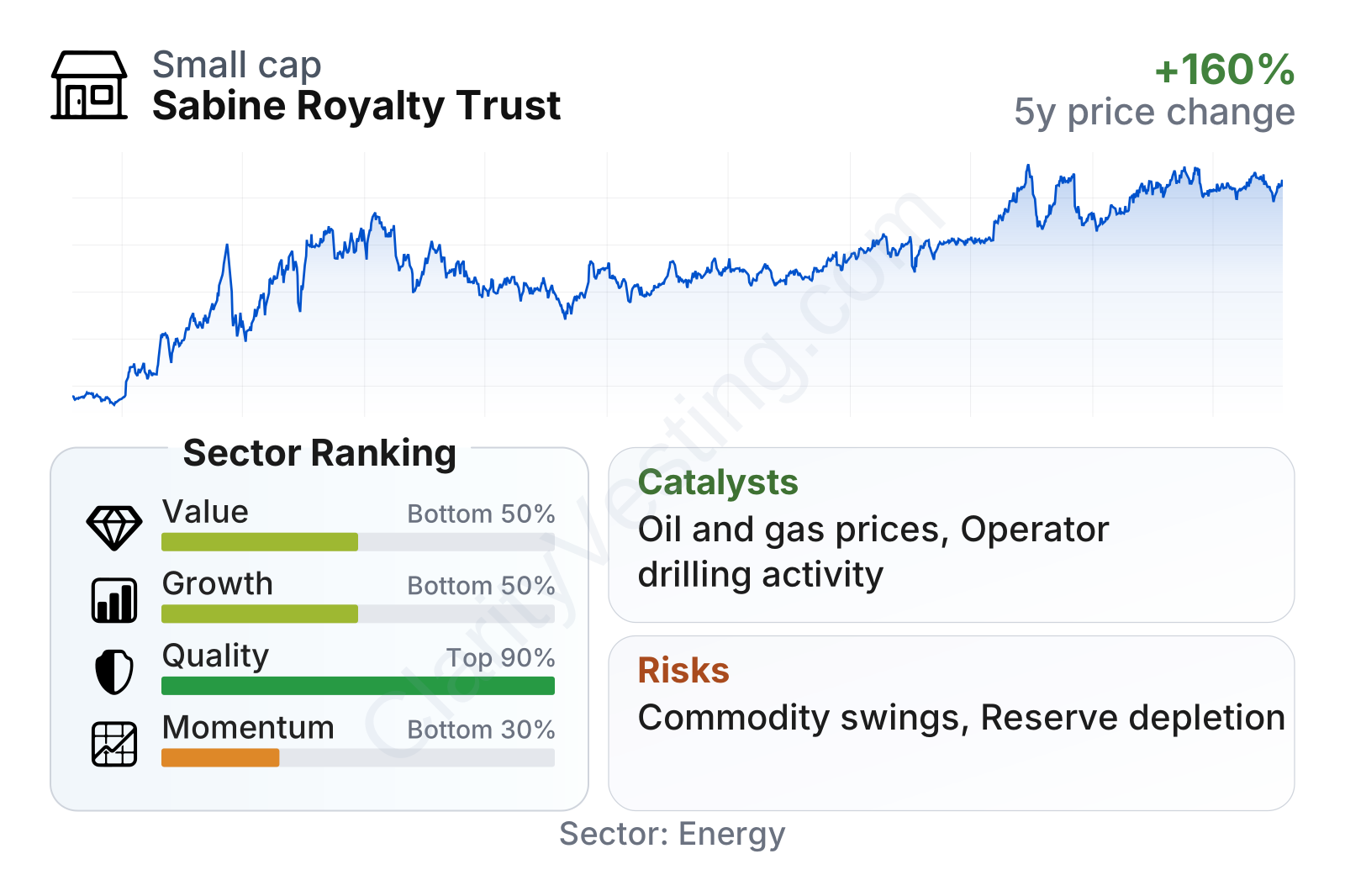
Sabine Royalty Trust is a relatively small public energy vehicle with a market value around $1 billion and a very low beta, which suggests its trading pattern has historically been less volatile than many energy stocks. On valuation, its earnings multiple is roughly in line with the sector median, while free cash flow yield is somewhat below the sector median. Its trailing dividend yield is clearly above the sector median, reflecting the trust’s pass-through structure.
The table also highlights an unusual balance sheet profile. Sabine carries effectively no net debt and sits near the top of the sector on quality metrics. That strength comes less from expansion potential and more from the trust model itself: limited operating complexity, low overhead, and very high margins. At the same time, growth and market momentum rank in the weaker half of the sector, which fits a mature royalty vehicle better than a growing operating company.
Growth
Sabine operates in the energy sector, which is large and structurally important, but it is not a straightforward growth vehicle. Long-term demand for oil and natural gas remains supported by industrial use, power generation, petrochemicals, and transportation, especially for natural gas in U.S. electricity and export markets. That provides a durable base for royalty income, but the trust itself has limited tools to accelerate growth because it does not actively develop new assets.
The strategy is best understood as asset harvesting rather than business building. Sabine benefits when operators on its properties increase production, improve well performance, or when commodity prices rise. It can also benefit from new drilling activity on acreage where it already owns royalty interests. However, it generally does not reinvest cash at scale to acquire new growth platforms, so future expansion depends heavily on outside operators and the natural productivity of its royalty base.
Revenue growth has been uneven. The trust experienced a sharp surge during the energy upcycle, then a more mixed pattern as prices and production normalized. More recently, year-over-year revenue has remained volatile, including periods of decline followed by recovery. That pattern is normal for a royalty trust, but it means growth should be viewed as cyclical rather than steadily compounding.
Cash generation remains an important support. Even with fluctuating revenue, Sabine has continued to convert a meaningful share of inflows into free cash flow because capital spending needs are minimal. That is one of the trust’s clearest economic strengths: it does not need to spend heavily just to keep the business model functioning.
The main catalysts for future upside are external rather than internal. Higher oil and natural gas prices would lift royalty receipts quickly. Increased drilling or completion activity by operators on the trust’s properties could also raise volumes. In addition, continued strength in U.S. natural gas demand, including LNG-related demand growth, can improve the backdrop for gas-linked royalty income over time. Recent trust communications have continued to focus on monthly cash distributions, reinforcing that the key driver remains commodity-linked cash flow rather than a new strategic initiative.
Risks
This article is for informational purposes only and does not constitute financial advice. Some content is AI-generated. See Disclaimer


