Stock Analysis · SBA Communications Corp (SBAC)
Overview
SBA Communications is a specialized real estate investment trust that owns and operates wireless communications infrastructure. In simple terms, it owns towers and other sites that mobile network operators and related customers use to place antennas and equipment. Instead of selling phone service to consumers, SBA makes money by leasing space on its infrastructure to carriers and by providing related site development services.
The business is built around long-lived physical assets, multi-year contracts, and recurring rent payments. That tends to create steadier cash generation than many other parts of the telecom ecosystem. SBA has a large footprint in the United States and also operates internationally, mainly in selected markets across the Americas and Africa.
Its revenue mix is heavily concentrated in leasing and operating communications sites, while a smaller portion comes from services tied to network deployment and site work. Based on the company’s recent filings, the main sources of revenue are approximately:
- Domestic site leasing and related revenue: about 74% to 76% — rent from wireless carriers and other customers using tower space in the United States, including amendments, renewals, and colocations.
- International site leasing and related revenue: about 18% to 20% — similar leasing income from towers outside the United States.
- Site development revenue: about 5% to 7% — services such as site acquisition, zoning, permitting, construction management, and related work that support network rollouts.
This structure matters because leasing revenue is the more attractive part of the business: it is recurring, high-margin, and usually grows as carriers add equipment to existing sites. Site development is useful, but it is generally less predictable and less profitable than rent-based income.
Over the last several years, the company’s economics have improved meaningfully. Revenue has grown, operating income has expanded faster than revenue, and net income has risen sharply. The main caution is that some line items for 2025 reflect unusual accounting presentation effects, so the broad takeaway is more important than any single year-to-year jump: SBA remains a large, profitable infrastructure owner with strong operating leverage.
The overall business picture is favorable: a relatively limited cost base supports a large stream of lease revenue, which helps explain why margins are well above the typical real estate company.
Key Figures
| Metric | Value | Sector ⓘ |
|---|---|---|
| Date | Oct 17, 2026 | |
| Context | ||
| Sector | Real Estate | |
| Industry | REIT - Specialty | |
| Market Cap ⓘ | $19.17B | |
| Beta ⓘ | 0.99 | |
Value (Cheapness) | ||
| P/E Ratio ⓘ | 19.60 | 17.38 |
| P/B Ratio ⓘ | N/A | 0.85 |
| FCF Yield ⓘ | 5.48% | 7.38% |
| Dividend Yield ⓘ | 2.60% | 4.85% |
| EBIT / EV ⓘ | 4.91% | 3.78% |
| PEG ⓘ | 10.77 | |
Growth (Business expansion) | ||
| Revenue Growth ⓘ | 2.30% | 5.30% |
| RPS Growth (5Y CAGR) ⓘ | 5.96% | 6.02% |
| EPS Growth (5Y CAGR) ⓘ | 3.59% | -11.37% |
| BVPS Growth (5Y CAGR) ⓘ | -0.88% | 0.45% |
| Margin Growth (5Y Trend) ⓘ | 25.50% | -0.22% |
| FCF Growth (5Y CAGR) ⓘ | 0.24% | 5.40% |
| DPS Growth (5Y CAGR) ⓘ | 18.22% | 5.02% |
Quality (Business durability) | ||
| ROIC (Latest) ⓘ | 18.97% | 5.69% |
| ROE (Latest) ⓘ | N/A | 7.56% |
| ROA (Latest) ⓘ | 8.61% | 2.85% |
| ROIC (5Y Median) ⓘ | 13.22% | 4.22% |
| ROE (5Y Median) ⓘ | N/A | 6.03% |
| ROA (5Y Median) ⓘ | 4.83% | 2.44% |
| Net Debt / EBIT (Latest) ⓘ | 8.77 | 7.59 |
| Net Debt / EBIT (5Y Median) ⓘ | 13.26 | 8.40 |
| Net Debt / EBITDA (Latest) ⓘ | 7.38 | 5.27 |
| Net Debt / Assets ⓘ | 126.74% | 37.76% |
| EBITDA / Interest ⓘ | 3.98 | 4.10 |
| Operating Margin (Latest) ⓘ | 59.09% | 35.29% |
| Operating Margin (5Y Median) ⓘ | 39.65% | 37.31% |
| Debt to Equity (Latest) ⓘ | -328.50% | 88.87% |
| Profit Margin (Latest) ⓘ | 34.51% | 19.61% |
| Free Cash Flow (Latest) ⓘ | $1.05B | |
Momentum (Price trend) | ||
| 3Y Return ⓘ | -3.65% | +30.75% |
| 12M Return (excl. last month) ⓘ | -5.17% | +4.36% |
| 6M Return ⓘ | -13.12% | -2.52% |
| Price vs. 200-Day MA ⓘ | -2.59% | -2.34% |
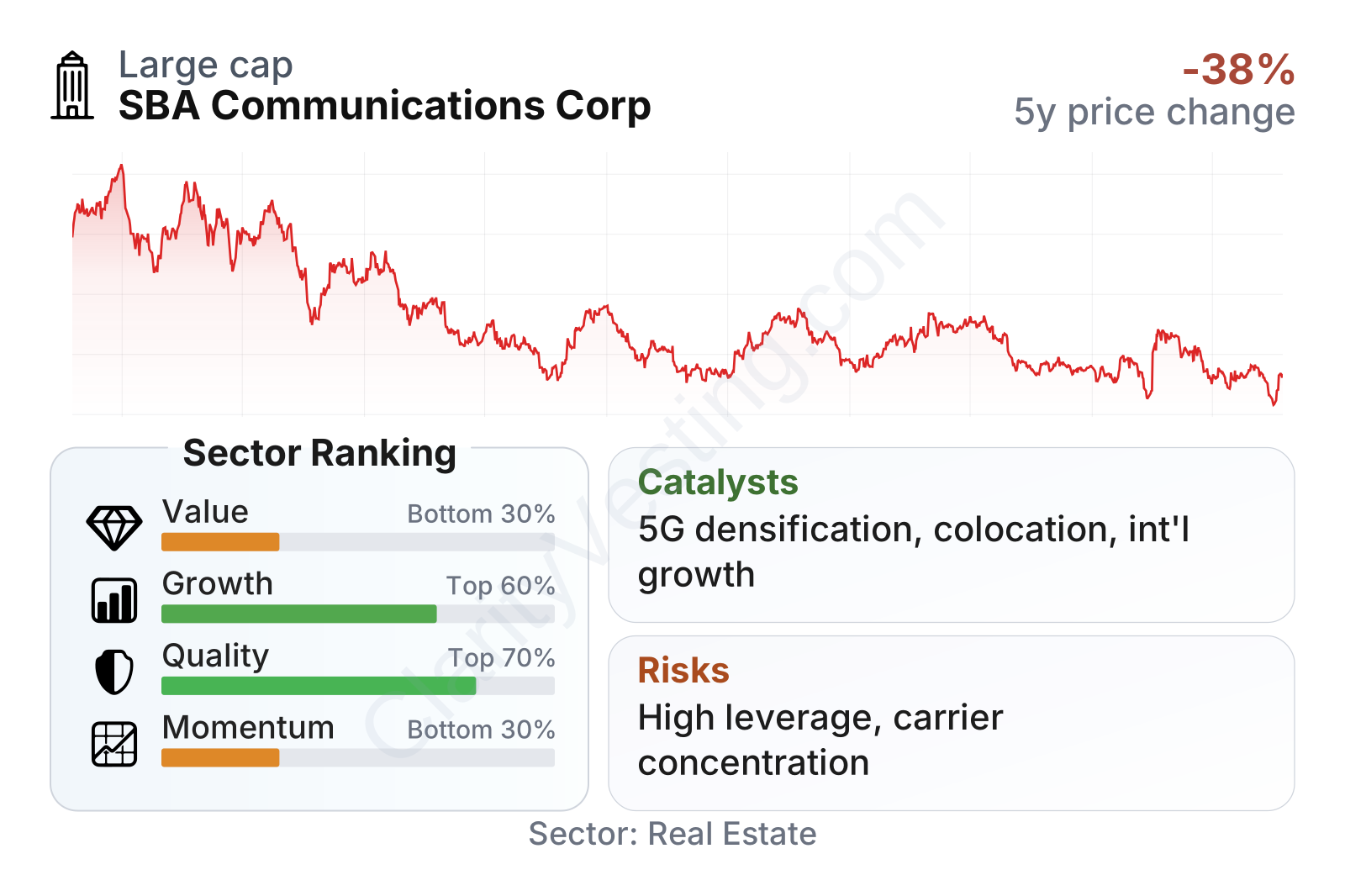
SBA is a large-cap infrastructure REIT with stock-price volatility close to the broader market. The operating profile stands out more than the valuation profile. Quality metrics are strong versus the real estate sector, helped by high margins and strong returns on capital and assets. Growth looks mixed: long-term revenue per share and earnings growth have been solid, but recent revenue growth has been modest relative to the sector median. Momentum is weak, which means the market has not rewarded the shares recently. On valuation, the picture is not obviously cheap on cash-flow and dividend measures, even though the earnings multiple is near the sector median.
Growth
SBA operates in a sector with durable long-term demand. Mobile data traffic keeps expanding, networks keep getting denser, and carriers still need well-located towers to support 4G and 5G coverage and capacity. Even when telecom spending goes through slower phases, tower assets remain central pieces of wireless infrastructure. That gives the sector a structural tailwind, although growth can move in waves depending on carrier capital spending.
The company’s strategy also makes sense for long-term expansion. A tower landlord benefits when a second or third tenant is added to an existing site because the incremental revenue usually comes with high additional margins. This “colocation” model is one of the strongest features of the industry. SBA also has room to grow through contractual rent escalators, selective new tower construction, acquisitions, and international expansion where wireless usage is still developing.
Revenue per share has trended upward over the last five years, with growth in the mid-single-digit range. That is an important sign for long-term analysis because it shows the business has expanded on a per-share basis rather than relying only on headline growth.
SBA has also been increasing its dividend rapidly from a low base, which signals growing confidence in recurring cash generation. Even so, the stock is still not primarily an income vehicle compared with many REIT peers, since its current yield remains below the sector median.
The dividend per share has climbed at a much faster pace than the sector median over the past five years. That supports the view that management has been shifting more cash back to shareholders while still relying on the core tower model for expansion.
One of the clearest business catalysts is continued 5G network densification. Carriers may not need an entirely new nationwide tower grid, but they do need more equipment on existing sites, amendments to leases, and additional network capacity in busy areas. SBA is positioned to benefit from that trend because it already controls the real estate and infrastructure in many attractive locations.
Another meaningful catalyst is the company’s international portfolio. In emerging wireless markets, smartphone use and data consumption can still rise for years from current levels. That creates a runway for more tenants, contract escalations, and new leasing opportunities, although it also comes with added country risk.
Recent company communications have also pointed to continued emphasis on leasing activity, disciplined capital allocation, and balancing growth with debt management. For a tower owner, that combination matters because the best outcomes usually come from steady tenancy growth rather than aggressive expansion at any cost.
Risks
This article is for informational purposes only and does not constitute financial advice. Some content is AI-generated. See Disclaimer


