Stock Analysis · Straumann Holding AG (SAUHF)
Overview
Straumann Holding AG is a Swiss dental technology company focused on tooth replacement, orthodontics, and digital dentistry. In simple terms, it sells products and systems used by dentists, oral surgeons, and dental labs to replace missing teeth, straighten teeth, and plan treatments digitally. Its best-known activities are dental implants and clear aligners, but the company has expanded into a broader platform that connects physical products with scanners, software, and treatment planning tools.
The business is largely built around premium and value dental implant brands, orthodontic solutions, and digital tools used in dental practices. This mix matters because implants often bring high margins and recurring demand from consumables and prosthetic components, while digital equipment and aligners can help deepen relationships with clinics over time.
Based on company reporting, Straumann’s revenue mix can be summarized approximately as follows:
- Implantology and prosthetics: about 70% to 75% — dental implants, abutments, biomaterials, prosthetic parts, and related restorative solutions sold through brands such as Straumann, Neodent, Medentika, and Anthogyr.
- Orthodontics, including clear aligners: about 15% to 20% — clear aligners and related planning services, mainly through the Group’s orthodontic platforms.
- Digital solutions and equipment: about 10% to 15% — intraoral scanners, milling, software, treatment planning, and workflow tools that help dentists move toward digital dentistry.
Geographically, Straumann is broadly diversified across Europe, North America, Asia-Pacific, and Latin America, with notable exposure to faster-growing emerging markets through brands positioned at different price points. That gives the company a wider runway than a single-brand premium implant manufacturer.
The broader financial picture shows a business that has steadily increased revenue over the last several years, from just above $2.0 billion in 2021 to roughly $2.6 billion in 2025, while still keeping operating profitability at a strong level. Gross profit has stayed high, but costs have also moved up, especially selling and administrative expenses, which helps explain why growth in earnings has been less smooth than growth in sales.
Revenue has climbed steadily over the past five years, while operating income has remained solid rather than accelerating at the same pace. That points to a company still expanding successfully, but with a cost base that has grown meaningfully alongside sales.
Key Figures
| Metric | Value | Sector ⓘ |
|---|---|---|
| Date | Oct 10, 2026 | |
| Context | ||
| Sector | Healthcare | |
| Industry | Medical Instruments & Supplies | |
| Market Cap ⓘ | $18.09B | |
| Beta ⓘ | 1.36 | |
Value (Cheapness) | ||
| P/E Ratio ⓘ | 38.76 | 24.79 |
| P/B Ratio ⓘ | 7.28 | 2.97 |
| FCF Yield ⓘ | 3.82% | 3.11% |
| Dividend Yield ⓘ | 1.13% | 2.04% |
| EBIT / EV ⓘ | N/A | 0.57% |
| PEG ⓘ | 1.22 | |
Growth (Business expansion) | ||
| Revenue Growth ⓘ | 2.30% | 7.35% |
| RPS Growth (5Y CAGR) ⓘ | 6.51% | 8.61% |
| EPS Growth (5Y CAGR) ⓘ | -29.42% | -18.43% |
| BVPS Growth (5Y CAGR) ⓘ | 9.56% | 3.94% |
| Margin Growth (5Y Trend) ⓘ | -6.18% | -0.61% |
| FCF Growth (5Y CAGR) ⓘ | -6.91% | 0.88% |
| DPS Growth (5Y CAGR) ⓘ | 13.42% | 6.74% |
Quality (Business durability) | ||
| ROIC (Latest) ⓘ | 39.81% | 3.34% |
| ROA (Latest) ⓘ | 20.37% | 2.95% |
| ROIC (5Y Median) ⓘ | 20.89% | 4.60% |
| ROA (5Y Median) ⓘ | 11.19% | 1.89% |
| Net Debt / EBIT (Latest) ⓘ | 0.08 | 1.36 |
| Net Debt / EBIT (5Y Median) ⓘ | 0.01 | 1.86 |
| Net Debt / EBITDA (Latest) ⓘ | 0.07 | 1.02 |
| Net Debt / Assets ⓘ | 2.42% | 5.85% |
| EBITDA / Interest ⓘ | 5.73 | 9.60 |
| Operating Margin (Latest) ⓘ | 21.54% | 9.19% |
| Operating Margin (5Y Median) ⓘ | 23.21% | 7.53% |
| Debt to Equity (Latest) ⓘ | 22.40% | 29.44% |
| Profit Margin (Latest) ⓘ | 14.00% | 3.52% |
| Free Cash Flow (Latest) ⓘ | $690.30M | |
Momentum (Price trend) | ||
| 3Y Return ⓘ | -14.66% | +34.80% |
| 12M Return (excl. last month) ⓘ | +1.26% | +19.33% |
| 6M Return ⓘ | +0.37% | +7.18% |
| Price vs. 200-Day MA ⓘ | -12.18% | +3.20% |
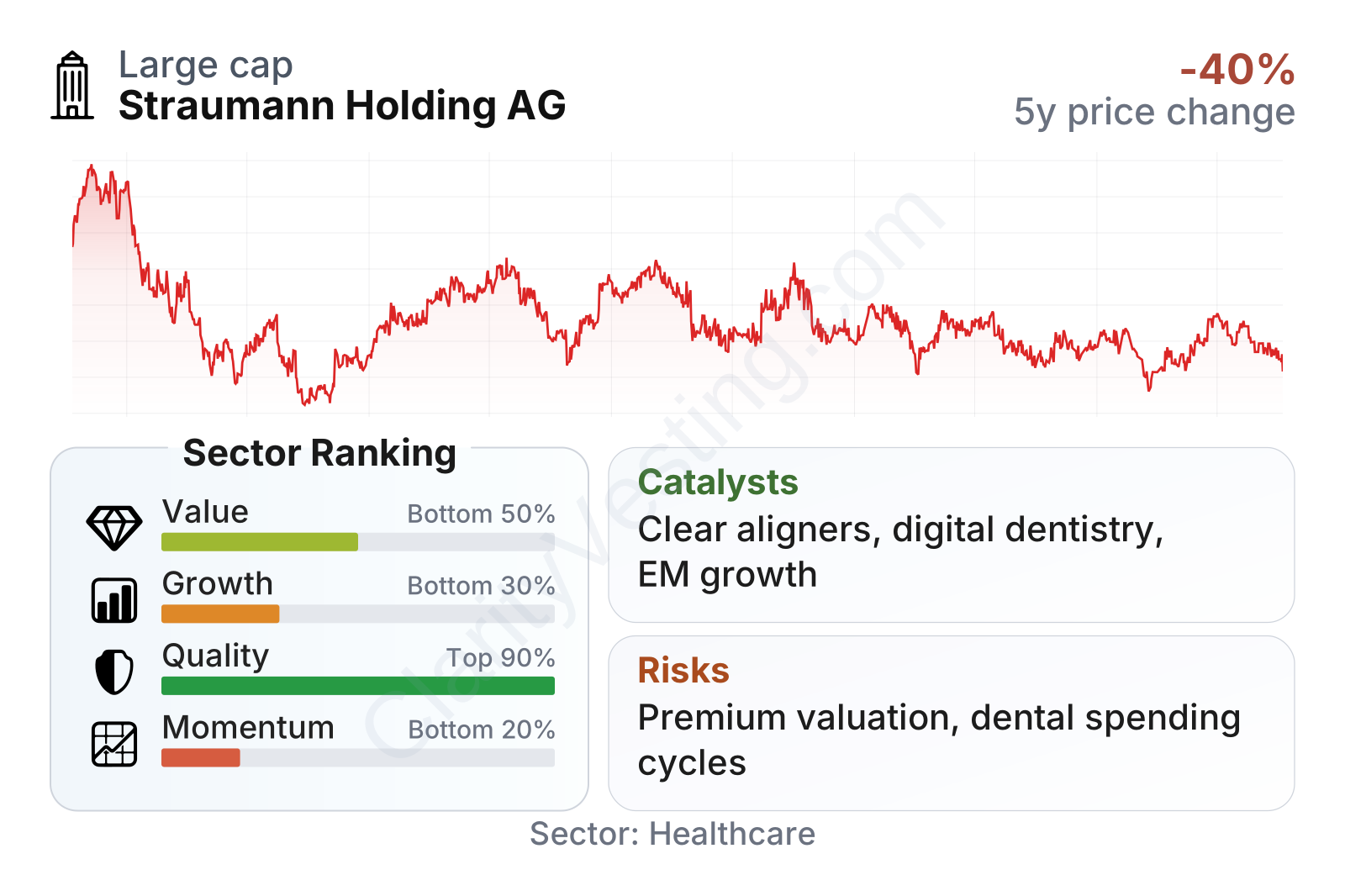
Straumann stands out for business quality more than for cheap valuation or recent momentum. Profitability is well above typical healthcare equipment peers, with operating margin around the low-20% range and profit margin near the mid-teens. Returns on capital are exceptionally high, and leverage is low, with net debt modest relative to earnings. On the other hand, recent growth metrics are softer than the sector median, and the stock’s market performance has lagged over multi-year periods even though the last six months have shown some recovery.
The company is also a large player rather than a niche micro-cap, with a market value in the tens of billions of dollars. Its beta above 1 suggests the shares can move more sharply than the broader market, which fits the stock’s visible swings since 2022. The dividend yield is low, so the financial profile is driven far more by operating performance than by income distribution.
Growth
Straumann operates in an attractive long-term segment of healthcare. Dental implants, tooth restoration, clear aligners, and digital dentistry are supported by several durable trends: aging populations, rising demand for esthetic dental care, growing adoption of implant-based treatment, and the ongoing digitalization of clinics and laboratories. Unlike some healthcare markets, a meaningful part of dental demand is also tied to consumer willingness to spend on quality-of-life and appearance, which can expand the market over time.
The company’s strategy is coherent. Rather than relying on a single premium brand, Straumann has built a multi-brand structure that addresses different price points and regions. Premium products help preserve margins and reputation, while value-oriented brands can expand access in faster-growing markets. This approach is particularly important in dentistry, where clinicians vary widely in budget, patient mix, and treatment complexity.
Another important growth driver is digital workflow integration. Dentists increasingly want scanners, planning software, aligners, implant systems, and lab connections that work together. Straumann’s push to combine implants, orthodontics, and digital tools can make the platform more useful to clinics and harder to replace once adopted. That does not guarantee faster growth every year, but it improves the logic of the commercial model.
There is also room for expansion through penetration rather than invention alone. Implant treatment still has relatively low penetration in many markets compared with the number of patients who could clinically benefit from it. In addition, value brands such as Neodent give Straumann access to demand where a strictly premium strategy might limit volume.
Recent company updates have continued to emphasize expansion in clear aligners, digital dentistry, and international growth, especially in emerging markets. These areas matter because they can broaden the addressable market beyond the traditional implant base and reduce dependence on a single product category. Even so, the latest operating trend looks more like moderated growth than a sharp acceleration, which is consistent with the weaker short-term growth metrics visible in the financial profile.
Risks
This article is for informational purposes only and does not constitute financial advice. Some content is AI-generated. See Disclaimer


