Stock Analysis · StandardAero Inc (SARO)
Overview
StandardAero is an aerospace maintenance, repair, and overhaul company. In simple terms, it helps keep aircraft and aircraft engines flying safely by inspecting, repairing, overhauling, modifying, and testing them. Its customers include commercial airlines, business jet operators, military organizations, and other aviation companies. This is generally a service-heavy business rather than a manufacturer model, which can create recurring demand because aircraft and engines require maintenance throughout their operating lives.
The company operates across engine services, airframe and component services, and aftermarket support. Based on its recent public filings, revenue is mainly tied to maintenance work on aircraft engines and related systems, with a mix of commercial aerospace, business aviation, and defense exposure. The business is diversified, but engines and long-term aftermarket activity appear to be the economic core.
The main revenue sources can be summarized as follows:
- Engine services and repairs: the largest contributor, estimated at well above 50% of revenue. This includes maintenance, overhaul, repair, testing, and support for propulsion systems used in commercial, military, and business aircraft.
- Component repair and accessories: an important secondary contributor, likely in the low double-digit to mid double-digit range. This includes parts repair, accessories, avionics-related support, and other specialized systems work.
- Airframe heavy maintenance and modifications: a smaller but still meaningful share, likely in the low double digits. This covers aircraft inspections, structural work, modifications, and related services.
- Defense and military programs: this is better viewed as an end-market that overlaps several service lines rather than a separate product line, but it represents a material portion of activity and adds some diversification to the commercial aviation cycle.
What stands out is that StandardAero earns money largely after aircraft and engines have already been sold. That matters because aftermarket demand is usually more stable than original equipment demand, especially when fleets stay in service longer and operators prefer repair over replacement.
The business mix has been moving in a constructive direction: revenue has expanded meaningfully since 2021, operating income has improved, and interest expense has fallen noticeably by 2025. That combination suggests better scale and a healthier earnings bridge than the company had a few years ago, even though margins remain moderate for the sector.
Key Figures
| Metric | Value | Sector ⓘ |
|---|---|---|
| Date | Oct 24, 2026 | |
| Context | ||
| Sector | Industrials | |
| Industry | Aerospace & Defense | |
| Market Cap ⓘ | $7.09B | |
| Beta ⓘ | 0.91 | |
Value (Cheapness) | ||
| P/E Ratio ⓘ | 22.09 | 22.29 |
| P/B Ratio ⓘ | 2.59 | 1.98 |
| FCF Yield ⓘ | 3.08% | 6.26% |
| Dividend Yield ⓘ | N/A | 1.92% |
| EBIT / EV ⓘ | 6.07% | 4.83% |
| PEG ⓘ | 0.58 | |
Growth (Business expansion) | ||
| Revenue Growth ⓘ | 4.60% | 9.30% |
| RPS Growth (5Y CAGR) ⓘ | 14.89% | 7.76% |
| EPS Growth (5Y CAGR) ⓘ | 684.15% | -13.17% |
| BVPS Growth (5Y CAGR) ⓘ | 30.54% | 6.13% |
| Margin Growth (5Y Trend) ⓘ | 4.48% | 0.74% |
| FCF Growth (5Y CAGR) ⓘ | N/A | 10.79% |
| DPS Growth (5Y CAGR) ⓘ | N/A | 9.41% |
Quality (Business durability) | ||
| ROIC (Latest) ⓘ | 9.07% | 10.75% |
| ROA (Latest) ⓘ | 4.80% | 5.41% |
| ROIC (5Y Median) ⓘ | N/A | 9.37% |
| ROA (5Y Median) ⓘ | 0.18% | 4.95% |
| Net Debt / EBIT (Latest) ⓘ | 3.99 | 2.04 |
| Net Debt / EBIT (5Y Median) ⓘ | 8.44 | 2.27 |
| Net Debt / EBITDA (Latest) ⓘ | 3.02 | 1.39 |
| Net Debt / Assets ⓘ | 34.80% | 19.27% |
| EBITDA / Interest ⓘ | 4.75 | 9.58 |
| Operating Margin (Latest) ⓘ | 9.46% | 10.49% |
| Operating Margin (5Y Median) ⓘ | 6.90% | 10.30% |
| Debt to Equity (Latest) ⓘ | 93.08% | 64.82% |
| Profit Margin (Latest) ⓘ | 5.12% | 6.67% |
| Free Cash Flow (Latest) ⓘ | $218.39M | |
Momentum (Price trend) | ||
| 3Y Return ⓘ | N/A | +67.77% |
| 12M Return (excl. last month) ⓘ | -17.04% | +12.05% |
| 6M Return ⓘ | -14.58% | 0.00% |
| Price vs. 200-Day MA ⓘ | -20.33% | +0.67% |
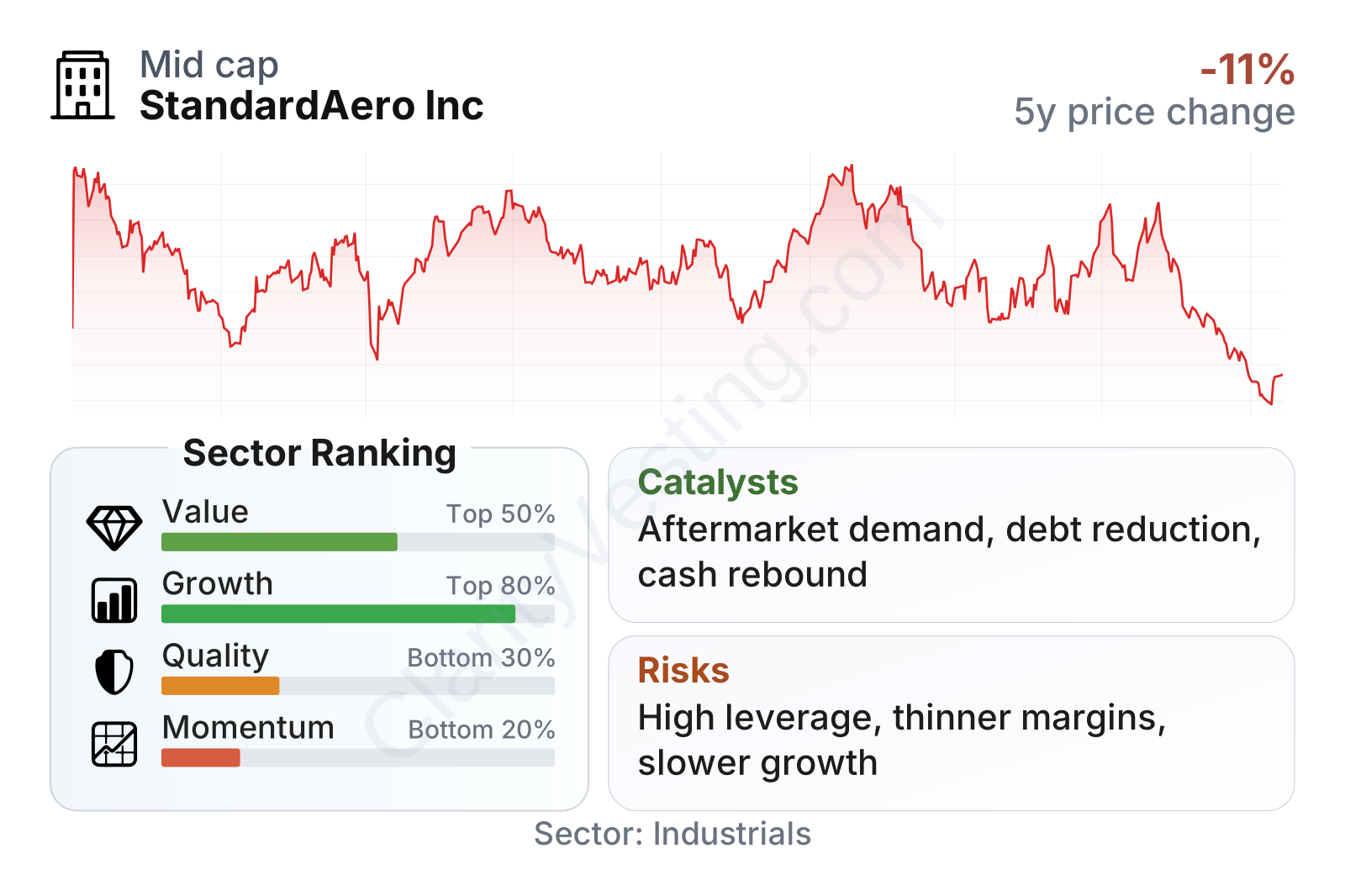
StandardAero sits in the middle of the sector on traditional valuation measures, but the broader picture is more mixed. Growth metrics are strong relative to many aerospace peers, while quality metrics are weaker because leverage is still elevated and profitability is not yet best-in-class. Market performance has also been soft recently, which shows up in the weaker momentum profile.
The company is now a mid-sized aerospace services business with improving earnings power. Free cash flow is positive on a trailing basis, but the cash flow yield remains lower than the sector median, implying that the market is already recognizing some of the operational progress.
Growth
StandardAero operates in a part of aerospace that has favorable long-term drivers. Global air traffic growth, aging fleets, constrained new aircraft deliveries, and high replacement costs all support maintenance demand. When airlines, business jet owners, and defense customers keep equipment in service longer, specialized repair providers can benefit. This makes the maintenance and overhaul market structurally attractive even when new aircraft production faces bottlenecks.
The company’s strategy also fits these industry conditions. StandardAero focuses on installed equipment already in use, where technical approvals, customer relationships, and turnaround time matter. That is a sensible position because operators often need trusted maintenance partners more urgently than they need entirely new hardware. A broad installed base can create recurring work across inspection cycles, repairs, overhauls, and parts replacement.
Recent revenue growth still looks positive, but the pace has cooled. Year-over-year growth was running in the low-to-mid teens before easing to about 5% in the most recent period shown. That does not necessarily point to a broken business, but it does suggest that the easy rebound phase may be over and that future expansion may need to come more from execution, pricing, capacity utilization, and program wins than from broad industry recovery alone.
Cash generation appears to be improving from a weak point. Free cash flow moved from negative territory in one earlier trailing period to clearly positive later on. For a maintenance business, that matters because it shows operating profits are increasingly turning into cash after working capital and capital spending. If that trend continues, it could gradually strengthen the balance sheet and improve flexibility for expansion or debt reduction.
A visible catalyst is the combination of commercial aviation recovery, defense demand, and a large installed engine base that needs long-term servicing. Another meaningful opportunity is the company’s ability to benefit from supply chain delays at original equipment manufacturers: when delivery slots are tight, customers often repair existing assets instead of replacing them. That can extend the demand runway for aftermarket providers like StandardAero.
Risks
This article is for informational purposes only and does not constitute financial advice. Some content is AI-generated. See Disclaimer


