Stock Analysis · Boston Beer Company Inc (SAM)
Overview
Boston Beer Company is a U.S. alcoholic beverage producer best known for Samuel Adams beer, but its business has become much broader than traditional beer. The company owns and markets a portfolio that includes beer, flavored malt beverages, hard cider, and hard seltzer, with brands such as Samuel Adams, Twisted Tea, Truly, Angry Orchard, Dogfish Head, and Sun Cruiser. It sells primarily to wholesalers and distributors, which then supply retailers, bars, restaurants, and other points of sale.
For long-term analysis, the most important point is that Boston Beer is no longer mainly a classic beer company. Its revenue mix is driven by several categories, and that diversification matters because consumer tastes in alcoholic beverages have shifted over time away from standard beer and toward flavored, ready-to-drink, and alternative alcohol products.
Based on recent company reporting, the main sources of revenue can be summarized approximately as follows:
- Tastefully flavored beer and malt beverage brands: about 50% to 60% of volume, led by Twisted Tea and including other flavored malt beverage offerings. This is currently the largest engine of the business.
- Hard seltzer: about 20% to 30% of volume, mainly Truly. This category was once a major growth driver, but it has become more competitive and less predictable.
- Beer: about 10% to 20% of volume, primarily Samuel Adams and Dogfish Head craft beer products.
- Hard cider: about 5% to 10% of volume, largely Angry Orchard.
- Other products: a small remaining share from newer ready-to-drink and related offerings, including brands such as Sun Cruiser.
That mix shows a company with meaningful brand breadth, but also one that depends heavily on categories where consumer demand can change quickly. Revenue has stayed around the $2.0 billion level in recent years, while profitability has moved around much more sharply. Gross profit has improved from 2021 through 2025, and operating income recovered meaningfully after weaker periods, suggesting the company has been managing pricing, mix, and costs with some discipline even without strong top-line expansion.
The broad financial flow points to a business that has kept sales relatively stable while gradually rebuilding gross profit and operating earnings after a difficult period. The key issue is not whether Boston Beer can generate revenue, but whether it can do so with steady margins in categories that are still evolving.
Key Figures
| Metric | Value | Sector ⓘ |
|---|---|---|
| Date | Oct 17, 2026 | |
| Context | ||
| Sector | Consumer Defensive | |
| Industry | Beverages - Brewers | |
| Market Cap ⓘ | $1.85B | |
| Beta ⓘ | 0.82 | |
Value (Cheapness) | ||
| P/E Ratio ⓘ | N/A | 17.88 |
| P/B Ratio ⓘ | 2.57 | 1.29 |
| FCF Yield ⓘ | 11.16% | 12.39% |
| Dividend Yield ⓘ | N/A | 2.85% |
| EBIT / EV ⓘ | -5.67% | 6.43% |
| PEG ⓘ | 0.77 | |
Growth (Business expansion) | ||
| Revenue Growth ⓘ | -3.30% | 4.10% |
| RPS Growth (5Y CAGR) ⓘ | 4.45% | 6.18% |
| EPS Growth (5Y CAGR) ⓘ | -8.73% | -13.59% |
| BVPS Growth (5Y CAGR) ⓘ | 0.25% | 3.20% |
| Margin Growth (5Y Trend) ⓘ | 4.57% | -0.15% |
| FCF Growth (5Y CAGR) ⓘ | N/A | 4.10% |
| DPS Growth (5Y CAGR) ⓘ | -33.10% | 6.79% |
Quality (Business durability) | ||
| ROIC (Latest) ⓘ | -9.46% | 12.34% |
| ROA (Latest) ⓘ | -5.60% | 6.30% |
| ROIC (5Y Median) ⓘ | 10.37% | 10.49% |
| ROA (5Y Median) ⓘ | 4.79% | 5.44% |
| Net Debt / EBIT (Latest) ⓘ | N/A | 1.96 |
| Net Debt / EBIT (5Y Median) ⓘ | -1.14 | 2.35 |
| Net Debt / EBITDA (Latest) ⓘ | -8.03 | 1.38 |
| Net Debt / Assets ⓘ | -18.64% | 21.51% |
| EBITDA / Interest ⓘ | N/A | 9.46 |
| Operating Margin (Latest) ⓘ | -4.05% | 8.87% |
| Operating Margin (5Y Median) ⓘ | 6.06% | 9.53% |
| Debt to Equity (Latest) ⓘ | 4.42% | 72.35% |
| Profit Margin (Latest) ⓘ | -3.64% | 5.40% |
| Free Cash Flow (Latest) ⓘ | $206.02M | |
Momentum (Price trend) | ||
| 3Y Return ⓘ | -49.25% | +20.92% |
| 12M Return (excl. last month) ⓘ | -20.37% | +2.13% |
| 6M Return ⓘ | -27.10% | +1.26% |
| Price vs. 200-Day MA ⓘ | -11.30% | +1.39% |
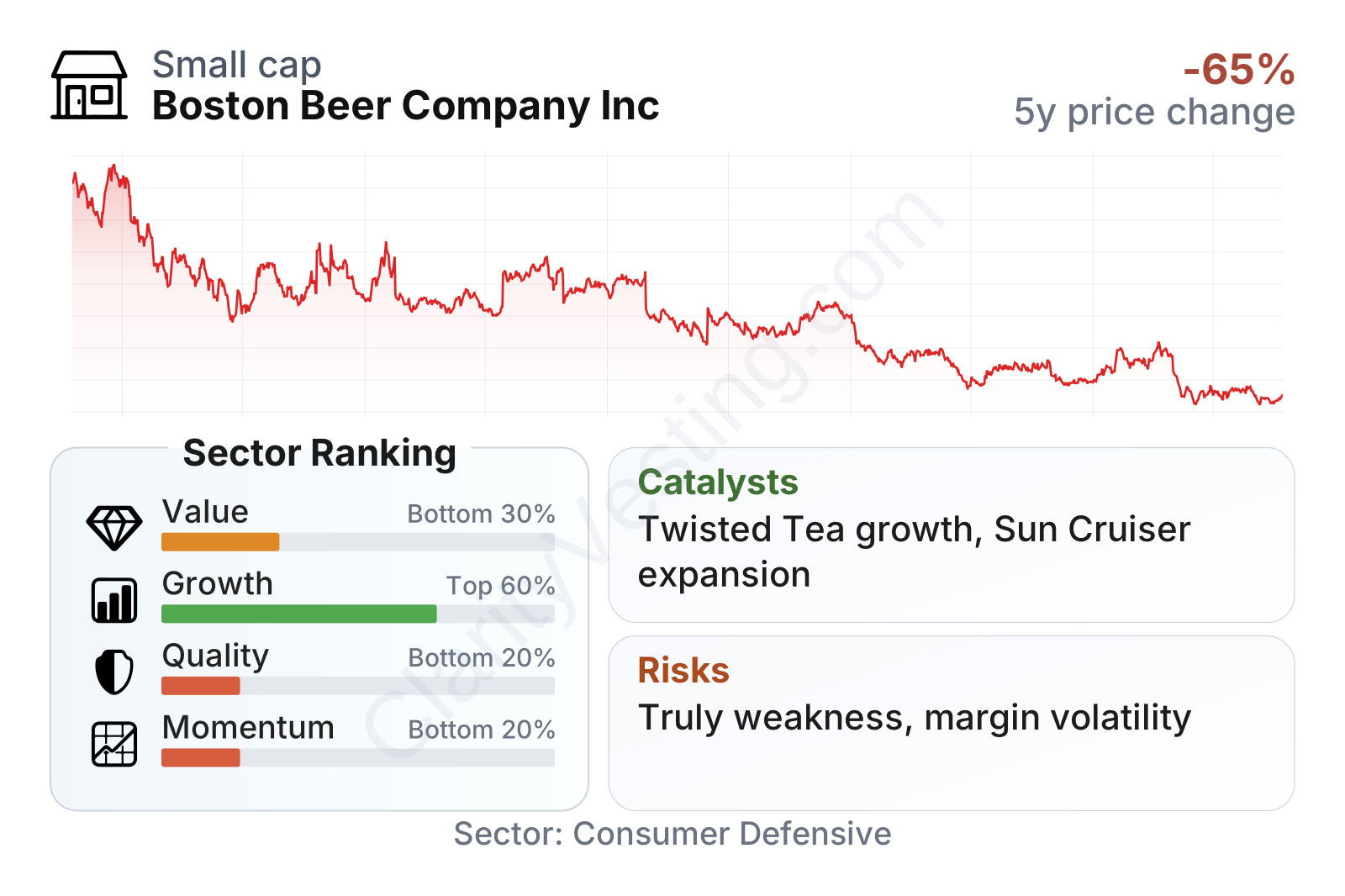
Boston Beer is a mid-sized consumer defensive company with a market value around the low single-digit billions and a stock that has been far less volatile than many consumer names, as reflected in a beta below 1. Even so, the share price history has been rough: the stock is far below its 2021 levels, which signals that the market has sharply reduced expectations after earlier enthusiasm around hard seltzer.
The overall factor picture is mixed. Growth characteristics sit around the middle of the sector, while value, quality, and momentum rank weaker. That combination usually means the market sees some recovery potential but remains unconvinced about consistency. Boston Beer stands out positively on balance sheet strength and cash generation, but recent profitability measures have been weak enough to drag down the quality score.
The table also highlights an important contrast. Free cash flow remains solid and roughly in line with sector norms on yield, yet recent returns on capital and margins trail the broader beverage group by a wide margin. In plain terms, the company still produces cash, but its recent earnings efficiency has not matched that cash performance.
Growth
Boston Beer operates in a beverage segment that is mature in aggregate but still capable of producing pockets of growth through innovation. The larger U.S. beer market is not a high-growth arena, yet flavored malt beverages, ready-to-drink alcohol, and premium alternative products continue to create openings for brands that connect with changing consumer tastes. That is the part of the sector where Boston Beer is trying to win.
Its strategy makes sense on paper. The company already has national distribution, established retailer relationships, and a portfolio that reaches beyond one category. Twisted Tea has been a major bright spot, and management has also been expanding newer products such as Sun Cruiser to capture demand in ready-to-drink occasions. This is important because Boston Beer needs fresh growth vehicles rather than relying on a full return of the hard seltzer boom.
Revenue growth has been uneven rather than steadily upward. Some quarters have shown strong rebounds, but the pattern remains lumpy, which suggests the business is still exposed to changing category trends, shipment timing, and brand mix. The latest year-over-year readings point more to stabilization than to a clean breakout into sustained high growth.
Cash generation is a more encouraging part of the picture. Free cash flow turned sharply positive after earlier weakness and has remained healthy in recent periods, hovering around the high hundreds of millions of dollars on a trailing basis. That gives Boston Beer room to fund marketing, innovation, brewery operations, and capacity decisions without depending heavily on outside financing.
A practical catalyst for future growth is product mix. If Twisted Tea continues gaining share and newer launches such as Sun Cruiser scale successfully, Boston Beer could improve both revenue quality and margin structure. Another potential support is operational efficiency: when a branded beverage company can keep costs under control while shifting sales toward stronger products, earnings can recover faster than revenue. Recent company updates have also pointed to ongoing focus on innovation, brand support, and supply chain discipline, all of which are sensible for a company in a trend-driven market.
Risks
This article is for informational purposes only and does not constitute financial advice. Some content is AI-generated. See Disclaimer


