Stock Analysis · Saia Inc (SAIA)
Overview
Saia Inc. is a U.S. freight transportation company focused mainly on less-than-truckload, usually called LTL. In simple terms, LTL means Saia combines shipments from many customers into the same trailer instead of dedicating one full truck to a single load. This service is widely used by manufacturers, distributors, retailers, and other businesses that need regular freight movement but do not fill an entire trailer on their own.
The company operates a large network of terminals across the United States and handles pickup, linehaul transportation between terminals, and final delivery. Its business model depends on network density, reliable service, pricing discipline, and efficient use of equipment and labor. In recent years, Saia has also expanded its terminal footprint and headcount to capture freight from shippers looking for alternatives among national carriers.
Saia reports its operations in one segment, but its revenue sources can still be described by service type. Based on company filings, the business is overwhelmingly tied to LTL transportation, with a smaller contribution from accessorial and related services.
- LTL freight transportation: approximately 90% to 95% of revenue. This is the core service and includes moving palletized freight through Saia’s terminal network.
- Accessorial and other freight-related services: approximately 5% to 10% of revenue. This generally includes items such as fuel surcharges, special handling, and other shipment-related charges tied to the core freight move.
Over the last several years, revenue has climbed meaningfully, but the mix of costs has also become more demanding as Saia has invested heavily in network expansion. That helps explain why sales have continued to rise while profit conversion has become less favorable than at its recent peak.
The business has grown from roughly $2.3 billion in revenue in 2021 to more than $3.2 billion by 2025, showing solid scale gains. However, net income did not follow the same upward path in 2025, reflecting pressure from operating costs, expansion spending, and a softer freight backdrop.
Key Figures
| Metric | Value | Sector ⓘ |
|---|---|---|
| Date | Oct 24, 2026 | |
| Context | ||
| Sector | Industrials | |
| Industry | Trucking | |
| Market Cap ⓘ | $8.88B | |
| Beta ⓘ | 2.19 | |
Value (Cheapness) | ||
| P/E Ratio ⓘ | 32.21 | 22.29 |
| P/B Ratio ⓘ | 3.33 | 1.98 |
| FCF Yield ⓘ | 2.88% | 6.26% |
| Dividend Yield ⓘ | N/A | 1.92% |
| EBIT / EV ⓘ | 4.59% | 4.83% |
| PEG ⓘ | 2.46 | |
Growth (Business expansion) | ||
| Revenue Growth ⓘ | 17.10% | 9.30% |
| RPS Growth (5Y CAGR) ⓘ | 8.95% | 7.76% |
| EPS Growth (5Y CAGR) ⓘ | -21.65% | -13.17% |
| BVPS Growth (5Y CAGR) ⓘ | 20.47% | 6.13% |
| Margin Growth (5Y Trend) ⓘ | -3.74% | 0.74% |
| FCF Growth (5Y CAGR) ⓘ | -27.11% | 10.79% |
| DPS Growth (5Y CAGR) ⓘ | 32.80% | 9.41% |
Quality (Business durability) | ||
| ROIC (Latest) ⓘ | 10.39% | 10.75% |
| ROA (Latest) ⓘ | 7.69% | 5.41% |
| ROIC (5Y Median) ⓘ | 20.09% | 9.37% |
| ROA (5Y Median) ⓘ | 14.92% | 4.95% |
| Net Debt / EBIT (Latest) ⓘ | 0.49 | 2.04 |
| Net Debt / EBIT (5Y Median) ⓘ | 0.16 | 2.27 |
| Net Debt / EBITDA (Latest) ⓘ | 0.29 | 1.39 |
| Net Debt / Assets ⓘ | 4.97% | 19.27% |
| EBITDA / Interest ⓘ | 52.51 | 9.58 |
| Operating Margin (Latest) ⓘ | 11.17% | 10.49% |
| Operating Margin (5Y Median) ⓘ | 15.11% | 10.30% |
| Debt to Equity (Latest) ⓘ | 9.87% | 64.82% |
| Profit Margin (Latest) ⓘ | 8.19% | 6.67% |
| Free Cash Flow (Latest) ⓘ | $255.23M | |
Momentum (Price trend) | ||
| 3Y Return ⓘ | -11.55% | +67.77% |
| 12M Return (excl. last month) ⓘ | +12.26% | +12.05% |
| 6M Return ⓘ | -23.31% | 0.00% |
| Price vs. 200-Day MA ⓘ | -12.91% | +0.67% |
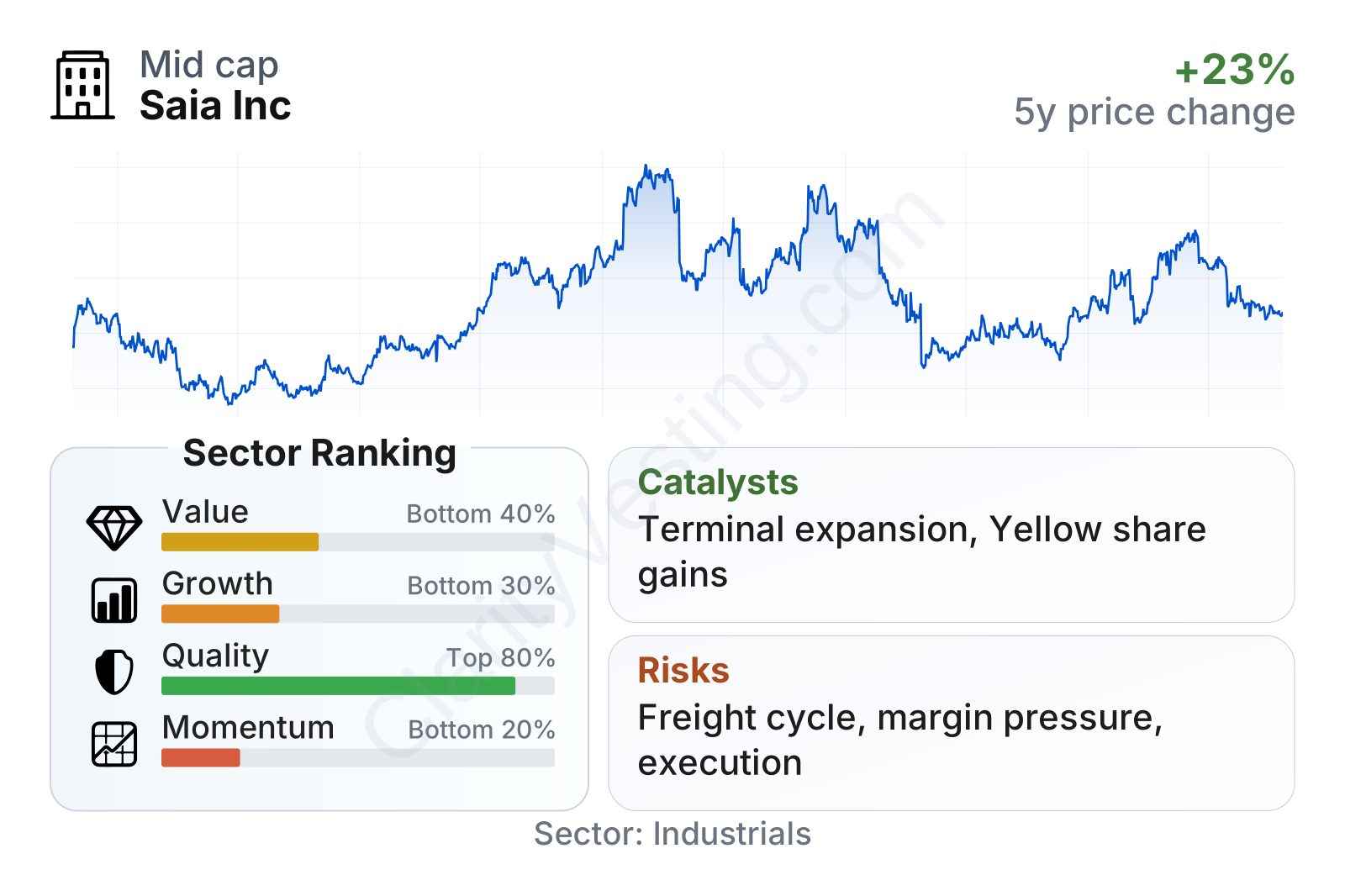
Saia sits in the mid-to-large range within trucking, with a market value around the high single-digit billions of dollars. The table points to a business with strong balance-sheet quality and above-average profitability versus much of the sector, but also a stock that still trades at a premium on earnings and book value. Growth is mixed: recent revenue growth has improved, yet earnings and free cash flow trends over longer periods have been less impressive because the company is spending heavily to build out capacity. Share price behavior has also been more volatile than average, which matches the company’s high beta.
Growth
Saia operates in a freight market that tends to grow over time with industrial production, retail replenishment, e-commerce support, and supply chain activity. Within trucking, the LTL niche has structural advantages over more commoditized full-truckload services because network quality, service levels, and terminal coverage matter a great deal. That usually creates a more disciplined pricing environment for established operators.
Saia’s strategy for future growth is clear: expand its national footprint, open and enlarge terminals, add equipment, and build enough density to serve more freight lanes efficiently. This approach makes strategic sense in LTL because scale and route density can improve service and margins over time. The company has been one of the most active carriers in expanding physical capacity, which positions it to win business as shippers diversify carrier relationships.
Recent revenue growth shows that the business has been able to reaccelerate after a softer patch. The latest year-over-year pace is well above the sector median, which suggests Saia is still taking share or benefiting from newly added capacity coming into use. That said, the pattern has not been smooth. Freight demand remains cyclical, so quarter-to-quarter swings should be expected.
Free cash flow has been much more uneven than revenue because terminal expansion and fleet investment require large upfront spending. The recent return to positive free cash flow is encouraging, especially after periods of negative cash generation, but this is still a company in an investment-heavy phase rather than a steady cash-harvesting phase.
A major catalyst has been industry disruption following the shutdown of Yellow in 2023. That event released freight into the market and created a rare opening for stronger LTL carriers to win customers, improve network density, and strengthen pricing. Saia has been one of the carriers investing aggressively to absorb that opportunity. In addition, continued terminal openings and service-center expansion remain important company-specific growth drivers because they can support higher shipment counts and broader geographic coverage over time.
Risks
This article is for informational purposes only and does not constitute financial advice. Some content is AI-generated. See Disclaimer


