Stock Analysis · Safety Insurance Group Inc (SAFT)
Overview
Safety Insurance Group is a regional property and casualty insurer focused mainly on personal automobile insurance in Massachusetts. The company also writes homeowners, dwelling fire, umbrella, and a smaller amount of commercial policies. In simple terms, it collects premiums from policyholders, invests part of the float generated by those premiums, and aims to earn an underwriting profit over time by pricing risk better than the claims and expenses it ultimately pays.
Its business is concentrated geographically. Massachusetts remains the core market, with additional activity in New Hampshire and Maine. That regional focus makes the company easier to understand than a national insurer, but it also means performance is closely tied to weather patterns, driving trends, repair costs, and regulation in a limited number of states.
Based on recent company filings, the main sources of revenue are approximately:
- Net earned premiums: about 85% to 90% — the largest source by far, coming mainly from private passenger automobile insurance, plus homeowners and other personal lines.
- Net investment income: about 7% to 10% — income from the bond portfolio, cash, and other invested assets that support insurance reserves and capital.
- Realized investment gains and other income: usually below 5% — a smaller and more variable contribution that can move meaningfully from year to year.
Within premiums, personal auto is the dominant line, while homeowners is the second-largest contributor. Commercial auto, business owner policies, public auto, and other specialty coverages add diversification but remain much smaller than the personal insurance franchise.
The recent financial flow shows a business that recovered after a difficult 2023. Revenue has climbed steadily over the last several years, while profitability rebounded in 2024 and 2025 as underwriting results improved from the prior trough.
Key Figures
| Metric | Value | Sector ⓘ |
|---|---|---|
| Date | Oct 17, 2026 | |
| Context | ||
| Sector | Financial Services | |
| Industry | Insurance - Property & Casualty | |
| Market Cap ⓘ | $1.53B | |
| Beta ⓘ | 0.17 | |
Value (Cheapness) | ||
| P/E Ratio ⓘ | 22.30 | 12.26 |
| P/B Ratio ⓘ | 1.73 | 1.23 |
| FCF Yield ⓘ | 11.52% | 10.40% |
| Dividend Yield ⓘ | 3.54% | 3.02% |
| EBIT / EV ⓘ | 5.94% | 8.14% |
| PEG ⓘ | 0.95 | |
Growth (Business expansion) | ||
| Revenue Growth ⓘ | 3.00% | 9.35% |
| RPS Growth (5Y CAGR) ⓘ | 10.07% | 12.19% |
| EPS Growth (5Y CAGR) ⓘ | -34.22% | -9.53% |
| BVPS Growth (5Y CAGR) ⓘ | -0.65% | 4.99% |
| Margin Growth (5Y Trend) ⓘ | -8.83% | -3.86% |
| FCF Growth (5Y CAGR) ⓘ | 9.58% | 4.81% |
| DPS Growth (5Y CAGR) ⓘ | 0.24% | 8.79% |
Quality (Business durability) | ||
| ROIC (Latest) ⓘ | 7.66% | 9.49% |
| ROE (Latest) ⓘ | 7.73% | 13.90% |
| ROA (Latest) ⓘ | 2.77% | 1.55% |
| ROIC (5Y Median) ⓘ | 8.40% | 7.86% |
| ROE (5Y Median) ⓘ | 8.66% | 12.17% |
| ROA (5Y Median) ⓘ | 3.34% | 1.30% |
| Net Debt / EBIT (Latest) ⓘ | -0.09 | 0.96 |
| Net Debt / EBIT (5Y Median) ⓘ | -0.04 | 0.73 |
| Net Debt / EBITDA (Latest) ⓘ | -0.08 | 0.92 |
| Operating Margin (Latest) ⓘ | 6.10% | 22.30% |
| Operating Margin (5Y Median) ⓘ | 8.14% | 24.63% |
| Debt to Equity (Latest) ⓘ | 6.82% | 58.56% |
| Profit Margin (Latest) ⓘ | 5.33% | 26.57% |
| Free Cash Flow (Latest) ⓘ | $175.72M | |
Momentum (Price trend) | ||
| 3Y Return ⓘ | +64.72% | +88.33% |
| 12M Return (excl. last month) ⓘ | +48.60% | +19.38% |
| 6M Return ⓘ | +41.90% | +4.75% |
| Price vs. 200-Day MA ⓘ | +27.05% | +3.50% |
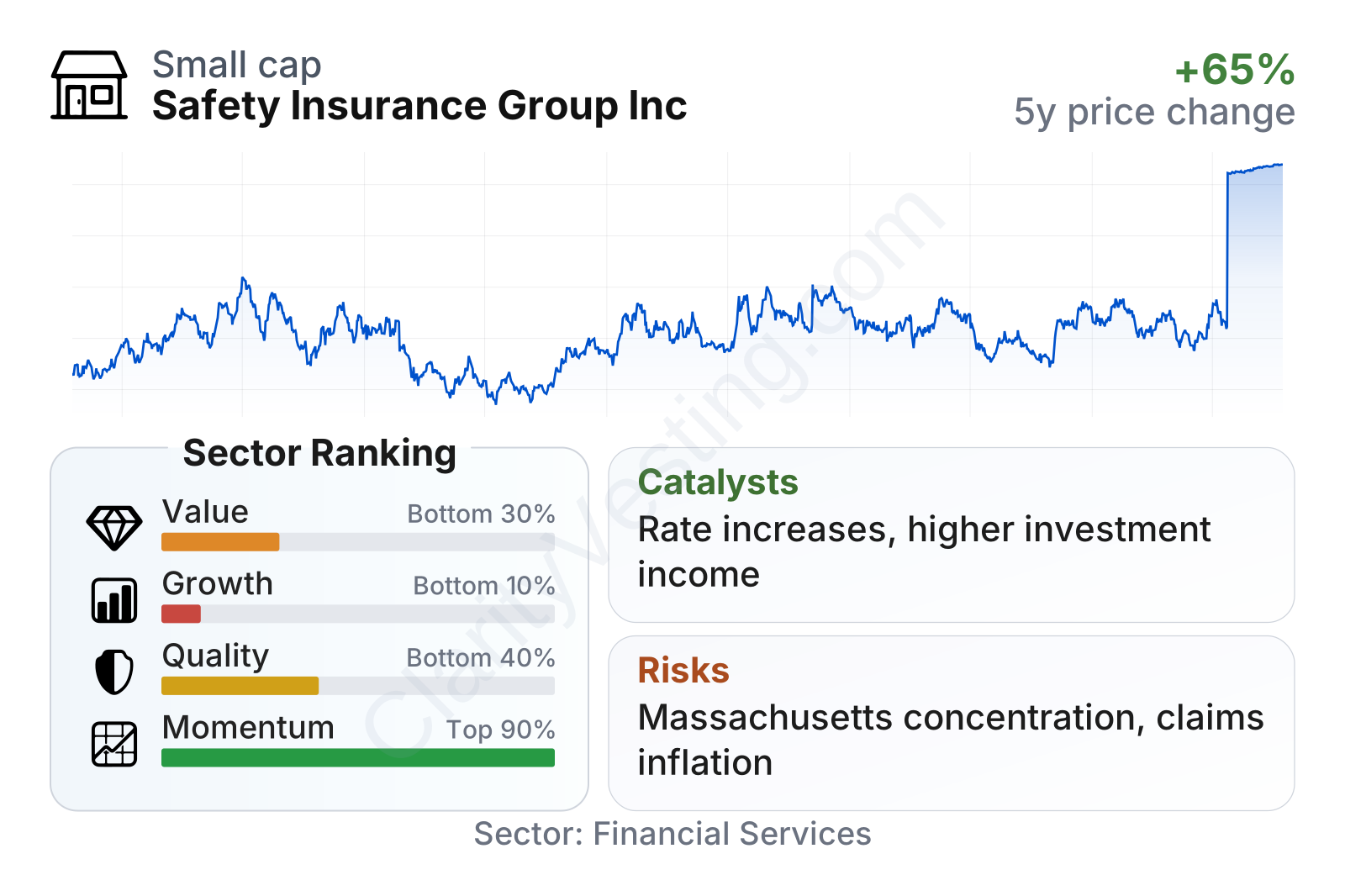
Safety Insurance is a small-cap insurer with unusually low share-price volatility, reflected in a beta far below the broader market. The factor profile is mixed. Momentum is strong, helped by the stock’s solid move over the last 6 to 12 months, but growth ranks weakly versus the sector. Value metrics also look less favorable than many peers because the shares trade at a premium on both earnings and book value. Quality is more balanced: leverage is conservative and free cash flow is solid, but profitability margins and return on equity remain below many insurance peers.
Growth
Property and casualty insurance is not a high-growth industry, but it is a necessary one. Demand for auto and homeowners coverage tends to be durable because these products are required by lenders, regulators, or basic household risk management. That makes the sector resilient, even if growth usually comes from better pricing, selective expansion, and disciplined underwriting rather than rapid volume increases.
Safety Insurance’s strategy is sensible for that kind of market. The company has stayed focused on territories and products it knows well instead of chasing national scale. For a regional insurer, that can be a strength: local pricing knowledge, established agency relationships, and cautious underwriting often matter more than headline growth. The trade-off is that expansion opportunities are narrower than for larger national carriers.
A major growth lever has been rate increases. Across personal auto and homeowners insurance, insurers have been pushing for higher premiums to offset inflation in vehicle repairs, medical severity, construction costs, and catastrophe losses. If pricing continues to catch up with claims inflation, underwriting margins can improve even without very strong policy-count growth. Higher bond yields also support investment income, which is especially relevant for insurers with large fixed-income portfolios.
Earnings per share illustrate how cyclical this business can be. Profit fell sharply in 2022 and especially 2023 as claims pressure weighed on results, then recovered materially in 2024 and 2025. That pattern suggests the company has operating leverage to better pricing conditions, but it also shows that profit can swing widely when loss costs move faster than premiums.
Book value per share also matters because it reflects the capital base supporting the insurer. After declining in 2022 and 2023, it turned upward again in 2024 and 2025. That recovery is encouraging because insurers that rebuild book value after a difficult claims cycle usually have more flexibility for dividends, growth, and absorbing future shocks.
One recent opportunity is the broader normalization of insurance pricing. The industry has been working through a period of inadequate rates relative to inflationary claims trends. For companies that maintained capital discipline and distribution strength, that environment can create improved profitability once approved rate changes earn through the book. Safety Insurance appears positioned to benefit from that dynamic, though its regional footprint limits how much it can diversify growth across markets.
Risks
This article is for informational purposes only and does not constitute financial advice. Some content is AI-generated. See Disclaimer


