Stock Analysis · Safran SA (SAFRF)
Overview
Safran is a French aerospace and defense group best known for aircraft engines, cabin equipment, landing systems, avionics, and military electronics. For long-term shareholders, the company stands out because it is deeply tied to global air traffic, airline fleet renewal, and defense spending. Its business is not limited to selling equipment once: a large portion of its economics comes from servicing products over many years, especially engines already in operation.
The company is organized around three main activities. Based on recent annual reporting, revenue is roughly distributed as follows:
- Propulsion: about 52% of revenue. This includes aircraft engines for commercial jets and helicopters, spare parts, and maintenance services. The largest program is the CFM family of engines, produced through Safran’s long-standing joint venture with GE Aerospace.
- Equipment & Defense: about 30% of revenue. This covers landing gear, wheels and brakes, nacelles, avionics, electrical systems, flight controls, optronics, navigation, and a range of defense electronics.
- Aircraft Interiors: about 18% of revenue. This includes cabin interiors, seats, galleys, lavatories, and related onboard equipment.
This mix matters because propulsion tends to provide the strongest long-term aftermarket opportunity, while equipment and defense add diversification across civil aviation, military programs, and recurring support contracts. Over the last several years, Safran’s revenue base has expanded meaningfully, but profitability has also been affected at times by accounting items, integration costs, and the normal volatility of large aerospace programs.
The business flow shows a company that has materially increased revenue since 2021, with research and development spending also rising as Safran invests for future programs. Earnings have been less smooth than sales, which is common in aerospace, where margins can move with production rates, contract mix, currency effects, and one-off items.
Key Figures
| Metric | Value | Sector ⓘ |
|---|---|---|
| Date | Oct 10, 2026 | |
| Context | ||
| Sector | Industrials | |
| Industry | Aerospace & Defense | |
| Market Cap ⓘ | $154.07B | |
| Beta ⓘ | 0.97 | |
Value (Cheapness) | ||
| P/E Ratio ⓘ | 33.93 | 22.32 |
| P/B Ratio ⓘ | 10.65 | 1.98 |
| FCF Yield ⓘ | 5.04% | 6.34% |
| Dividend Yield ⓘ | 0.89% | 1.95% |
| EBIT / EV ⓘ | N/A | 4.71% |
| PEG ⓘ | 1.84 | |
Growth (Business expansion) | ||
| Revenue Growth ⓘ | 16.00% | 9.25% |
| RPS Growth (5Y CAGR) ⓘ | 21.38% | 7.75% |
| EPS Growth (5Y CAGR) ⓘ | 20.95% | -13.37% |
| BVPS Growth (5Y CAGR) ⓘ | 3.90% | 6.12% |
| Margin Growth (5Y Trend) ⓘ | 12.18% | 0.81% |
| FCF Growth (5Y CAGR) ⓘ | 27.80% | 11.01% |
| DPS Growth (5Y CAGR) ⓘ | 62.63% | 9.48% |
Quality (Business durability) | ||
| ROIC (Latest) ⓘ | 14.07% | 10.70% |
| ROA (Latest) ⓘ | 13.52% | 5.38% |
| ROIC (5Y Median) ⓘ | 4.35% | 9.26% |
| ROA (5Y Median) ⓘ | 0.11% | 4.94% |
| Net Debt / EBIT (Latest) ⓘ | -0.36 | 2.08 |
| Net Debt / EBIT (5Y Median) ⓘ | 0.11 | 2.29 |
| Net Debt / EBITDA (Latest) ⓘ | -0.21 | 1.43 |
| Net Debt / Assets ⓘ | -2.11% | 19.34% |
| EBITDA / Interest ⓘ | 28.81 | 9.54 |
| Operating Margin (Latest) ⓘ | 6.12% | 10.34% |
| Operating Margin (5Y Median) ⓘ | 12.35% | 10.29% |
| Debt to Equity (Latest) ⓘ | 35.19% | 65.52% |
| Profit Margin (Latest) ⓘ | 11.56% | 6.63% |
| Free Cash Flow (Latest) ⓘ | $7.76B | |
Momentum (Price trend) | ||
| 3Y Return ⓘ | +139.91% | +61.33% |
| 12M Return (excl. last month) ⓘ | +18.73% | +14.82% |
| 6M Return ⓘ | +8.13% | +3.53% |
| Price vs. 200-Day MA ⓘ | -2.59% | +0.88% |
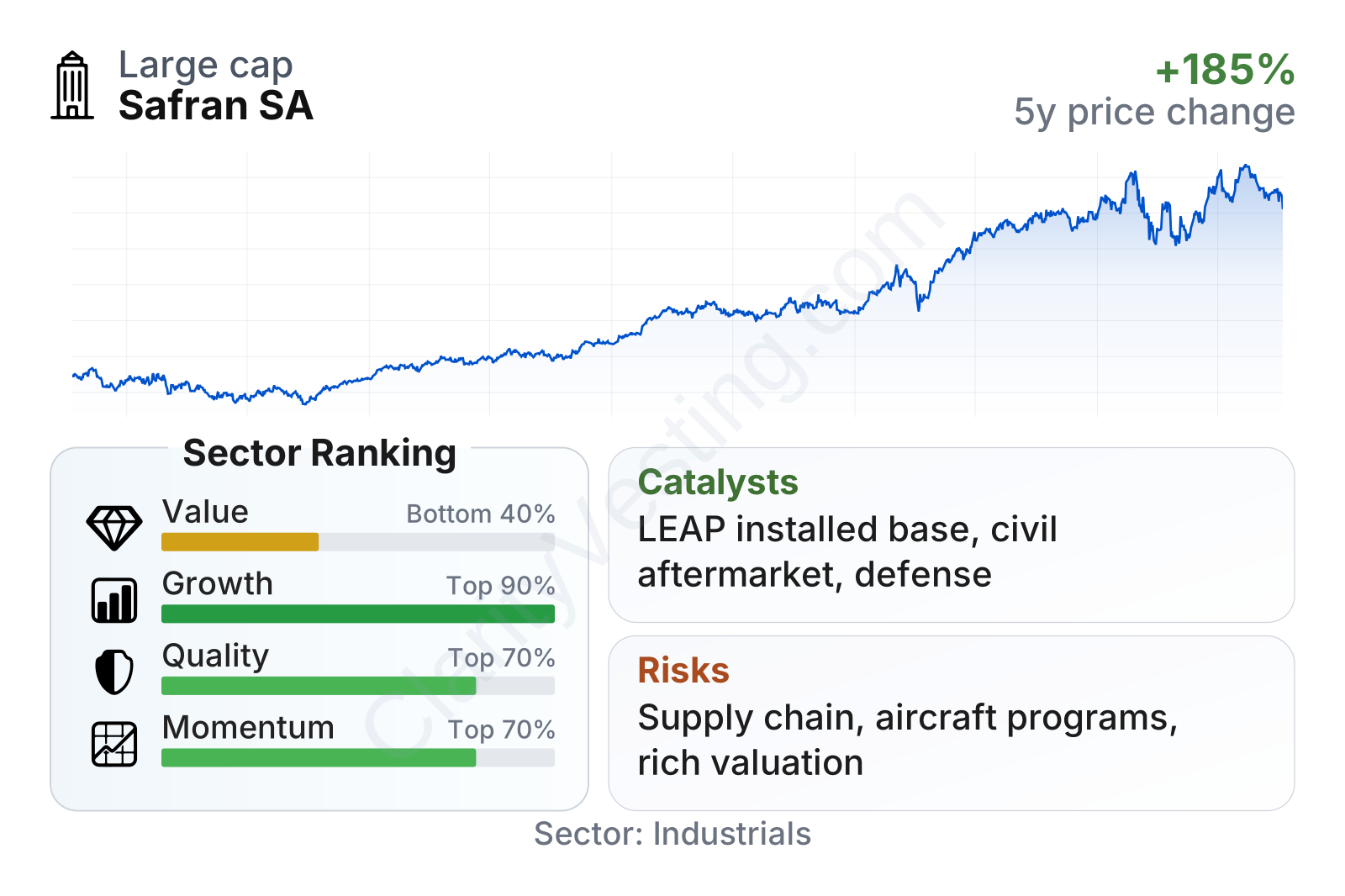
Safran is now a very large aerospace group with a share price trend that has been strongly positive over the last three years. On growth, it ranks near the top of its sector: revenue, earnings, and free cash flow expansion have all outpaced many industrial peers. Quality is also solid overall, especially on current returns on capital, profitability, and balance sheet strength.
The weaker point is valuation. The shares trade on a noticeably higher earnings multiple than the sector median, while the free cash flow yield and dividend yield are lower than many peers. In simple terms, the market is paying up for Safran’s growth profile, engine aftermarket exposure, and financial resilience.
Growth
Safran operates in a sector with durable long-term support. Commercial aerospace is benefiting from rising passenger traffic, large aircraft order backlogs, aging fleets that need replacement, and years of under-delivery from manufacturers and suppliers after the pandemic. Even when aircraft deliveries are delayed, installed engines still need maintenance, which supports service revenue.
A central part of Safran’s growth case is the LEAP engine program, produced by CFM International, the joint venture between Safran Aircraft Engines and GE Aerospace. LEAP powers major narrowbody aircraft families, including the Airbus A320neo and Boeing 737 MAX. These aircraft sit in the most important segment of commercial aviation by volume, and each delivered engine creates a long tail of maintenance, repair, and overhaul work. That installed base effect can support revenue for decades.
Safran also has a sensible second layer of growth drivers. Defense budgets in Europe have moved higher, supporting demand for optronics, navigation, and military systems. In civil aerospace, the company is exposed to upgrades in aircraft equipment, braking systems, electrical architectures, and cabin products. On top of that, Safran is investing in future propulsion technologies, including more efficient engines and work related to lower-emission aviation.
Recent growth remains strong by sector standards. Year-over-year revenue expansion has stayed comfortably above the industry median, and the longer five-year picture is even more impressive, with revenue per share, earnings per share, and free cash flow all compounding at rates well ahead of most peers. That combination suggests Safran is not just riding a cyclical rebound; it has also been converting industry recovery into stronger operating performance.
Recent company communications have continued to point to robust civil aftermarket demand, rising LEAP deliveries over time despite supply-chain constraints, and broad exposure to aircraft utilization. These are important because the most profitable part of many aerospace businesses is often the installed base rather than the original equipment sale.
Risks
This article is for informational purposes only and does not constitute financial advice. Some content is AI-generated. See Disclaimer


