Stock Analysis · Safilo Group S.p.A (SAFLF)
Overview
Safilo Group S.p.A. is an Italian eyewear company that designs, manufactures, markets, and distributes prescription frames, sunglasses, sports eyewear, goggles, and related products. Its business is built around a mix of owned brands and licensed brands, sold through opticians, chains, department stores, sporting goods retailers, e-commerce, and direct-to-consumer channels. While some market databases classify the company under healthcare-related equipment because prescription eyewear is tied to vision correction, Safilo operates much more like a branded consumer eyewear group.
The company’s revenue base is diversified by channel, geography, and brand portfolio, but the most useful way to understand Safilo is by product category and business model. Public company materials indicate that prescription frames remain the core activity, with sunglasses as the second-largest product line. Safilo also has a growing presence in sports and performance eyewear through brands such as Blenders and Smith, alongside direct online sales.
Based on company disclosures and brand mix, Safilo’s main revenue sources can be summarized as follows:
- Prescription frames: approximately 50% to 60% of revenue. This includes optical frames sold through eye care professionals and retail optical networks.
- Sunglasses: approximately 30% to 40% of revenue. This covers fashion and lifestyle sunglasses across licensed and proprietary brands.
- Sports eyewear, goggles, helmets, and direct-to-consumer accessories: approximately 10% to 20% of revenue. This includes performance-focused products, especially through outdoor and digital-native brands.
Another important split is between owned brands and licensed brands. Safilo has spent the past few years reducing dependence on external fashion licenses after losing some major contracts in earlier periods. That shift matters because owned brands usually offer more control, potentially better durability, and less contract-renewal risk, even if they may take time to scale.
Geographically, Europe and North America are the largest markets, with additional exposure to Asia-Pacific and Latin America. This gives Safilo a broad footprint, but also exposes it to changing consumer demand, currency movements, and retailer inventory cycles.
The profit flow over the last five years shows a business that has largely stabilized after a difficult 2023. Revenue has stayed close to the €1 billion range, while gross profit has remained relatively resilient. The more important change is lower operating costs and a recovery in operating income and net income through 2024 and 2025, suggesting that restructuring efforts and portfolio repositioning have had a visible effect.
Key Figures
| Metric | Value | Sector ⓘ |
|---|---|---|
| Date | Oct 17, 2026 | |
| Context | ||
| Sector | Healthcare | |
| Industry | Medical Instruments & Supplies | |
| Market Cap ⓘ | $1.00B | |
| Beta ⓘ | 0.95 | |
Value (Cheapness) | ||
| P/E Ratio ⓘ | 18.43 | 24.79 |
| P/B Ratio ⓘ | 2.32 | 3.08 |
| FCF Yield ⓘ | 17.54% | 3.15% |
| Dividend Yield ⓘ | N/A | 1.94% |
| EBIT / EV ⓘ | N/A | 0.57% |
| PEG ⓘ | N/A | |
Growth (Business expansion) | ||
| Revenue Growth ⓘ | -4.80% | 7.45% |
| RPS Growth (5Y CAGR) ⓘ | -7.77% | 8.61% |
| EPS Growth (5Y CAGR) ⓘ | N/A | -17.81% |
| BVPS Growth (5Y CAGR) ⓘ | -4.45% | 3.72% |
| Margin Growth (5Y Trend) ⓘ | 4.13% | -0.62% |
| FCF Growth (5Y CAGR) ⓘ | N/A | 1.04% |
| DPS Growth (5Y CAGR) ⓘ | -34.68% | 6.77% |
Quality (Business durability) | ||
| ROIC (Latest) ⓘ | N/A | 3.24% |
| ROA (Latest) ⓘ | 14.15% | 3.01% |
| ROIC (5Y Median) ⓘ | 6.71% | 4.60% |
| ROA (5Y Median) ⓘ | 2.63% | 1.89% |
| Net Debt / EBIT (Latest) ⓘ | 0.03 | 1.34 |
| Net Debt / EBIT (5Y Median) ⓘ | 2.15 | 1.84 |
| Net Debt / EBITDA (Latest) ⓘ | 0.02 | 1.00 |
| Net Debt / Assets ⓘ | 0.66% | 5.45% |
| EBITDA / Interest ⓘ | N/A | 9.64 |
| Operating Margin (Latest) ⓘ | 9.49% | 9.27% |
| Operating Margin (5Y Median) ⓘ | 4.22% | 7.38% |
| Debt to Equity (Latest) ⓘ | 16.62% | 28.58% |
| Profit Margin (Latest) ⓘ | 5.36% | 3.59% |
| Free Cash Flow (Latest) ⓘ | $175.45M | |
Momentum (Price trend) | ||
| 3Y Return ⓘ | +214.86% | +42.80% |
| 12M Return (excl. last month) ⓘ | +61.25% | +18.50% |
| 6M Return ⓘ | +11.69% | +7.57% |
| Price vs. 200-Day MA ⓘ | +17.61% | +5.12% |
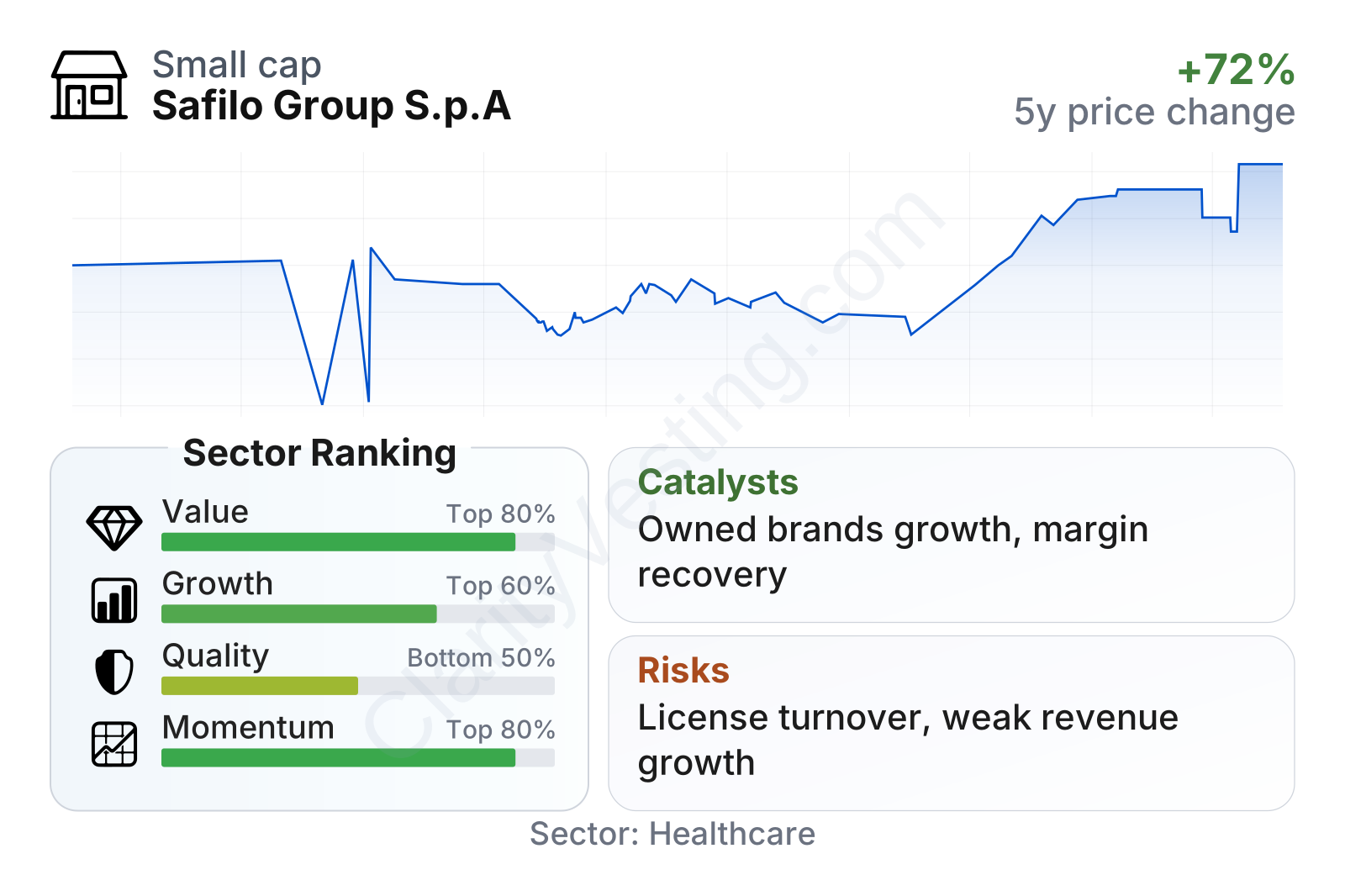
Safilo currently looks like a small-cap company with an equity value around $1 billion and a share-price profile that has been strong over the last three years. The stock’s recent momentum has clearly outpaced much of its sector, and it remains well above its long-term trend line. That price strength likely reflects improving profitability, cleaner finances, and growing confidence that the business is moving past an earlier reset period.
On valuation, the company screens cheaper than the sector median on earnings and book value, while free cash flow generation stands out as unusually strong. The free cash flow yield is far above the sector median, which points to a business that is converting a meaningful share of its market value into cash. That said, growth indicators are mixed. Recent revenue has been slightly lower year over year, and longer-term sales per share have declined over five years, even though margin trends have improved.
Balance-sheet risk appears limited. Net debt compared with EBIT and EBITDA is extremely low, debt-to-equity is moderate, and profitability margins are currently above sector medians. The overall picture is of a company whose recent quality has improved materially, even if top-line expansion still looks less convincing than the cash generation profile.
Growth
Safilo operates in a market with durable long-term support. Eyewear benefits from several structural trends: aging populations, rising demand for vision correction, increasing screen exposure, premiumization in branded accessories, and continued consumer interest in sunglasses and sports eyewear. These are favorable foundations because demand is not purely fashion-driven; part of the category is tied to recurring vision needs.
The company’s current strategy is also more coherent than it was several years ago. Management has been emphasizing owned brands, premium positioning, supply-chain discipline, digital channels, and selective expansion in performance eyewear. That approach makes strategic sense. Relying less on large fashion licenses can reduce the risk of sudden contract losses, while strengthening owned labels can improve long-term control over pricing, product development, and customer relationships.
One of the clearest operating catalysts is the improvement in profitability despite flat-to-soft revenue. Safilo’s operating income rebounded strongly in 2025 after weakness in 2023, indicating that the business is becoming more efficient. If the company can combine that leaner cost base with even modest organic sales growth, earnings can expand faster than revenue.
Another potential growth driver is brand portfolio execution. Safilo has continued investing in brands with stronger identity in eyewear and outdoor use cases, where customer loyalty can be more durable than in purely trend-led fashion categories. The direct-to-consumer side also offers a path to better margins and more customer data, although it remains a competitive channel.
Recent company communications have also highlighted licensing developments and portfolio management as important levers. For a business like Safilo, a meaningful new license, a renewal on attractive terms, or stronger traction in owned brands can move revenue expectations noticeably because brand visibility plays a central role in retailer demand and consumer recognition.
Risks
This article is for informational purposes only and does not constitute financial advice. Some content is AI-generated. See Disclaimer


