Stock Analysis · Rhythm Pharmaceuticals Inc (RYTM)
Overview
Rhythm Pharmaceuticals is a biotechnology company focused on rare diseases linked to the melanocortin-4 receptor pathway, a biological system involved in hunger and energy balance. Its lead product is IMCIVREE (setmelanotide), a prescription therapy for specific rare genetic forms of obesity. In simple terms, the company is trying to treat patients whose severe, chronic hunger is driven by identifiable genetic defects rather than by common lifestyle-related obesity.
This is a highly specialized business. Rhythm is not a broad pharmaceutical company with dozens of products across many fields. Its current commercial model is centered on one approved medicine, while future growth depends on expanding into additional rare-disease patient groups and geographies.
The company’s revenue is currently concentrated in product sales, with only limited contribution from other sources. Based on recent annual results, the revenue mix is approximately:
- IMCIVREE product revenue: about 99%+ of total revenue. This includes sales in approved rare genetic obesity indications across markets where the drug is commercialized.
- Other revenue: less than 1%. This may include small amounts such as collaboration-related or miscellaneous revenue, but it is not a meaningful driver of the business at this stage.
That concentration matters. It makes the business easier to understand, but it also means company performance is tightly tied to one product, one disease area, and the pace of diagnosis and reimbursement for very rare conditions.
The financial profile shows a company moving from a pre-commercial phase into a revenue-generating one. Sales have climbed sharply over the last several years, gross profit has expanded with them, and losses remain large because Rhythm is still spending heavily on research, clinical development, and commercial infrastructure.
Key Figures
| Metric | Value | Sector ⓘ |
|---|---|---|
| Date | Oct 24, 2026 | |
| Context | ||
| Sector | Healthcare | |
| Industry | Biotechnology | |
| Market Cap ⓘ | $6.21B | |
| Beta ⓘ | 2.01 | |
Value (Cheapness) | ||
| P/E Ratio ⓘ | N/A | 25.42 |
| P/B Ratio ⓘ | 28.69 | 3.08 |
| FCF Yield ⓘ | -2.42% | 3.12% |
| Dividend Yield ⓘ | N/A | 1.85% |
| EBIT / EV ⓘ | -2.84% | 0.56% |
| PEG ⓘ | N/A | |
Growth (Business expansion) | ||
| Revenue Growth ⓘ | 46.90% | 7.50% |
| RPS Growth (5Y CAGR) ⓘ | 160.32% | 8.60% |
| EPS Growth (5Y CAGR) ⓘ | -19.27% | -17.73% |
| BVPS Growth (5Y CAGR) ⓘ | -7.71% | 3.72% |
| Margin Growth (5Y Trend) ⓘ | N/A | -0.57% |
| FCF Growth (5Y CAGR) ⓘ | -6.32% | 0.96% |
| DPS Growth (5Y CAGR) ⓘ | N/A | 6.69% |
Quality (Business durability) | ||
| ROIC (Latest) ⓘ | -112.83% | 3.17% |
| ROA (Latest) ⓘ | -43.50% | 2.98% |
| ROIC (5Y Median) ⓘ | -61.18% | 4.56% |
| ROA (5Y Median) ⓘ | -50.88% | 1.87% |
| Net Debt / EBIT (Latest) ⓘ | N/A | 1.34 |
| Net Debt / EBIT (5Y Median) ⓘ | N/A | 1.86 |
| Net Debt / EBITDA (Latest) ⓘ | N/A | 1.00 |
| Net Debt / Assets ⓘ | -14.16% | 5.06% |
| EBITDA / Interest ⓘ | N/A | 9.55 |
| Operating Margin (Latest) ⓘ | -77.44% | 9.25% |
| Operating Margin (5Y Median) ⓘ | -219.85% | 7.33% |
| Debt to Equity (Latest) ⓘ | 1.69% | 26.68% |
| Profit Margin (Latest) ⓘ | -85.59% | 3.34% |
| Free Cash Flow (Latest) ⓘ | -$150.49M | |
Momentum (Price trend) | ||
| 3Y Return ⓘ | +320.06% | +51.61% |
| 12M Return (excl. last month) ⓘ | +0.27% | +19.90% |
| 6M Return ⓘ | +6.72% | +10.10% |
| Price vs. 200-Day MA ⓘ | -6.75% | +6.44% |
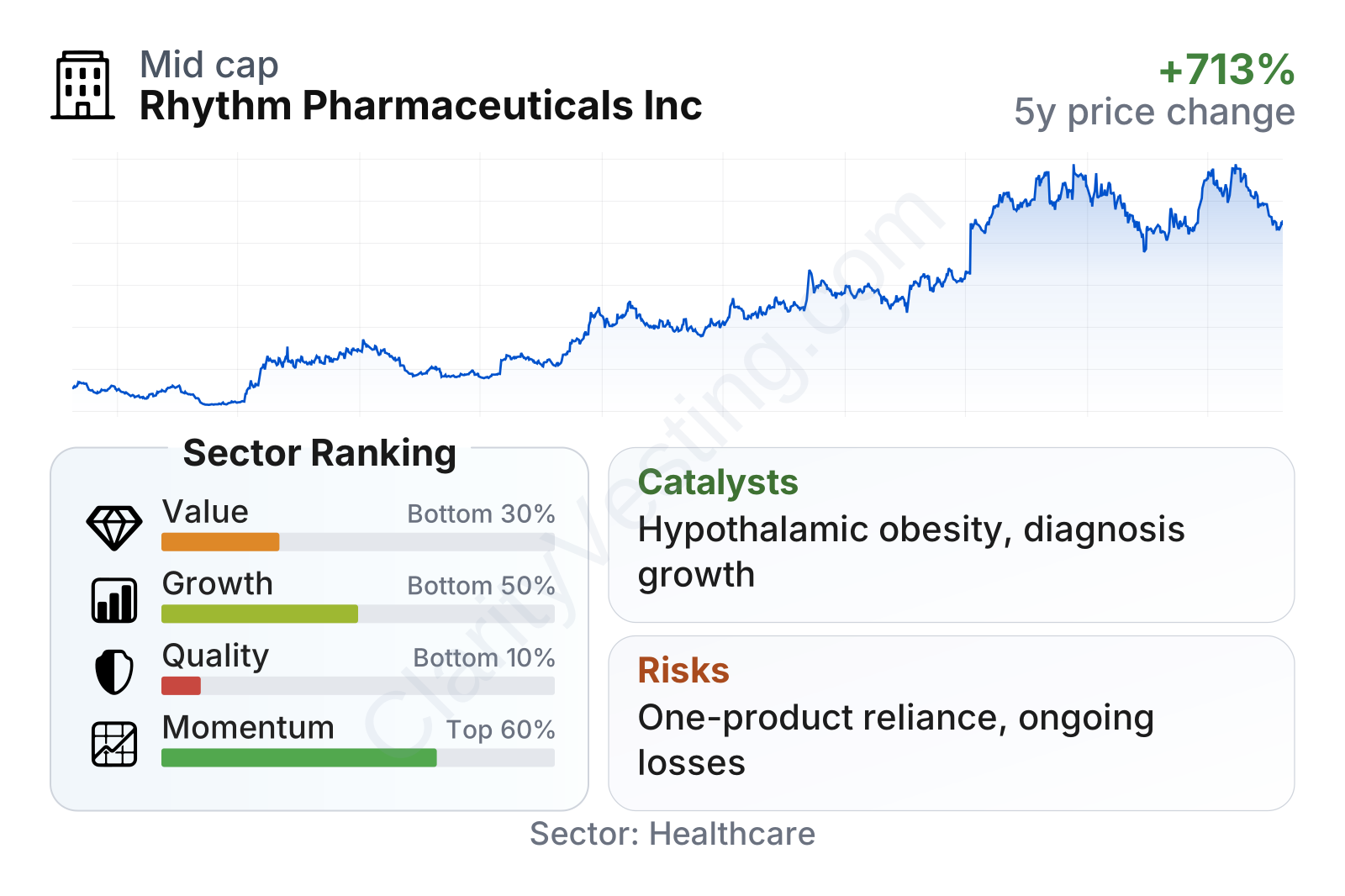
Rhythm sits in an unusual position: growth metrics are strong relative to much of the healthcare sector, while profitability and valuation metrics remain weak. Revenue growth is well above the sector median, but returns on capital, operating margin, and profit margin are still deeply negative. The company also trades at a very rich price-to-book multiple, which suggests the market is already assigning significant value to future expansion rather than current earnings power.
The stock has also been volatile. Over the last several years, it has moved from low double digits to above $100, with sharp swings along the way. That pattern is common in clinical-stage and newly commercial biotech names, where each regulatory, clinical, or reimbursement update can meaningfully change expectations.
Growth
Rhythm operates in a part of healthcare that is structurally attractive for long-term growth: rare diseases with high unmet need. These markets are small in patient count, but they can support premium pricing, long treatment duration, and strong physician engagement when a therapy addresses a clearly defined biological cause. In addition, rare disease companies often benefit from regulatory incentives, including exclusivity protections and streamlined development pathways in some regions.
Rhythm’s strategy is coherent. Instead of competing in the crowded general-obesity market, it is targeting genetically defined obesity disorders where diagnosis can be improved through testing and where a targeted drug can have a clearer medical value proposition. That approach can support both pricing and reimbursement if the clinical benefit remains strong and the patient identification funnel keeps expanding.
Recent revenue growth has remained strong, though it has naturally become less explosive than in the earliest launch periods. The latest year-over-year growth rate is still around the high-40% range, far above the sector median. That suggests commercial adoption is continuing, supported by additional patients, broader market access, and ongoing geographic expansion.
Cash generation remains negative, but the trend is more important than the absolute level. Free cash flow is still in the red, yet it has improved materially compared with earlier periods. That indicates the business is scaling, even if it has not reached self-funding status. For a rare disease biotech, the key question is whether revenue can grow faster than operating expenses over time; Rhythm has not fully proven that yet, but the direction has become more favorable.
Important catalysts continue to center on label expansion and broader diagnosis. The biggest medium-term opportunity is to move beyond the currently approved indications into larger adjacent genetic obesity populations, especially hypothalamic obesity, which management has highlighted as a major development program. If clinical and regulatory progress continues there, the commercial opportunity could become meaningfully larger than the company’s current base.
Another growth driver is geography. Rare disease launches often start in the United States and then build through Europe and selected international markets. Each new reimbursement agreement can add incremental patients and reduce dependence on a single region. For Rhythm, commercial execution is not only about selling more to known prescribers; it is also about finding undiagnosed eligible patients and converting diagnostic awareness into treated patients.
Risks
This article is for informational purposes only and does not constitute financial advice. Some content is AI-generated. See Disclaimer


