Stock Analysis · Rayonier Inc (RYN)
Overview
Rayonier Inc is a timberland real estate investment trust, or REIT. In simple terms, it owns large areas of working forests and earns money from growing, harvesting, selling, and managing timber, while also generating value from higher-and-better-use land sales and a separate real estate development business. The company’s land base is concentrated in the U.S. South, the U.S. Pacific Northwest, and New Zealand, giving it exposure to several timber markets rather than a single region.
Its revenue mix can move around meaningfully from year to year because land sales and development transactions can be large but irregular. Based on the company’s recent segment reporting, the main sources of revenue are generally:
- Southern Timber: about 35% to 45% in a typical year. This includes sales of standing timber and delivered logs from U.S. Southern timberlands, where harvest cycles are relatively short and the land base is broad.
- Pacific Northwest Timber: about 15% to 25%. This business sells logs and stumpage from higher-value species in the Northwestern U.S., often with pricing tied more closely to export and sawlog conditions.
- New Zealand Timber: about 15% to 25%. Rayonier has an interest in timber operations there, adding geographic diversification and exposure to Asian export markets.
- Real Estate / HBU land sales: about 10% to 20%, but this can swing sharply. These sales involve rural land, recreational land, conservation transactions, and parcels with development potential.
- Timber Fund and other management activities: usually a small single-digit to low-teens percentage, depending on fees, partnerships, and transaction timing.
- Wildlight development and other non-timber activities: generally a small percentage, but occasionally more visible when project sales close.
What makes Rayonier different from many traditional REITs is that timber is both a real asset and a biological asset: trees keep growing even when markets are weak, which can allow harvest timing to be adjusted. That flexibility is one of the core attractions of the timberland model, although it does not eliminate earnings volatility.
Over the last several years, the business has shown that revenue and profit can be heavily influenced by asset sales and non-routine transactions. That means reported results may not always reflect the underlying pace of wood demand alone, so it is important to look at the mix of timber operations, land monetization, and balance-sheet management together.
The revenue and profit flow has been uneven rather than steadily linear. A stronger 2024 was followed by a much lower revenue base in 2025, while net income stayed unusually elevated, a sign that gains outside ordinary timber harvesting likely had an outsized impact on reported earnings.
Key Figures
| Metric | Value | Sector ⓘ |
|---|---|---|
| Date | Oct 17, 2026 | |
| Context | ||
| Sector | Real Estate | |
| Industry | REIT - Specialty | |
| Market Cap ⓘ | $5.58B | |
| Beta ⓘ | 0.92 | |
Value (Cheapness) | ||
| P/E Ratio ⓘ | 40.54 | 17.38 |
| P/B Ratio ⓘ | 0.59 | 0.85 |
| FCF Yield ⓘ | 4.73% | 7.38% |
| Dividend Yield ⓘ | 5.64% | 4.85% |
| EBIT / EV ⓘ | 1.16% | 3.78% |
| PEG ⓘ | 23.24 | |
Growth (Business expansion) | ||
| Revenue Growth ⓘ | 272.10% | 5.30% |
| RPS Growth (5Y CAGR) ⓘ | -20.49% | 6.02% |
| EPS Growth (5Y CAGR) ⓘ | -29.19% | -11.37% |
| BVPS Growth (5Y CAGR) ⓘ | 3.54% | 0.45% |
| Margin Growth (5Y Trend) ⓘ | -3.51% | -0.22% |
| FCF Growth (5Y CAGR) ⓘ | 31.09% | 5.40% |
| DPS Growth (5Y CAGR) ⓘ | 14.89% | 5.02% |
Quality (Business durability) | ||
| ROIC (Latest) ⓘ | 1.67% | 5.69% |
| ROE (Latest) ⓘ | 2.05% | 7.56% |
| ROA (Latest) ⓘ | 1.39% | 2.85% |
| ROIC (5Y Median) ⓘ | 6.83% | 4.22% |
| ROE (5Y Median) ⓘ | 9.30% | 6.03% |
| ROA (5Y Median) ⓘ | 4.67% | 2.44% |
| Net Debt / EBIT (Latest) ⓘ | 17.41 | 7.59 |
| Net Debt / EBIT (5Y Median) ⓘ | 4.07 | 8.40 |
| Net Debt / EBITDA (Latest) ⓘ | 5.46 | 5.27 |
| Net Debt / Assets ⓘ | 19.90% | 37.76% |
| EBITDA / Interest ⓘ | 6.07 | 4.10 |
| Operating Margin (Latest) ⓘ | 8.78% | 35.29% |
| Operating Margin (5Y Median) ⓘ | 21.95% | 37.31% |
| Debt to Equity (Latest) ⓘ | 36.29% | 88.87% |
| Profit Margin (Latest) ⓘ | 7.83% | 19.61% |
| Free Cash Flow (Latest) ⓘ | $264.07M | |
Momentum (Price trend) | ||
| 3Y Return ⓘ | -10.20% | +30.75% |
| 12M Return (excl. last month) ⓘ | -12.95% | +4.36% |
| 6M Return ⓘ | -6.58% | -2.52% |
| Price vs. 200-Day MA ⓘ | -8.28% | -2.34% |
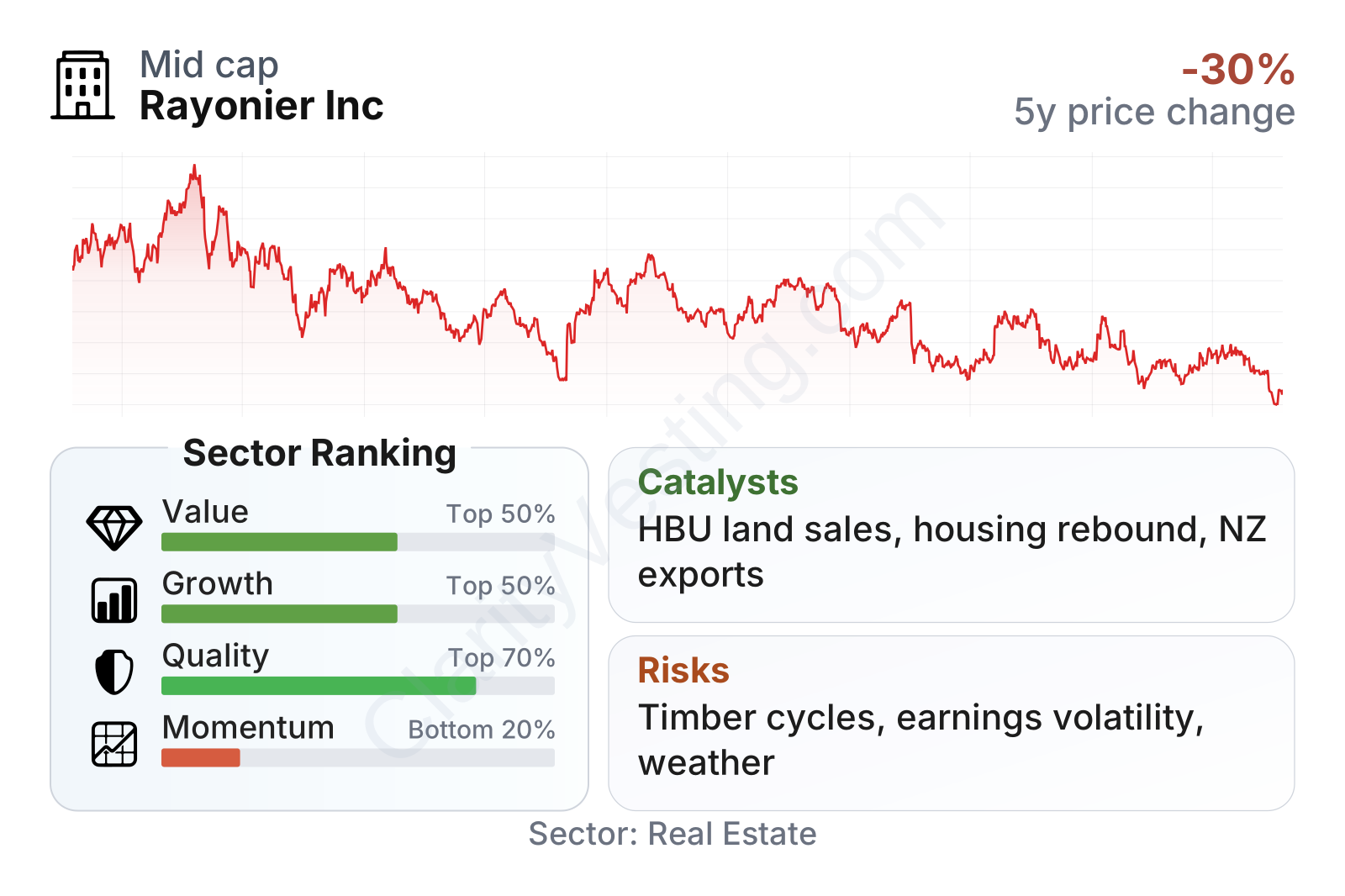
Rayonier is a mid-sized specialty REIT with a stock that has traded below the broader real estate sector’s recent performance. The latest snapshot shows a mixed profile: the shares look inexpensive on book value, but much less so on earnings and enterprise-value-based measures. Growth and momentum rank in the weaker half of the sector, while quality is more balanced because leverage is still moderate for a land-heavy business and interest coverage remains solid.
The main tension in the numbers is that asset backing appears strong, but current profitability is not. Return measures and operating margins are below sector medians on a trailing basis, which helps explain why the market has not rewarded the stock with stronger price momentum even though the dividend yield is above the sector median.
Growth
Rayonier operates in a sector with long-term support from housing, repair-and-remodel activity, packaging, and land scarcity. Timberland is not a fast-growth industry in the way software or semiconductors can be, but it can benefit from inflation over time because replacement costs for land and timber tend to rise. In addition, timber serves several end markets at once, which gives the company multiple paths to create value.
The company’s strategy for future growth is sensible in structure. It combines cash generation from recurring harvests with selective land sales, real estate development, and portfolio optimization. Management has also emphasized improving value per acre rather than simply maximizing harvest volumes. For a timber owner, that matters: the highest return can come from deciding when to cut, what to sell, and which land should be repositioned for development or conservation rather than left in pure timber use.
Revenue per share has been volatile. There was a recovery through 2024, followed by a sharp drop in 2025, which suggests that growth has depended partly on transaction timing instead of steady operating expansion. That does not invalidate the business model, but it does make Rayonier less straightforward than a company with a smooth upward sales trend.
One brighter point is the dividend record. Dividend per share has trended upward over the last five years, and the trailing yield is above the sector median. For a land-based REIT, that signals that cash returns to shareholders have remained an important part of the capital allocation framework even while operating results fluctuate.
Several catalysts could support future growth. A healthier U.S. housing market would likely lift sawtimber demand in the South. New Zealand offers leverage to export log markets if Asian demand improves. Rayonier also retains optionality in higher-value land sales and development projects, especially where population growth increases the value of land beyond timber production. Carbon-related markets and conservation transactions could become an additional source of land monetization over time, although those are still more of a developing opportunity than a core earnings driver.
Recent company updates have also pointed to continued portfolio activity and land value realization as an important part of the playbook. For Rayonier, meaningful upside often comes less from rapid harvest growth and more from converting selected acreage into higher-value uses while keeping the core timber base productive.
Risks
This article is for informational purposes only and does not constitute financial advice. Some content is AI-generated. See Disclaimer


