Stock Analysis · Recursion Pharmaceuticals Inc (RXRX)
Overview
Recursion Pharmaceuticals is a biotechnology company that uses automation, large-scale laboratory experiments, and artificial intelligence to discover and develop new medicines. In simple terms, the company tries to make drug discovery faster and more data-driven by combining biology, chemistry, software, and computing. Its work spans internal drug programs, partnerships with larger pharmaceutical companies, and platform-related services built on its research engine.
For a long-term reader, the important point is that Recursion is not yet a mature drug seller. It is still in the development stage, so the business today is mostly funded by collaboration payments and research-related revenue rather than recurring sales from approved medicines. That makes the company more similar to an early commercial platform biotech than to an established pharmaceutical business.
Based on recent company reporting, revenue has come primarily from collaboration and partnership activity, with smaller contributions from other research-related arrangements. Exact mix can move sharply from one period to another because milestone timing is uneven, but the current structure can be summarized this way:
- Collaboration revenue: roughly 80% to 95% of total revenue in recent periods. This includes upfront payments, research funding, and milestone-related recognition from partnerships with pharmaceutical and technology companies.
- Other revenue and services: roughly 5% to 20%. This can include contract-related work, platform access arrangements, and smaller research support items.
- Product sales: 0%. Recursion does not currently depend on approved drug sales as a meaningful source of revenue.
The operating profile is also clear: revenue is still small compared with spending, and most expenses are directed toward research and development. Over the last several years, research and development has been the largest cost item by far, followed by selling, general, and administrative expenses. That expense mix is typical for a company trying to build a discovery platform while advancing multiple drug candidates at the same time.
The broad financial flow shows a business that has been increasing revenue over time, but operating expenses have grown faster. Research spending remains the central use of capital, which fits the company’s strategy but also explains why losses remain large.
Key Figures
| Metric | Value | Sector ⓘ |
|---|---|---|
| Date | Oct 10, 2026 | |
| Context | ||
| Sector | Healthcare | |
| Industry | Biotechnology | |
| Market Cap ⓘ | $2.29B | |
| Beta ⓘ | 1.03 | |
Value (Cheapness) | ||
| P/E Ratio ⓘ | N/A | 24.79 |
| P/B Ratio ⓘ | 2.30 | 2.97 |
| FCF Yield ⓘ | -15.47% | 3.11% |
| Dividend Yield ⓘ | N/A | 2.04% |
| EBIT / EV ⓘ | -34.29% | 0.57% |
| PEG ⓘ | N/A | |
Growth (Business expansion) | ||
| Revenue Growth ⓘ | -60.10% | 7.35% |
| RPS Growth (5Y CAGR) ⓘ | 29.84% | 8.61% |
| EPS Growth (5Y CAGR) ⓘ | -24.68% | -18.43% |
| BVPS Growth (5Y CAGR) ⓘ | -5.64% | 3.94% |
| Margin Growth (5Y Trend) ⓘ | N/A | -0.61% |
| FCF Growth (5Y CAGR) ⓘ | N/A | 0.88% |
| DPS Growth (5Y CAGR) ⓘ | N/A | 6.74% |
Quality (Business durability) | ||
| ROIC (Latest) ⓘ | -38.95% | 3.34% |
| ROA (Latest) ⓘ | -39.73% | 2.95% |
| ROIC (5Y Median) ⓘ | -47.33% | 4.60% |
| ROA (5Y Median) ⓘ | -44.11% | 1.89% |
| Net Debt / EBIT (Latest) ⓘ | N/A | 1.36 |
| Net Debt / EBIT (5Y Median) ⓘ | N/A | 1.86 |
| Net Debt / EBITDA (Latest) ⓘ | N/A | 1.02 |
| Net Debt / Assets ⓘ | -39.90% | 5.85% |
| EBITDA / Interest ⓘ | N/A | 9.60 |
| Operating Margin (Latest) ⓘ | -953.07% | 9.19% |
| Operating Margin (5Y Median) ⓘ | -787.26% | 7.53% |
| Debt to Equity (Latest) ⓘ | 6.76% | 29.44% |
| Profit Margin (Latest) ⓘ | N/A | 3.52% |
| Free Cash Flow (Latest) ⓘ | -$354.26M | |
Momentum (Price trend) | ||
| 3Y Return ⓘ | -41.57% | +34.80% |
| 12M Return (excl. last month) ⓘ | -25.54% | +19.33% |
| 6M Return ⓘ | +16.52% | +7.18% |
| Price vs. 200-Day MA ⓘ | +10.55% | +3.20% |
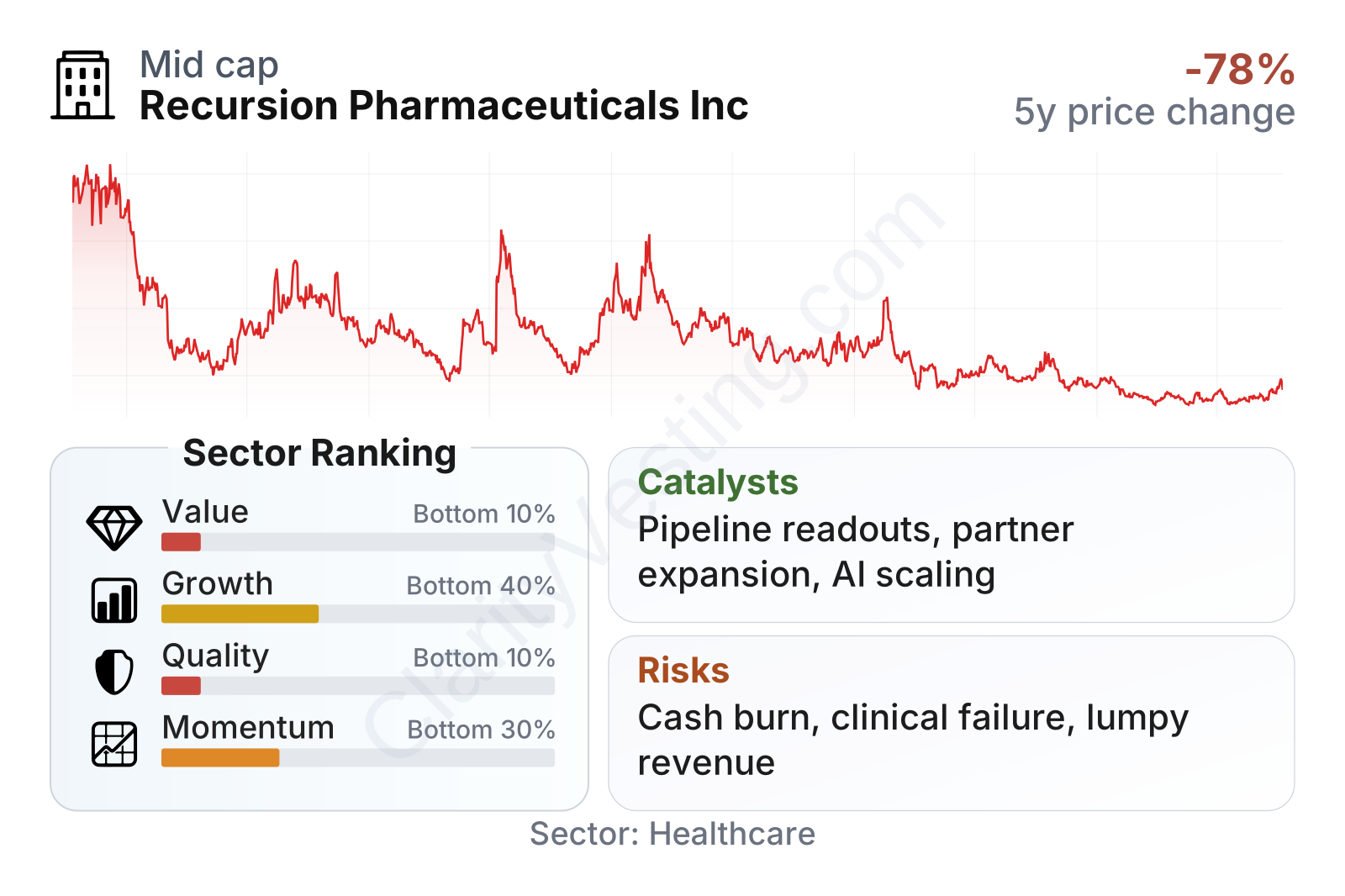
Recursion is a mid-sized biotechnology company by market value, with stock volatility close to the broader market rather than extremely detached from it. The table points to a business that looks weak on traditional quality, value, and profitability measures, which is common for development-stage biotech firms but still important. On the positive side, the balance sheet appears relatively lightly levered compared with the sector, while momentum has improved somewhat over the last six months even though the longer share-price record remains deeply negative.
The stock-price history also shows how sentiment has shifted since listing. Shares have fallen substantially from 2021 levels, with periods of sharp rebounds followed by renewed weakness. That pattern usually reflects changing expectations around partnerships, pipeline progress, financing conditions, and confidence in the platform model.
Growth
Recursion operates in a part of healthcare that is attracting long-term interest: AI-enabled drug discovery and tech-driven biotechnology. The broader sector still has real strategic relevance because pharmaceutical companies need better ways to lower development failure rates, reduce timelines, and identify promising compounds more efficiently. If Recursion’s platform proves it can consistently generate valuable candidates or partnership outputs, the addressable opportunity could be much larger than its current revenue base suggests.
The company’s strategy is logically coherent. It is trying to create a feedback loop where large biological data generation improves machine-learning models, which in turn helps prioritize experiments and compounds. That can create value in several ways at once: internal drug programs, licensing or co-development partnerships, and potentially broader platform monetization. The partnership model is especially important because it can provide outside validation and non-dilutive capital while the internal pipeline is still maturing.
Revenue growth has been highly uneven. There have been bursts of very strong growth followed by steep declines, which is typical when milestone payments and collaboration accounting drive the top line. That means rising revenue in one quarter does not necessarily indicate a stable commercial ramp. Over a longer horizon, however, annual revenue has trended upward from a low base, showing that the company has been able to expand the scale of its partnerships even if short-term comparisons remain volatile.
Cash generation remains a major watchpoint. Free cash flow has stayed deeply negative, although the most recent trend looks somewhat less severe than the prior trough. In practical terms, the company is still consuming large amounts of cash to fund research, computing infrastructure, and pipeline advancement. For long-term analysis, that makes future milestone receipts, disciplined spending, and access to capital central growth variables.
A meaningful catalyst is the company’s relationship with major industry partners and its continued effort to move candidates through development. Recursion has also emphasized the combination of its experimental platform with large-scale compute capabilities, which could improve discovery productivity if execution is strong. Recent company communications have continued to highlight pipeline advancement, platform scaling, and collaboration activity as the main avenues for creating future value. For a business like this, a single successful clinical update, licensing deal, or expanded partnership can change expectations quickly because the current revenue base is still relatively small.
Risks
This article is for informational purposes only and does not constitute financial advice. Some content is AI-generated. See Disclaimer