Stock Analysis · RXO Inc (RXO)
Overview
RXO Inc. is a freight transportation and logistics company. In simple terms, it helps shippers move goods by matching loads with trucking capacity, arranging transportation, and managing freight networks. The company was separated from XPO in late 2022 and operates mainly as an asset-light provider, meaning it generally does not need to own a large truck fleet to run its core brokerage activity. That model can be attractive when volumes are strong because it can scale without the same capital needs as traditional trucking operators, but it can also be vulnerable when pricing turns weak.
Its business mix changed meaningfully after the Coyote Logistics acquisition, which expanded RXO’s freight brokerage platform and customer reach. Based on recent company reporting, revenue is concentrated in truck brokerage and managed transportation, with smaller contributions from complementary services.
Main revenue sources are approximately:
- Brokered transportation services: about 85% to 90% of revenue. This is the core business, where RXO connects shippers with third-party carriers and earns revenue from arranging loads.
- Managed transportation: about 10% to 15% of revenue. This includes outsourced transportation planning, procurement, execution, and network optimization for customers.
- Other logistics services: a small remainder. This can include additional freight-related and technology-enabled services tied to customer transportation needs.
Economically, the business runs on volume and spread management: RXO needs enough freight volume, healthy pricing between what customers pay and what carriers charge, and disciplined overhead. The recent financial flow also shows that while revenue rebounded strongly after the acquisition, operating expenses and interest costs increased enough to keep profitability under pressure.
The long-term pattern is clear: revenue has risen again after the 2023 slowdown, but a larger cost base has made earnings conversion much weaker than it was several years ago.
Key Figures
| Metric | Value | Sector ⓘ |
|---|---|---|
| Date | Oct 17, 2026 | |
| Context | ||
| Sector | Industrials | |
| Industry | Trucking | |
| Market Cap ⓘ | $4.72B | |
| Beta ⓘ | 1.99 | |
Value (Cheapness) | ||
| P/E Ratio ⓘ | N/A | 22.10 |
| P/B Ratio ⓘ | 3.23 | 1.97 |
| FCF Yield ⓘ | -0.38% | 6.38% |
| Dividend Yield ⓘ | N/A | 1.94% |
| EBIT / EV ⓘ | -2.18% | 4.79% |
| PEG ⓘ | 172.13 | |
Growth (Business expansion) | ||
| Revenue Growth ⓘ | 25.00% | 9.30% |
| RPS Growth (5Y CAGR) ⓘ | -4.09% | 7.81% |
| EPS Growth (5Y CAGR) ⓘ | N/A | -13.06% |
| BVPS Growth (5Y CAGR) ⓘ | -0.12% | 6.14% |
| Margin Growth (5Y Trend) ⓘ | -5.47% | 0.88% |
| FCF Growth (5Y CAGR) ⓘ | N/A | 11.01% |
| DPS Growth (5Y CAGR) ⓘ | N/A | 9.48% |
Quality (Business durability) | ||
| ROIC (Latest) ⓘ | -3.44% | 10.84% |
| ROA (Latest) ⓘ | -3.15% | 5.41% |
| ROIC (5Y Median) ⓘ | -8.88% | 9.38% |
| ROA (5Y Median) ⓘ | 0.21% | 4.95% |
| Net Debt / EBIT (Latest) ⓘ | N/A | 2.08 |
| Net Debt / EBIT (5Y Median) ⓘ | 4.22 | 2.27 |
| Net Debt / EBITDA (Latest) ⓘ | 37.53 | 1.39 |
| Net Debt / Assets ⓘ | 20.61% | 19.28% |
| EBITDA / Interest ⓘ | 0.53 | 9.58 |
| Operating Margin (Latest) ⓘ | -1.43% | 10.50% |
| Operating Margin (5Y Median) ⓘ | 0.92% | 10.29% |
| Debt to Equity (Latest) ⓘ | 48.34% | 65.48% |
| Profit Margin (Latest) ⓘ | -1.72% | 6.67% |
| Free Cash Flow (Latest) ⓘ | -$18.06M | |
Momentum (Price trend) | ||
| 3Y Return ⓘ | +54.91% | +61.68% |
| 12M Return (excl. last month) ⓘ | +17.58% | +12.58% |
| 6M Return ⓘ | +76.66% | 0.00% |
| Price vs. 200-Day MA ⓘ | +42.24% | +0.02% |
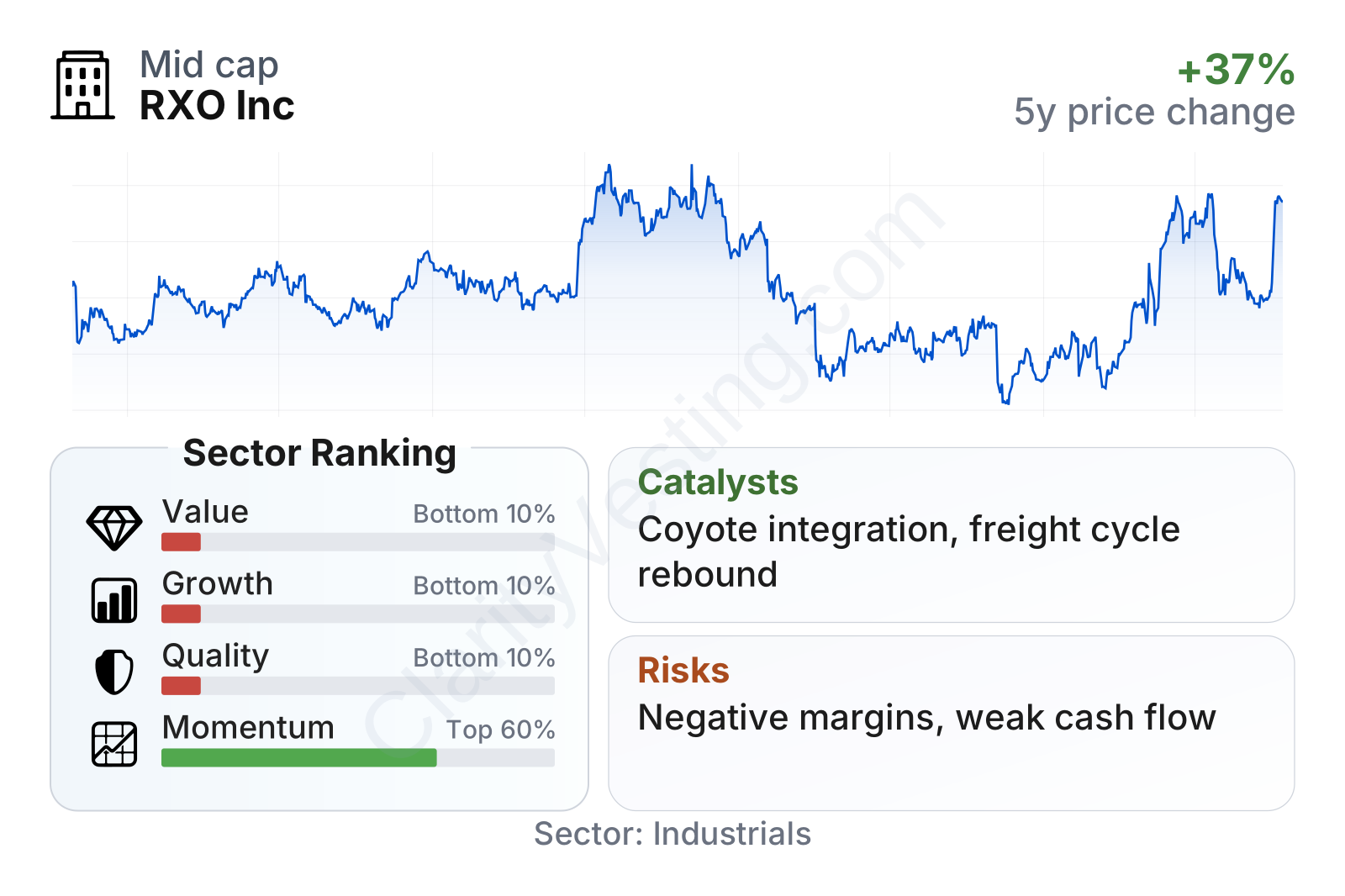
RXO is a mid-sized transportation company with a stock that has been volatile since its spin-off, which fits a cyclical freight business and is reinforced by a high beta near 2. On the factor view, the company currently ranks weakly on value, quality, and growth versus much of the industrial sector. Shorter-term share performance has improved, but that recovery sits on top of a business that is still dealing with negative margins, negative free cash flow, and modest balance sheet pressure from a profit perspective rather than from headline leverage alone.
Growth
RXO operates in a large and important market. Freight brokerage and managed transportation benefit from long-term themes such as supply chain outsourcing, the need for flexible capacity, and the growing use of software and data to match loads with carriers more efficiently. Over time, shippers have increasingly looked for logistics partners that can provide visibility, procurement tools, and broad carrier access without forcing them to manage everything internally. That gives RXO exposure to a sector with structural relevance, even if near-term performance moves with the freight cycle.
The company’s strategy is logical on paper. Scale matters in freight brokerage because larger networks can improve load matching, service reliability, and access to carriers. The Coyote acquisition significantly increased RXO’s scale, and management has highlighted opportunities from cross-selling, procurement efficiencies, and technology integration. If execution improves, the larger platform could eventually support better density and margin recovery.
Recent revenue growth has been strong on a year-over-year basis, but part of that strength reflects acquisition effects rather than purely organic expansion. The pattern suggests that RXO has become a bigger company, yet the more important question for long-term analysis is whether that larger revenue base can produce durable profit improvement.
Cash generation remains the more cautious part of the growth picture. Free cash flow has moved from clearly positive to negative territory over the past few years, which indicates that scale has not yet translated into stronger cash economics. For a logistics company, that matters because long-term value creation depends less on revenue alone and more on turning network activity into steady cash earnings.
A meaningful catalyst is any improvement in the freight market itself. If trucking capacity tightens and pricing conditions normalize, brokerage spreads can recover quickly. Another potential catalyst is execution on integration: combining platforms, removing duplicated costs, and improving productivity across the larger organization. Recent company communications have also emphasized technology investments and automation, which could help with carrier matching and labor efficiency if adopted successfully.
Risks
This article is for informational purposes only and does not constitute financial advice. Some content is AI-generated. See Disclaimer


