Stock Analysis · Rubis (RUBSF)
Overview
Rubis is a French energy distribution and infrastructure company active mainly in the storage, distribution, and marketing of petroleum products, liquefied gases, and related services. Its business is built around supplying end customers in areas where logistics, import capacity, and local distribution networks matter more than pure scale. That makes the company different from a large integrated oil major: Rubis is less exposed to upstream oil production and more focused on moving, storing, and delivering fuels and energy products in local markets.
The group operates across Europe, the Caribbean, and Africa, with a particularly strong presence in islands and other supply-constrained markets. In recent years it has also expanded its exposure to cleaner-energy themes through photovoltaic activities and through its stake in HDF Energy, a company focused on hydrogen-power solutions. Even so, Rubis remains primarily a downstream energy distributor and storage operator.
Based on recent annual reporting, Rubis’ revenue mix is still dominated by fuel distribution. Approximate revenue sources can be summarized as follows.
- Energy distribution: approximately 85% to 90% of revenue. This includes service-station fuels, aviation fuel, marine fuels, LPG, bitumen, and other petroleum products sold to retail, commercial, and industrial customers.
- Support and services: approximately 10% to 15% of revenue. This includes storage and logistics-related activities, wholesale support, and other linked services depending on geography and period.
- Renewables and other activities: currently a small share of revenue. This includes solar-related operations and development interests that are strategically relevant but still modest compared with the core fuel business.
What stands out in Rubis’ model is not rapid disruption, but the resilience of local infrastructure positions. The company often serves territories where import terminals, depots, distribution fleets, and retail networks are difficult to replicate. That gives Rubis a practical role in everyday energy supply, even if the business remains tied to fuel volumes and commodity-linked demand.
The long-term financial pattern shows a business that has kept revenue broadly elevated since the post-2021 recovery, while operating profit and net income have remained positive through changing fuel-price environments. At the same time, interest expense has risen over the period, which matters because Rubis relies on infrastructure assets and acquisitions to support its footprint.
Key Figures
| Metric | Value | Sector ⓘ |
|---|---|---|
| Date | Oct 17, 2026 | |
| Context | ||
| Sector | Energy | |
| Industry | Oil & Gas Refining & Marketing | |
| Market Cap ⓘ | $4.09B | |
| Beta ⓘ | 0.86 | |
Value (Cheapness) | ||
| P/E Ratio ⓘ | 11.79 | 15.44 |
| P/B Ratio ⓘ | 1.45 | 1.73 |
| FCF Yield ⓘ | 13.22% | 8.20% |
| Dividend Yield ⓘ | 5.23% | 3.59% |
| EBIT / EV ⓘ | N/A | 7.46% |
| PEG ⓘ | N/A | |
Growth (Business expansion) | ||
| Revenue Growth ⓘ | 24.20% | 26.90% |
| RPS Growth (5Y CAGR) ⓘ | 8.93% | 6.90% |
| EPS Growth (5Y CAGR) ⓘ | -35.99% | -15.73% |
| BVPS Growth (5Y CAGR) ⓘ | 0.41% | 6.07% |
| Margin Growth (5Y Trend) ⓘ | -1.07% | 0.58% |
| FCF Growth (5Y CAGR) ⓘ | 33.56% | 1.86% |
| DPS Growth (5Y CAGR) ⓘ | 27.13% | 16.79% |
Quality (Business durability) | ||
| ROIC (Latest) ⓘ | N/A | 11.40% |
| ROA (Latest) ⓘ | 8.30% | 6.06% |
| ROIC (5Y Median) ⓘ | 9.38% | 10.30% |
| ROA (5Y Median) ⓘ | 5.23% | 5.42% |
| Net Debt / EBIT (Latest) ⓘ | 1.81 | 1.64 |
| Net Debt / EBIT (5Y Median) ⓘ | 2.86 | 1.83 |
| Net Debt / EBITDA (Latest) ⓘ | 1.24 | 1.08 |
| Net Debt / Assets ⓘ | 26.53% | 17.29% |
| EBITDA / Interest ⓘ | 11.59 | 9.64 |
| Operating Margin (Latest) ⓘ | 7.71% | 16.27% |
| Operating Margin (5Y Median) ⓘ | 8.16% | 20.39% |
| Debt to Equity (Latest) ⓘ | 91.00% | 54.76% |
| Profit Margin (Latest) ⓘ | 4.60% | 8.82% |
| Free Cash Flow (Latest) ⓘ | $541.31M | |
Momentum (Price trend) | ||
| 3Y Return ⓘ | +121.65% | +67.38% |
| 12M Return (excl. last month) ⓘ | +18.91% | +49.19% |
| 6M Return ⓘ | -0.98% | +7.07% |
| Price vs. 200-Day MA ⓘ | +27.73% | +9.56% |
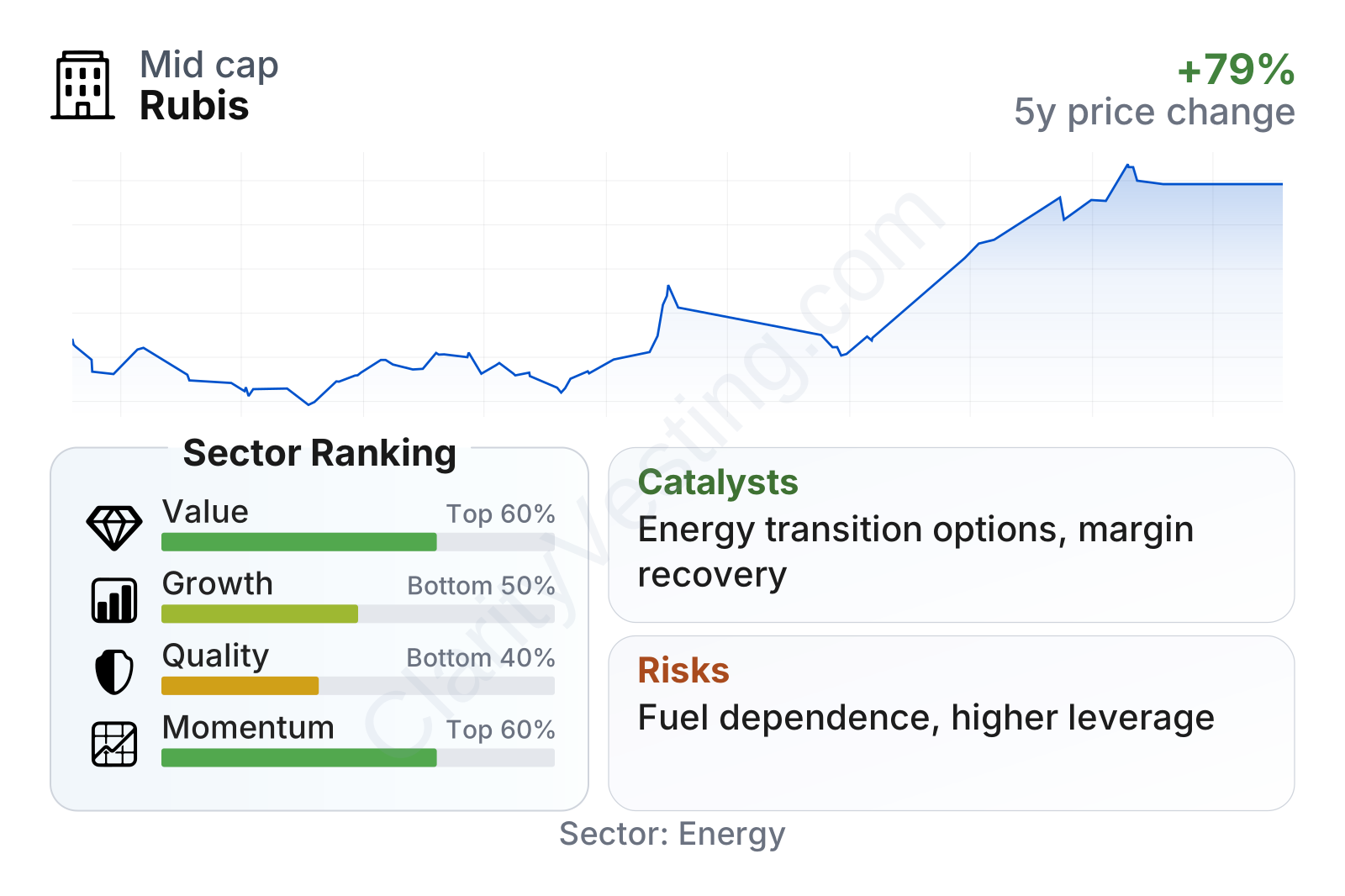
Rubis is a mid-sized energy company with a stock-market profile that looks moderately priced relative to much of the sector. Valuation metrics sit below sector medians on earnings and book value, while free-cash-flow yield and dividend yield are both higher than typical peers. That combination suggests the market is not assigning an aggressive growth premium to the shares.
On growth measures, the picture is mixed but not weak. Revenue expansion over five years has been solid, free cash flow has grown strongly, and dividend growth has been notably robust. The softer points are earnings per share, book value growth, and margin trend, which shows that top-line progress has not translated into equally strong underlying profitability improvement.
Quality metrics are more uneven. Returns on assets are decent, and interest coverage remains comfortable, but leverage is higher than the sector median and operating margins are clearly below many peers. In other words, Rubis generates cash and remains profitable, yet it does so with thinner margins and a more leveraged balance sheet than stronger-quality names in the energy space.
Price performance has been favorable over a three-year period, and the shares have traded well above their long-term average level more recently. That indicates the market has already recognized some improvement in the business, even if the valuation still does not look stretched by sector standards.
Growth
Rubis operates in a sector that is mature in developed markets but still structurally relevant in many of the geographies it serves. Fuel demand growth is not likely to be dramatic over the long run, yet demand for reliable distribution, storage, and last-mile delivery often remains durable, especially in island markets, aviation-linked routes, and regions where logistics barriers protect established operators. That means Rubis is not positioned in a classic high-growth industry, but it can still expand through market share, acquisitions, network optimization, and selective energy transition projects.
The company’s strategy broadly makes sense for that environment. Its strength is not in producing hydrocarbons at the lowest cost; it is in controlling local infrastructure and customer relationships in fragmented markets. That model can support recurring cash generation, especially when Rubis adds terminals, retail networks, or import capacity that deepen its presence in a territory. Historically, bolt-on acquisitions and disciplined geographic expansion have been an important part of the company’s development.
A meaningful longer-term catalyst is Rubis’ effort to broaden its energy mix. Solar activities and its exposure to hydrogen-related projects do not yet reshape group earnings, but they provide an option on energy transition without requiring the company to abandon its profitable distribution base. If these newer activities scale successfully, they could gradually improve the market’s perception of Rubis from a pure fuel distributor toward a more diversified energy infrastructure company.
Another potential catalyst is operational execution in existing markets. The company’s network spans regions where dependable supply matters and competition can be local rather than global. Improvements in logistics, pricing discipline, storage utilization, and product mix can lift earnings without requiring a major surge in overall fuel demand. That is especially relevant for a business whose margin profile has room for improvement.
Recent corporate communication has continued to emphasize portfolio management, disciplined capital allocation, and energy transition initiatives alongside the core downstream business. The significance of that approach is that Rubis does not need a dramatic industry breakthrough to progress; steadier gains in cash generation, infrastructure returns, and selected growth projects can already move the investment case.
Risks
This article is for informational purposes only and does not constitute financial advice. Some content is AI-generated. See Disclaimer


