Stock Analysis · Rotork plc (RTOXF)
Overview
Rotork plc is a UK-based industrial engineering company that makes actuators, gearboxes, control systems, and related services. In simple terms, its products help customers open, close, regulate, and monitor valves and dampers used in pipelines, plants, and industrial processes. These components are essential in sectors such as oil and gas, water and wastewater, power generation, chemical processing, mining, marine, and general industrial facilities.
The business is built around equipment that is usually small compared with the total cost of a plant or pipeline, but critical for safety, reliability, and automation. That tends to make Rotork relevant in maintenance cycles as well as in new project spending. The company also benefits from a large installed base, because once actuators and controls are in the field, customers often need spare parts, upgrades, monitoring, and servicing over many years.
Based on recent annual reporting, Rotork organizes revenue by product and service categories rather than by a single end market. The main sources of revenue are approximately:
- Electric actuators and controls: the largest category, roughly 45% to 50% of revenue. These products automate valve movement using electric power and are widely used where precision, control, and digital monitoring matter.
- Pneumatic and hydraulic actuation systems: roughly 25% to 30%. These are common in demanding industrial settings, especially where fast operation or fail-safe performance is required.
- Gearboxes and related mechanical products: roughly 15% to 20%. These are used alongside actuators or manual valve operation systems.
- Service, software, spares, and site support: roughly 10% to 15%. This includes aftermarket support, replacement parts, diagnostics, and digital tools tied to installed equipment.
Geographically, Rotork is broadly diversified across Europe, the Americas, Asia-Pacific, the Middle East, and Africa, which reduces dependence on any one country. That said, demand is still closely linked to industrial capital spending and maintenance budgets in energy, water, and process industries.
The business mix has been improving in a useful way for long-term analysis: revenue has climbed steadily over the last several years, while operating profit has expanded faster than sales. That suggests better pricing, mix, execution, or all three. Gross profit has also grown faster than cost of revenue, pointing to stronger margin quality than a simple sales increase alone would imply.
Key Figures
| Metric | Value | Sector ⓘ |
|---|---|---|
| Date | Oct 24, 2026 | |
| Context | ||
| Sector | Industrials | |
| Industry | Specialty Industrial Machinery | |
| Market Cap ⓘ | $5.09B | |
| Beta ⓘ | 1.06 | |
Value (Cheapness) | ||
| P/E Ratio ⓘ | 31.25 | 22.29 |
| P/B Ratio ⓘ | 9.27 | 1.98 |
| FCF Yield ⓘ | 4.42% | 6.26% |
| Dividend Yield ⓘ | 1.34% | 1.92% |
| EBIT / EV ⓘ | N/A | 4.83% |
| PEG ⓘ | 3.98 | |
Growth (Business expansion) | ||
| Revenue Growth ⓘ | N/A | 9.30% |
| RPS Growth (5Y CAGR) ⓘ | 9.08% | 7.76% |
| EPS Growth (5Y CAGR) ⓘ | -26.77% | -13.17% |
| BVPS Growth (5Y CAGR) ⓘ | 2.96% | 6.13% |
| Margin Growth (5Y Trend) ⓘ | 4.86% | 0.74% |
| FCF Growth (5Y CAGR) ⓘ | 15.50% | 10.79% |
| DPS Growth (5Y CAGR) ⓘ | -2.21% | 9.41% |
Quality (Business durability) | ||
| ROIC (Latest) ⓘ | N/A | 10.75% |
| ROA (Latest) ⓘ | 28.75% | 5.41% |
| ROIC (5Y Median) ⓘ | 17.14% | 9.37% |
| ROA (5Y Median) ⓘ | 13.33% | 4.95% |
| Net Debt / EBIT (Latest) ⓘ | -0.08 | 2.04 |
| Net Debt / EBIT (5Y Median) ⓘ | -0.86 | 2.27 |
| Net Debt / EBITDA (Latest) ⓘ | -0.07 | 1.39 |
| Net Debt / Assets ⓘ | -3.30% | 19.27% |
| EBITDA / Interest ⓘ | 71.18 | 9.58 |
| Operating Margin (Latest) ⓘ | 21.61% | 10.49% |
| Operating Margin (5Y Median) ⓘ | 19.53% | 10.30% |
| Debt to Equity (Latest) ⓘ | 8.01% | 64.82% |
| Profit Margin (Latest) ⓘ | 15.75% | 6.67% |
| Free Cash Flow (Latest) ⓘ | $225.05M | |
Momentum (Price trend) | ||
| 3Y Return ⓘ | +92.53% | +67.77% |
| 12M Return (excl. last month) ⓘ | +44.47% | +12.05% |
| 6M Return ⓘ | +43.78% | 0.00% |
| Price vs. 200-Day MA ⓘ | +30.56% | +0.67% |
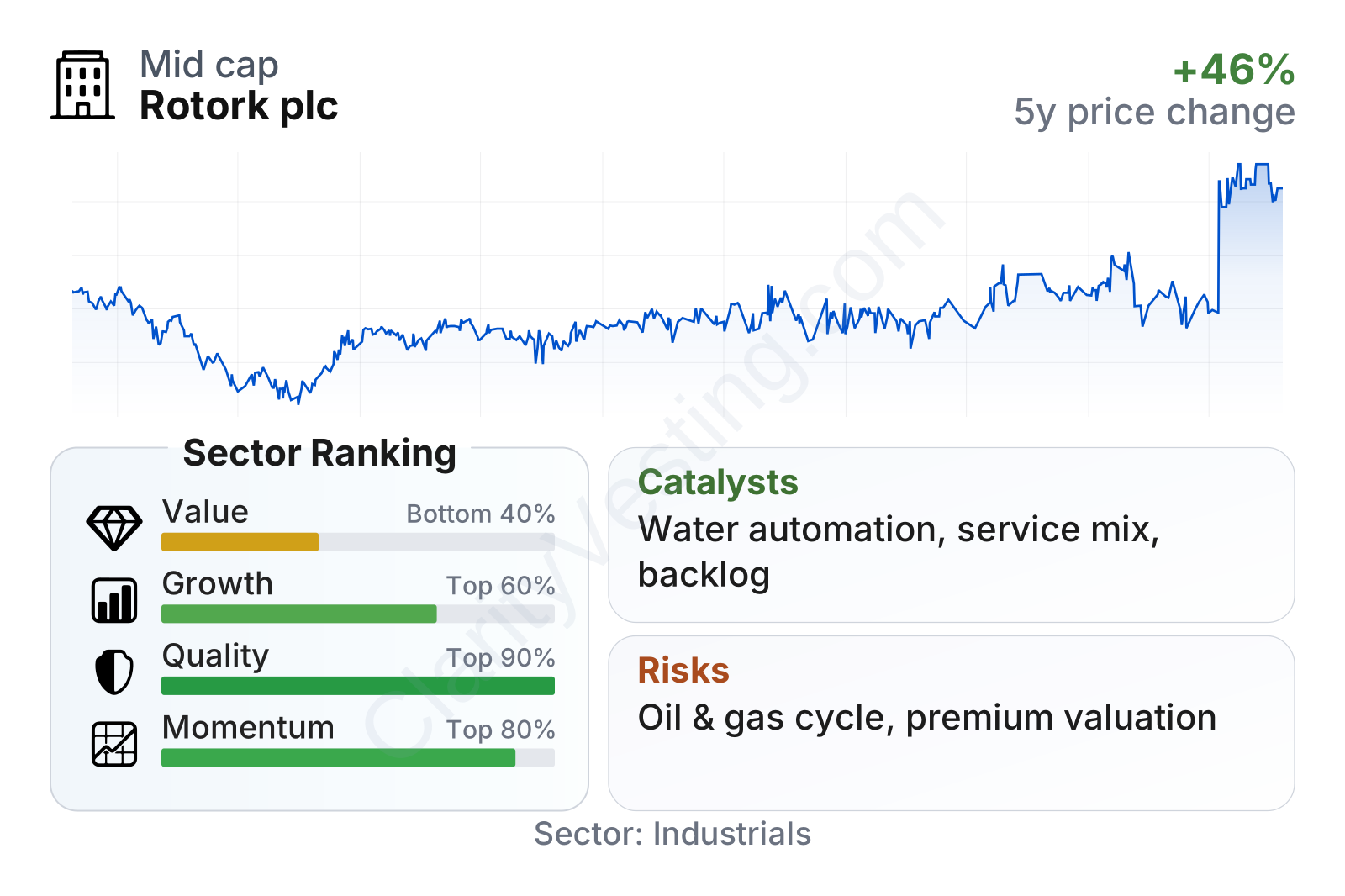
Rotork stands out most on quality rather than on cheapness. Profitability is notably stronger than the sector median, with operating margin around the low-20% range versus roughly 10% for the typical peer, and profit margin also well ahead of the group. The balance sheet is another strength: net debt metrics are negative, which indicates a net cash position, and leverage is far below sector norms.
Growth is more mixed. Over five years, revenue per share and free cash flow have compounded at a healthy pace, and margin trends have improved clearly. However, near-term revenue growth has flattened, and long-term earnings per share progression has been uneven. Market performance has been strong over the last 6 to 12 months and over three years, so the share price already reflects a good part of the company’s operating resilience.
Growth
Rotork operates in markets with long-term structural support. Industrial automation continues to expand as operators look for higher reliability, lower labor intensity, better safety, and more remote monitoring. Water infrastructure is another favorable area, as utilities worldwide need upgrades, leakage control, and more automated networks. Energy infrastructure also remains important, not only in traditional oil and gas but increasingly in areas tied to electrification, process efficiency, and selected lower-carbon projects.
The company’s strategy is logical for this environment. Rotork is not trying to build a consumer-style high-growth model; it is strengthening a specialist position in mission-critical flow control. That includes digital diagnostics, intelligent actuators, site services, and lifecycle support. This approach can create steadier demand because customers are often reluctant to switch away from proven equipment in regulated or safety-sensitive settings.
A key catalyst is the combination of automation and aftermarket revenue. As more installed equipment becomes connected and monitored, service opportunities can become more recurring and margins can remain strong. Another support is infrastructure renewal in water and process industries, where many assets are old and increasingly need automated control systems. In addition, Rotork’s broad geographic footprint helps it capture spending wherever project activity is strongest rather than relying on a single region.
Recent company reporting has also highlighted order intake and backlog trends as important indicators. For a business like Rotork, healthy orders matter because they provide visibility into future shipments. The wider industry backdrop still supports demand for valve actuation in energy security projects, pipeline upgrades, water treatment expansion, and industrial efficiency spending.
Risks
This article is for informational purposes only and does not constitute financial advice. Some content is AI-generated. See Disclaimer


