Stock Analysis · Rio Tinto Group (RTNTF)
Overview
Rio Tinto Group is one of the world’s largest mining companies. It produces raw materials that sit near the beginning of many industrial supply chains, including steel, aluminum, copper wiring, construction materials, and minerals used in energy transition technologies. Its operations span mine development, extraction, processing, rail and port logistics, and global sales.
The business is organized around a small number of large mining systems rather than a broad mix of unrelated activities. That matters for long-term analysis because Rio Tinto’s results are driven mainly by commodity prices, production volumes, and how efficiently it runs a portfolio of very large assets.
Based on the latest annual reporting, Rio Tinto’s revenue is concentrated in a few core commodities, led by iron ore. Approximate revenue mix is as follows:
- Iron Ore: about 55% to 60% — mainly Pilbara iron ore in Western Australia, sold largely to steelmakers, especially in Asia.
- Aluminum: about 20% to 25% — includes bauxite, alumina, and primary aluminum.
- Copper: about 10% to 15% — includes mined copper and associated by-products from assets such as Oyu Tolgoi and Kennecott.
- Minerals: about 5% to 10% — mainly titanium dioxide feedstocks, borates, iron and titanium products, and other industrial minerals.
This mix shows both a strength and a limitation. Rio Tinto has meaningful exposure to metals tied to electrification and infrastructure, but it still depends heavily on iron ore for profit generation. In practice, that makes the company partly a diversified miner and partly a very large iron ore franchise.
The recent financial flow also points to a business with resilient scale but uneven earnings conversion. Revenue remained broadly stable over the last several years, while profits moved around more sharply as commodity prices, costs, and margins changed. That pattern is common in mining, where even very efficient operators cannot fully escape the pricing cycle.
Over the last few years, sales have stayed in a relatively high range, but profitability has been more volatile than revenue. That suggests Rio Tinto’s earnings power depends less on top-line growth alone and more on commodity mix, operating discipline, and cost control at major assets.
Key Figures
| Metric | Value | Sector ⓘ |
|---|---|---|
| Date | Oct 03, 2026 | |
| Context | ||
| Sector | Basic Materials | |
| Industry | Other Industrial Metals & Mining | |
| Market Cap ⓘ | $182.04B | |
| Beta ⓘ | 0.66 | |
Value (Cheapness) | ||
| P/E Ratio ⓘ | 15.18 | 17.61 |
| P/B Ratio ⓘ | 2.99 | 1.77 |
| FCF Yield ⓘ | 5.96% | 5.87% |
| Dividend Yield ⓘ | 4.21% | 2.06% |
| EBIT / EV ⓘ | 9.63% | 6.43% |
| PEG ⓘ | N/A | |
Growth (Business expansion) | ||
| Revenue Growth ⓘ | 15.50% | 11.30% |
| RPS Growth (5Y CAGR) ⓘ | -2.53% | 4.46% |
| EPS Growth (5Y CAGR) ⓘ | -9.41% | -13.11% |
| BVPS Growth (5Y CAGR) ⓘ | 2.65% | 5.51% |
| Margin Growth (5Y Trend) ⓘ | -21.73% | -1.57% |
| FCF Growth (5Y CAGR) ⓘ | -27.44% | 0.55% |
| DPS Growth (5Y CAGR) ⓘ | -19.90% | 6.02% |
Quality (Business durability) | ||
| ROIC (Latest) ⓘ | N/A | 9.31% |
| ROA (Latest) ⓘ | 18.95% | 4.94% |
| ROIC (5Y Median) ⓘ | 17.64% | 7.91% |
| ROA (5Y Median) ⓘ | 11.20% | 3.93% |
| Net Debt / EBIT (Latest) ⓘ | 0.46 | 1.40 |
| Net Debt / EBIT (5Y Median) ⓘ | 0.36 | 1.70 |
| Net Debt / EBITDA (Latest) ⓘ | 0.33 | 0.91 |
| Net Debt / Assets ⓘ | 10.44% | 13.69% |
| EBITDA / Interest ⓘ | 22.75 | 11.93 |
| Operating Margin (Latest) ⓘ | 26.01% | 13.07% |
| Operating Margin (5Y Median) ⓘ | 29.13% | 11.86% |
| Debt to Equity (Latest) ⓘ | 34.91% | 40.43% |
| Profit Margin (Latest) ⓘ | 19.58% | 6.57% |
| Free Cash Flow (Latest) ⓘ | $10.85B | |
Momentum (Price trend) | ||
| 3Y Return ⓘ | +116.50% | +65.06% |
| 12M Return (excl. last month) ⓘ | +94.10% | +36.05% |
| 6M Return ⓘ | +10.06% | +1.89% |
| Price vs. 200-Day MA ⓘ | +26.93% | +1.03% |
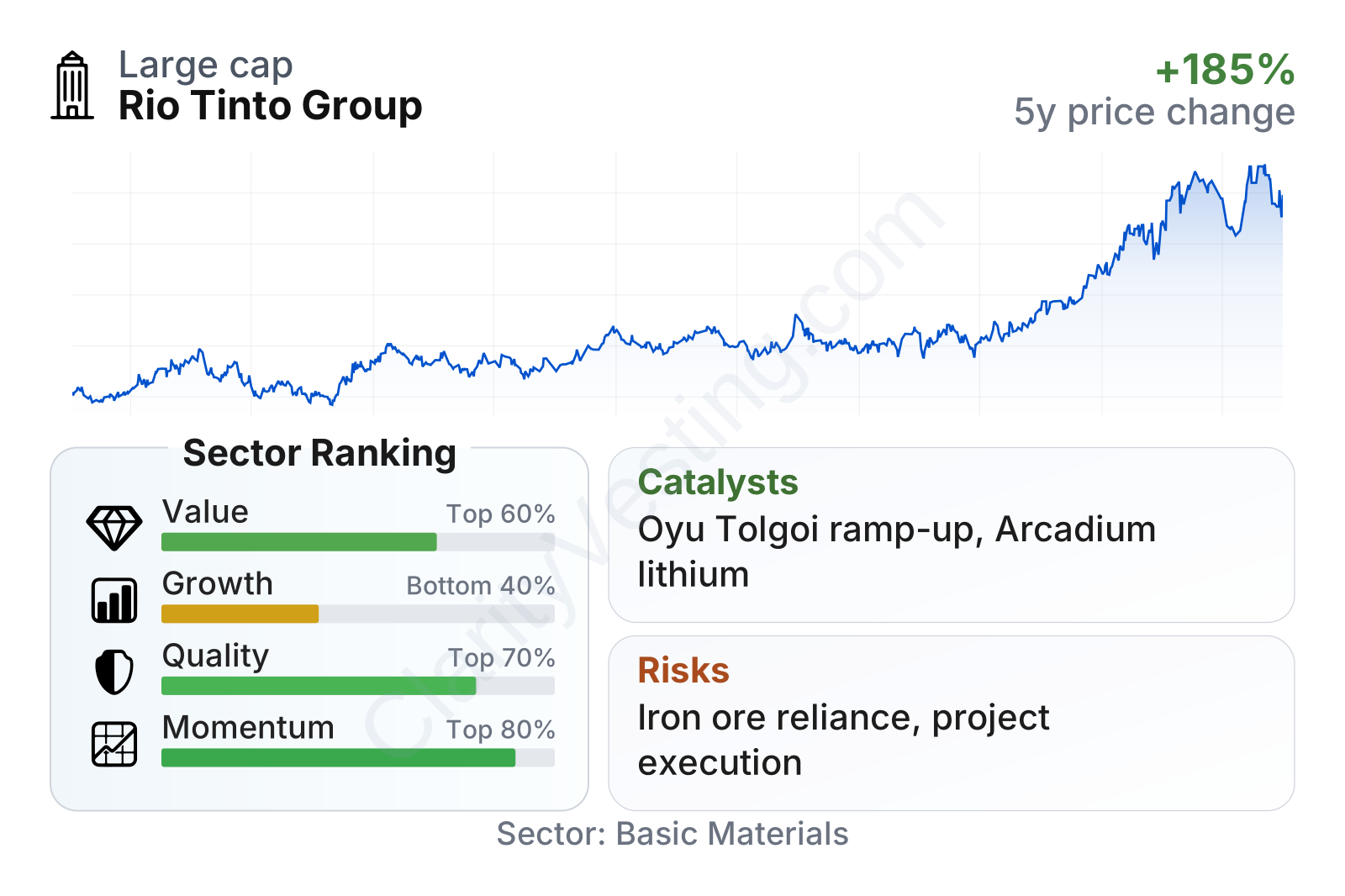
Rio Tinto stands out as a very large global miner with comparatively strong profitability and balance-sheet discipline. The quality profile is clearly above the sector median, helped by high returns on assets, solid operating margins, and low net debt relative to earnings. The growth profile is weaker, though: recent revenue growth has been good, but the longer-term record for revenue per share, free cash flow, and dividends has been less consistent. The valuation picture is mixed, with earnings-based measures looking moderate while the price-to-book ratio sits above the sector median.
The stock’s recent price performance has also been strong compared with much of the broader materials sector. That usually reflects improving market expectations around production, commodity prices, and large project delivery, but it also means sentiment is no longer depressed.
Growth
Rio Tinto operates in sectors that should remain important for many years. Iron ore still benefits from global steel demand tied to urbanization, infrastructure, and industrial activity. More importantly for longer-term growth, copper, aluminum, and certain industrial minerals are closely connected to electrification, grid investment, transportation upgrades, and lower-carbon technologies. These are not niche themes; they are large, multi-year demand drivers.
The company’s strategy broadly makes sense in that context. Rio Tinto is using the cash flow from its established iron ore business to support expansion in copper, aluminum, and lithium-related areas. The logic is straightforward: iron ore provides scale and cash generation, while copper and other transition-linked materials offer more structural demand support over time.
A major catalyst is the ramp-up of Oyu Tolgoi in Mongolia, one of the world’s largest known copper resources. As underground production increases, Rio Tinto can raise its exposure to copper without needing to reinvent the whole company. That is important because copper is one of the clearest long-duration growth commodities in mining. The group has also continued to invest in Pilbara replacement projects to sustain iron ore output, while pushing further into higher-value aluminum and low-carbon metal positioning.
Another notable development is Rio Tinto’s move to build a larger lithium presence through Arcadium Lithium. That adds direct exposure to battery materials, a market with attractive long-term demand potential even if near-term pricing remains cyclical. For a company already strong in bulk materials and industrial metals, lithium broadens the future-facing commodity mix.
Recent growth has looked better over the shorter term than over the five-year period. That gap matters. It suggests the company is capable of rebounding when operations and market conditions cooperate, but it has not yet translated that into smooth, sustained compounding across a full cycle.
Free cash flow remains one of the most important positives in the case. Even with mining’s natural volatility, Rio Tinto is still generating large absolute cash flow. That gives it flexibility to fund major projects, maintain dividends through cycles, and preserve a strong balance sheet while repositioning the portfolio.
Recent company updates have also emphasized project development in copper and lithium, along with efforts to improve productivity and mine replacement across key operations. For a miner of this scale, the combination of long-life assets, expansion in transition metals, and internal funding capacity is a meaningful growth platform.
Risks
This article is for informational purposes only and does not constitute financial advice. Some content is AI-generated. See Disclaimer


