Stock Analysis · Rightmove plc (RTMVF)
Overview
Rightmove plc operates the leading online property portal in the United Kingdom. Its platform connects home buyers, renters, sellers, landlords, estate agents, new-home developers, and commercial property professionals. In simple terms, Rightmove is the digital marketplace where property listings are displayed and where real estate professionals pay for visibility, leads, and related software tools.
The business model is attractive because it is largely based on recurring subscriptions from property professionals rather than one-time transaction fees. That makes revenue less dependent on whether an individual home sale closes, although market activity still matters because it affects customer demand for advertising and premium products.
Based on recent annual reporting, Rightmove’s revenue is mainly generated from three business lines.
- Estate Agency: approximately 70% to 75% of revenue. This is the core business, where estate agents pay monthly fees for listings, branding, lead-generation products, and premium visibility packages.
- New Homes: approximately 15% to 20% of revenue. Home developers and housebuilders use the platform to market newly built properties and related advertising products.
- Commercial Property: approximately 10% of revenue. This includes listings and marketing services for offices, retail, industrial, and other commercial real estate.
One of the most notable features of Rightmove’s model is how much of its revenue turns into profit and cash. Revenue has climbed steadily over recent years, while costs have grown much more slowly, allowing the company to keep exceptionally high operating margins. The visual breakdown of revenue, expenses, and profit makes that efficiency clear: the company converts a very large share of sales into operating income and free cash generation.
Key Figures
| Metric | Value | Sector ⓘ |
|---|---|---|
| Date | Oct 03, 2026 | |
| Context | ||
| Sector | Communication Services | |
| Industry | Internet Content & Information | |
| Market Cap ⓘ | $4.43B | |
| Beta ⓘ | 0.91 | |
Value (Cheapness) | ||
| P/E Ratio ⓘ | 16.05 | 18.20 |
| FCF Yield ⓘ | 10.22% | 14.71% |
| Dividend Yield ⓘ | 1.77% | 2.86% |
| EBIT / EV ⓘ | N/A | 4.85% |
| PEG ⓘ | N/A | |
Growth (Business expansion) | ||
| Revenue Growth ⓘ | 6.70% | 5.50% |
| RPS Growth (5Y CAGR) ⓘ | 11.52% | 4.55% |
| EPS Growth (5Y CAGR) ⓘ | -28.06% | -18.01% |
| Margin Growth (5Y Trend) ⓘ | -6.45% | 1.32% |
| FCF Growth (5Y CAGR) ⓘ | 5.18% | 5.96% |
| DPS Growth (5Y CAGR) ⓘ | 7.84% | 5.09% |
Quality (Business durability) | ||
| ROIC (Latest) ⓘ | N/A | 8.64% |
| ROIC (5Y Median) ⓘ | 260.43% | 8.11% |
| Net Debt / EBIT (Latest) ⓘ | -0.05 | 1.92 |
| Net Debt / EBIT (5Y Median) ⓘ | -0.11 | 2.85 |
| Net Debt / EBITDA (Latest) ⓘ | -0.05 | 1.25 |
| Net Debt / Assets ⓘ | -23.35% | 18.77% |
| EBITDA / Interest ⓘ | 559.81 | 8.75 |
| Operating Margin (Latest) ⓘ | 66.33% | 15.58% |
| Operating Margin (5Y Median) ⓘ | 70.83% | 13.53% |
| Debt to Equity (Latest) ⓘ | 7.30% | 59.53% |
| Profit Margin (Latest) ⓘ | 49.72% | 8.78% |
| Free Cash Flow (Latest) ⓘ | $452.27M | |
Momentum (Price trend) | ||
| 3Y Return ⓘ | -13.49% | +43.39% |
| 12M Return (excl. last month) ⓘ | -30.82% | +1.92% |
| 6M Return ⓘ | -5.79% | +2.94% |
| Price vs. 200-Day MA ⓘ | -17.00% | +0.74% |
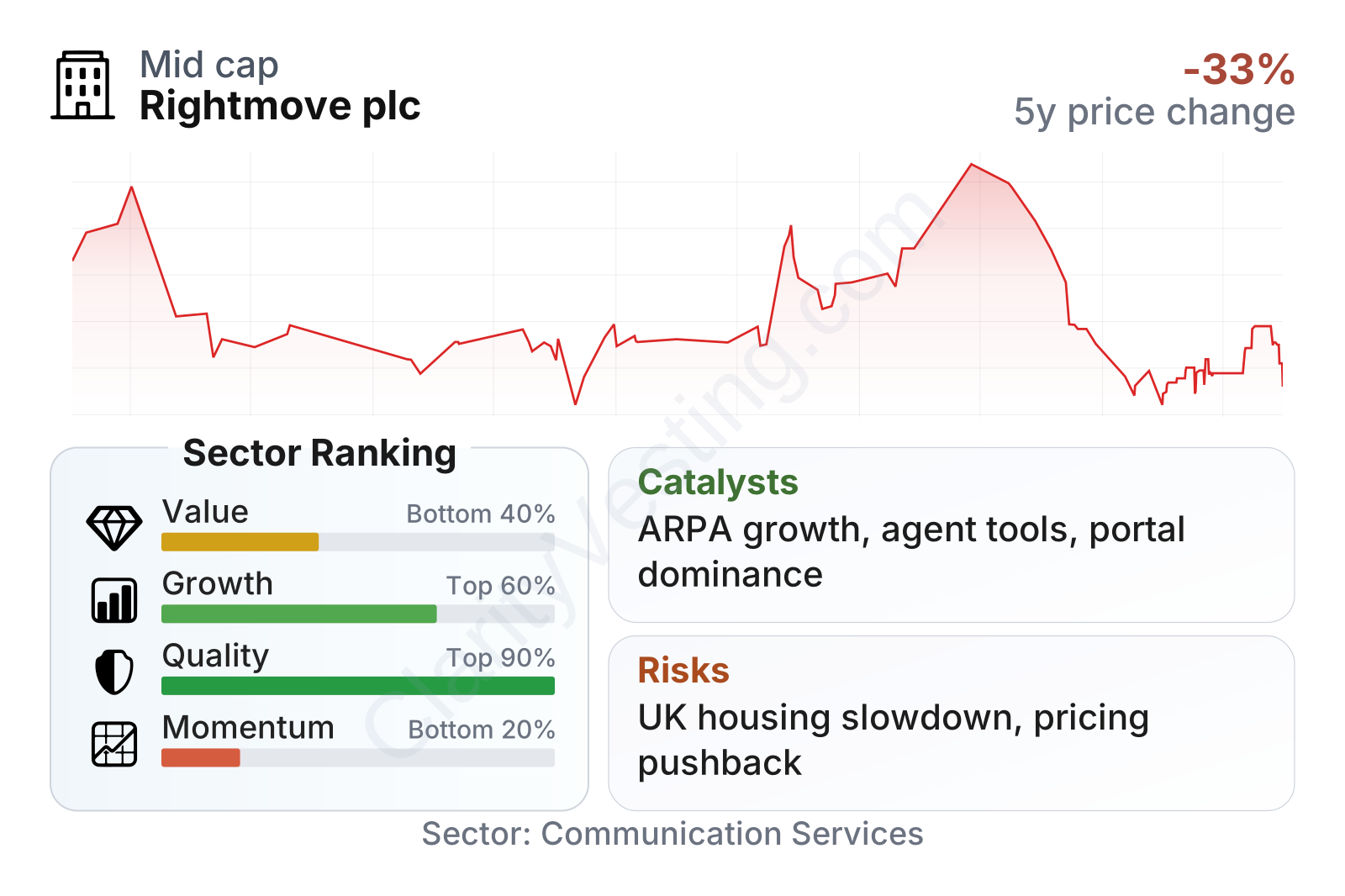
Rightmove stands out on business quality more than on headline cheapness or recent share-price strength. Profitability is far above typical companies in its sector, with operating margin around the mid-60% range and net margin close to 50%, both unusually strong for an online platform. The balance sheet is also very conservative, with net cash rather than meaningful net debt, which helps explain the very high interest coverage.
Growth is more mixed. Revenue has still been expanding, and the five-year increase in revenue per share is clearly ahead of the sector median. Free cash flow generation remains strong as well. However, earnings growth over five years looks weaker, and margins have eased from extremely high past levels, suggesting that cost growth and investment spending have taken some of the edge off the company’s peak profitability.
Market behavior has been softer than the operating profile. The shares have underperformed the sector over the last several months and over a multi-year period, which signals that sentiment has cooled even though the core economics of the business remain unusually strong.
Growth
Rightmove operates in a sector that should remain structurally relevant for a long time: digital property search and real estate advertising. Property markets naturally move in cycles, but the long-term direction of consumer behavior is clear. Most home searches begin online, and agents and developers need broad digital reach to attract leads efficiently. That trend supports continued demand for a dominant portal.
Its strategy for future growth is logical. Rather than relying only on more listing customers, Rightmove has been increasing average revenue per advertiser by offering premium products, data tools, branding options, and workflow software. This matters because the U.K. agency market is relatively mature; growth is more likely to come from deeper monetization of existing customers, expansion in adjacent services, and maintaining pricing power through audience scale.
There is also a network effect at work. Consumers go where the largest selection of listings is available, while agents want to advertise where the largest audience is searching. That loop can reinforce market leadership and make it easier to introduce higher-value products over time. The company’s very high returns on capital suggest this advantage has been real rather than theoretical.
A further positive factor is resilience. Even in slower housing markets, agents still need visibility to compete for instructions and leads. That does not make Rightmove immune to downturns, but it can make revenue more durable than transaction-based real estate businesses. The combination of recurring customer payments, strong brand recognition, and a cash-rich balance sheet gives the company room to invest through weaker periods.
Recent company updates have also pointed to ongoing product development around lead quality, digital tools, and enhanced offerings for agents and developers. These initiatives are important because they can support revenue growth without requiring dramatic expansion in customer numbers. In a mature market leader, that is often the clearest route to compounding.
Risks
This article is for informational purposes only and does not constitute financial advice. Some content is AI-generated. See Disclaimer