Stock Analysis · Resmed Inc DRC (RSMDF)
Overview
ResMed is a healthcare technology company focused on sleep-related breathing disorders and respiratory care. Its best-known products are devices and masks used to treat obstructive sleep apnea, especially CPAP and related systems. The company also sells equipment and software for people with chronic respiratory conditions treated at home or outside the hospital. In addition to hardware, ResMed has built a large software platform for care providers, helping sleep labs, home medical equipment providers, and nursing or senior care operators manage patients, workflows, billing, and compliance.
This mix matters because the business is not just selling one-time devices. A meaningful share of revenue comes from replacement masks and accessories that need to be repurchased regularly, while software adds recurring subscription-like income and helps strengthen customer relationships.
Based on recent company reporting, ResMed’s revenue is mainly organized as follows:
- Sleep and respiratory care devices and masks: approximately 85% to 90%. This is the core business and includes CPAP, APAP, bilevel devices, masks, humidifiers, and related accessories used mainly for sleep apnea and home respiratory care.
- Residential care software and related services: approximately 10% to 15%. This includes software used by out-of-hospital care providers, including operational, clinical, and administrative tools.
Within the hardware side, masks and accessories are especially important because they tend to generate repeat purchases, while device sales benefit from new patient starts and technology upgrades. Geographically, the United States is the largest market, with additional meaningful contributions from Europe and Asia-Pacific.
Over the last several years, revenue, gross profit, operating income, and net income have all moved steadily higher, while interest expense remained relatively low. That combination suggests improving scale and a business model that has become more efficient as sales expanded.
Key Figures
| Metric | Value | Sector ⓘ |
|---|---|---|
| Date | Oct 10, 2026 | |
| Context | ||
| Sector | Healthcare | |
| Industry | Medical Instruments & Supplies | |
| Market Cap ⓘ | $31.80B | |
| Beta ⓘ | 0.75 | |
Value (Cheapness) | ||
| P/E Ratio ⓘ | 21.74 | 24.79 |
| P/B Ratio ⓘ | 0.50 | 2.97 |
| FCF Yield ⓘ | 9.09% | 3.11% |
| Dividend Yield ⓘ | 10.61% | 2.04% |
| EBIT / EV ⓘ | 6.12% | 0.57% |
| PEG ⓘ | 1.31 | |
Growth (Business expansion) | ||
| Revenue Growth ⓘ | 8.60% | 7.35% |
| RPS Growth (5Y CAGR) ⓘ | 12.51% | 8.61% |
| EPS Growth (5Y CAGR) ⓘ | -2.23% | -18.43% |
| BVPS Growth (5Y CAGR) ⓘ | 18.73% | 3.94% |
| Margin Growth (5Y Trend) ⓘ | 6.29% | -0.61% |
| FCF Growth (5Y CAGR) ⓘ | 70.52% | 0.88% |
| DPS Growth (5Y CAGR) ⓘ | 9.65% | 6.74% |
Quality (Business durability) | ||
| ROIC (Latest) ⓘ | 21.66% | 3.34% |
| ROA (Latest) ⓘ | 17.64% | 2.95% |
| ROIC (5Y Median) ⓘ | 20.78% | 4.60% |
| ROA (5Y Median) ⓘ | 15.87% | 1.89% |
| Net Debt / EBIT (Latest) ⓘ | -0.33 | 1.36 |
| Net Debt / EBIT (5Y Median) ⓘ | 0.48 | 1.86 |
| Net Debt / EBITDA (Latest) ⓘ | -0.30 | 1.02 |
| Net Debt / Assets ⓘ | -7.18% | 5.85% |
| EBITDA / Interest ⓘ | 43.42 | 9.60 |
| Operating Margin (Latest) ⓘ | 34.01% | 9.19% |
| Operating Margin (5Y Median) ⓘ | 28.12% | 7.53% |
| Debt to Equity (Latest) ⓘ | 12.54% | 29.44% |
| Profit Margin (Latest) ⓘ | 26.95% | 3.52% |
| Free Cash Flow (Latest) ⓘ | $2.89B | |
Momentum (Price trend) | ||
| 3Y Return ⓘ | +65.83% | +34.80% |
| 12M Return (excl. last month) ⓘ | +49.23% | +19.33% |
| 6M Return ⓘ | -29.73% | +7.18% |
| Price vs. 200-Day MA ⓘ | +3.39% | +3.20% |
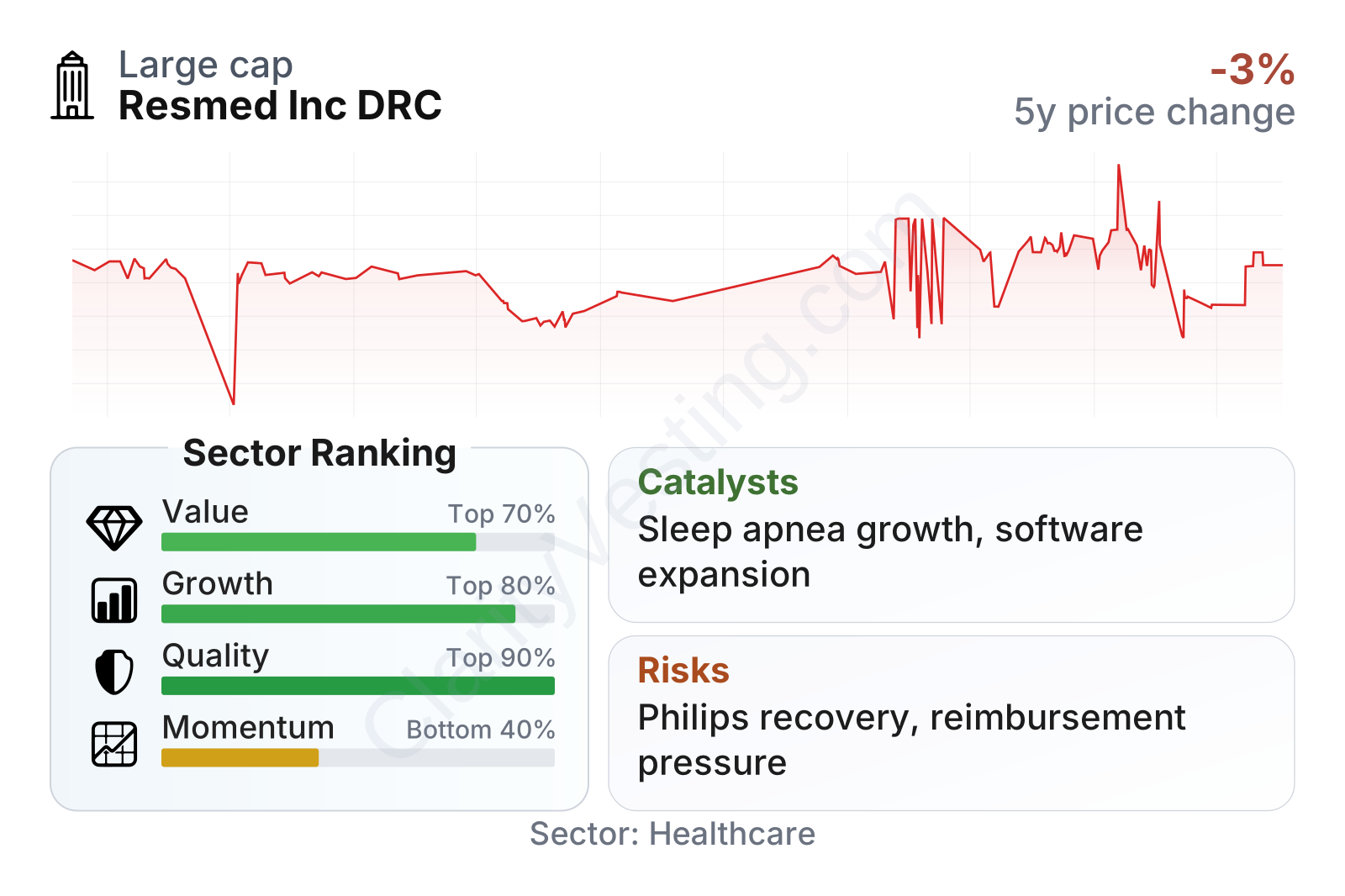
ResMed stands out for business quality. Profitability is well above the healthcare sector median, returns on capital are strong, and leverage is low. Growth metrics are also solid, with revenue and cash generation trending better than many peers. The main area that looks less impressive is recent share-price momentum, which has softened over the last six months even after a strong longer-term run.
Growth
ResMed operates in a market with durable long-term demand. Sleep apnea remains widely underdiagnosed globally, obesity trends continue to support patient growth, and aging populations increase the need for respiratory support and home-based care. These are not short-lived drivers. They are broad healthcare trends that can support demand for many years.
The company’s strategy also looks coherent for long-term expansion. It combines connected medical devices, consumable mask replacements, and software used by care providers. That creates several paths for growth at once: more diagnosed patients, more device placements, recurring replacement sales, and a larger installed base for digital services. This model is harder to disrupt than a pure hardware business because it mixes clinical products with data, workflow, and provider relationships.
Revenue growth has moderated from earlier spikes but has remained positive, and the recent pace still compares favorably with the sector median. That points to a company that is still expanding after the unusually strong demand recovery that followed supply disruptions in the sleep-device market.
Cash generation has improved dramatically over the last few years. That is important because it gives ResMed more flexibility to invest in research, manufacturing, software, acquisitions, and shareholder returns without relying heavily on debt. Strong free cash flow also reduces the pressure that can come from temporary slowdowns in a medical equipment cycle.
One of the strongest catalysts in recent years has been market-share capture after a major competitor faced prolonged product recalls in sleep therapy. ResMed benefited as providers and patients looked for reliable supply. More recently, the company has also continued introducing updated masks and connected device features, which can support retention and replacement demand. Its software business adds another layer of opportunity as healthcare providers shift more care into the home and increasingly need digital tools to manage patients efficiently.
A newer debate around obesity drugs has raised questions about future sleep apnea demand, since weight loss can reduce symptoms for some patients. ResMed has publicly argued that these therapies may still expand diagnosis and treatment pathways rather than simply reduce demand. For now, the company’s results suggest the underlying market remains healthy.
Risks
This article is for informational purposes only and does not constitute financial advice. Some content is AI-generated. See Disclaimer


