Stock Analysis · Republic Services Inc (RSG)
Overview
Republic Services is one of the largest waste and environmental services companies in the United States. Its core business is straightforward: it collects trash and recyclable materials from homes, businesses, and industrial customers, transports those materials through its network, and then either disposes of them in landfills or processes them for recycling and other recovery uses. The company also provides complementary services such as temporary waste containers, transfer stations, and environmental solutions for more specialized waste streams.
This is a business with an important local service element but strong national scale. Waste collection tends to be recurring, route-based, and tied to everyday economic activity, which makes demand relatively steady compared with many other industrial businesses. Republic also owns valuable infrastructure, especially landfills and transfer stations, that can be difficult and expensive for new competitors to replicate.
Based on recent company reporting, Republic’s revenue is mainly generated from its collection business, with disposal and environmental services making up smaller but still meaningful contributions. A practical way to think about the business mix is the following:
- Collection operations: about 70% to 75% of revenue. This includes residential, small-container commercial, large-container industrial, and other recurring pickup services.
- Landfill and transfer operations: about 15% to 20% of revenue. This covers disposal fees, transfer station activity, and the economics of owning key waste infrastructure.
- Environmental solutions and other services: about 8% to 12% of revenue. This includes more specialized waste handling, field services, and related offerings.
- Recycling and commodity-related revenue: a smaller share that can fluctuate with prices for recovered materials.
One useful feature of this model is that Republic does not rely only on volume growth. Pricing, route density, disposal ownership, and cost control are all important drivers of profitability. Over time, that can make the business more resilient than a simple volume-based operator.
Over the last several years, revenue, operating income, and net income have all moved higher, while operating profitability has stayed strong. That points to a company that has been expanding without giving up margin discipline, even as interest expense has also risen.
Key Figures
| Metric | Value | Sector ⓘ |
|---|---|---|
| Date | Oct 24, 2026 | |
| Context | ||
| Sector | Industrials | |
| Industry | Waste Management | |
| Market Cap ⓘ | $71.34B | |
| Beta ⓘ | 0.40 | |
Value (Cheapness) | ||
| P/E Ratio ⓘ | 32.49 | 22.29 |
| P/B Ratio ⓘ | 5.89 | 1.98 |
| FCF Yield ⓘ | 4.77% | 6.26% |
| Dividend Yield ⓘ | 1.09% | 1.92% |
| EBIT / EV ⓘ | 3.97% | 4.83% |
| PEG ⓘ | 2.74 | |
Growth (Business expansion) | ||
| Revenue Growth ⓘ | 4.60% | 9.30% |
| RPS Growth (5Y CAGR) ⓘ | 10.75% | 7.76% |
| EPS Growth (5Y CAGR) ⓘ | -8.39% | -13.17% |
| BVPS Growth (5Y CAGR) ⓘ | 8.09% | 6.13% |
| Margin Growth (5Y Trend) ⓘ | 2.46% | 0.74% |
| FCF Growth (5Y CAGR) ⓘ | 13.14% | 10.79% |
| DPS Growth (5Y CAGR) ⓘ | 8.14% | 9.41% |
Quality (Business durability) | ||
| ROIC (Latest) ⓘ | 10.48% | 10.75% |
| ROA (Latest) ⓘ | 6.34% | 5.41% |
| ROIC (5Y Median) ⓘ | 9.59% | 9.37% |
| ROA (5Y Median) ⓘ | 5.73% | 4.95% |
| Net Debt / EBIT (Latest) ⓘ | 4.50 | 2.04 |
| Net Debt / EBIT (5Y Median) ⓘ | 4.75 | 2.27 |
| Net Debt / EBITDA (Latest) ⓘ | 2.52 | 1.39 |
| Net Debt / Assets ⓘ | 40.35% | 19.27% |
| EBITDA / Interest ⓘ | 9.54 | 9.58 |
| Operating Margin (Latest) ⓘ | 18.67% | 10.49% |
| Operating Margin (5Y Median) ⓘ | 18.18% | 10.30% |
| Debt to Equity (Latest) ⓘ | 118.81% | 64.82% |
| Profit Margin (Latest) ⓘ | 12.94% | 6.67% |
| Free Cash Flow (Latest) ⓘ | $3.40B | |
Momentum (Price trend) | ||
| 3Y Return ⓘ | +64.19% | +67.77% |
| 12M Return (excl. last month) ⓘ | -4.65% | +12.05% |
| 6M Return ⓘ | +12.88% | 0.00% |
| Price vs. 200-Day MA ⓘ | +7.34% | +0.67% |
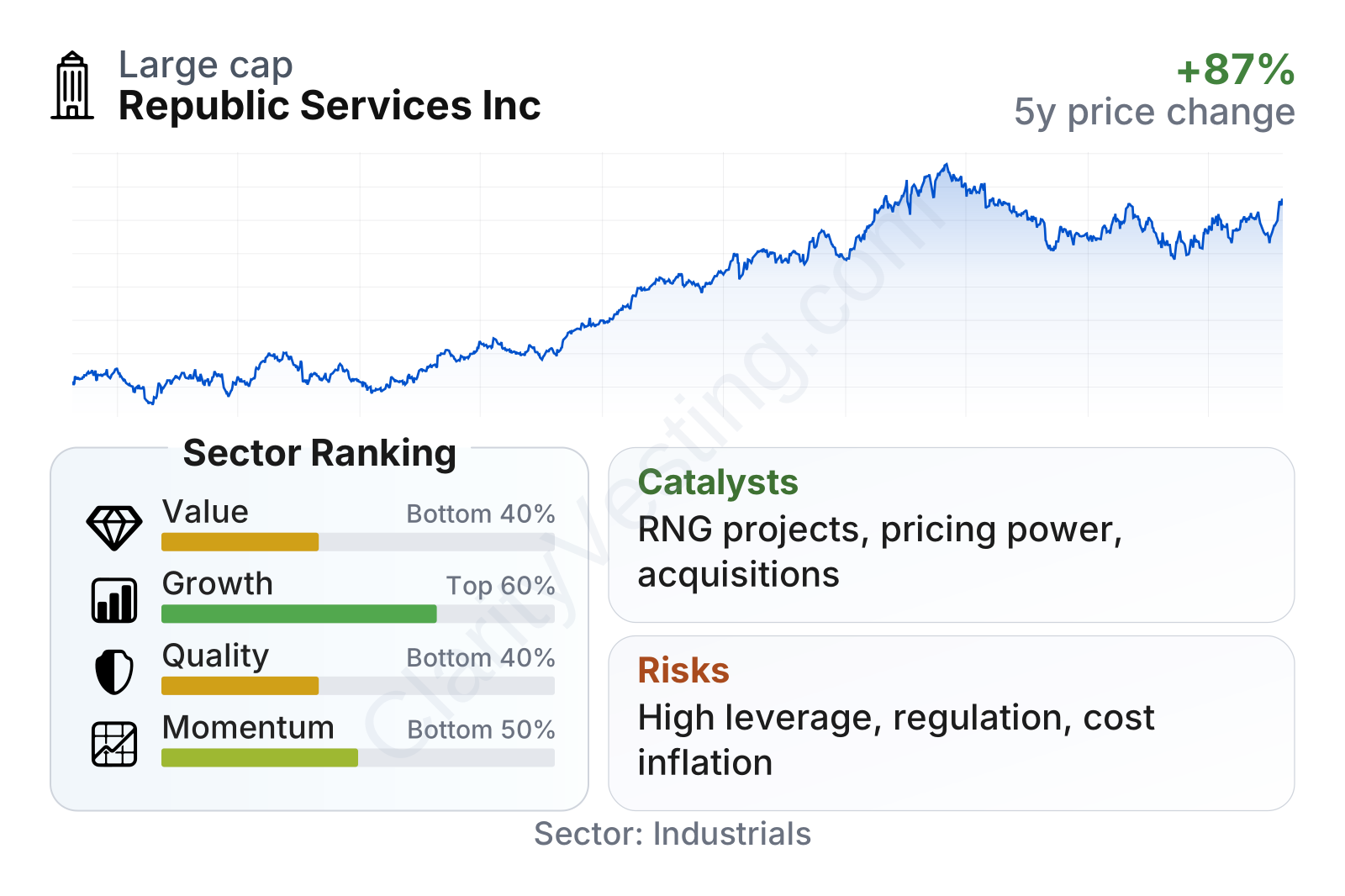
Republic stands out as a large, lower-volatility company in its sector, with a beta around 0.4. Profitability metrics are strong, especially margins, and the long-term cash generation trend has been favorable. The weaker areas are valuation and leverage: the shares trade above sector median multiples, while debt-related measures are also higher than many industrial peers. Growth is solid rather than fast, with revenue growth currently modest but multi-year free cash flow and revenue-per-share trends still encouraging.
The stock’s longer-term price trend has been clearly positive, although recent momentum has cooled. That combination often appears in businesses viewed as dependable and defensive: the market has historically been willing to pay a premium, but that premium also leaves less room for disappointment.
Growth
Waste management is generally considered a durable growth sector rather than a high-growth one. Population trends, business formation, construction activity, and stricter environmental requirements all support long-term demand. In addition, the industry has historically benefited from consolidation, because scale improves route efficiency, purchasing power, and the economics of landfill ownership.
Republic’s strategy for future growth is coherent. The company continues to focus on price-led revenue improvement, disciplined acquisitions, technology-enabled operating efficiency, and higher-value environmental services. It has also been investing in sustainability-related projects such as recycling upgrades and landfill gas-to-renewable natural gas facilities. Those projects matter because they can turn existing landfill assets into additional revenue streams while also supporting customer and regulatory demand for lower-emission waste solutions.
Revenue growth has slowed from the unusually strong post-2021 period into a more normal mid-single-digit range. That is not surprising for a mature infrastructure business. What matters more is that growth has remained positive and has been supported by pricing discipline rather than depending entirely on higher waste volumes.
Free cash flow has shown a strong upward trend over the last several years, reaching well above $2.5 billion on a trailing basis and around $3.4 billion on the latest trailing twelve-month measure in the broader metrics set. For a company like Republic, this is especially important because cash flow supports acquisitions, infrastructure investment, debt service, dividends, and share repurchases. A business that can steadily grow cash generation often has more strategic flexibility than one that only grows accounting earnings.
A meaningful recent opportunity comes from the continued buildout of renewable natural gas and broader resource recovery initiatives. Republic has highlighted these projects in its public communications as part of a longer-term plan to extract more value from landfill assets. Another support factor is the company’s acquisition pipeline in a fragmented industry, where smaller local operators can still be integrated into a larger network.
Risks
This article is for informational purposes only and does not constitute financial advice. Some content is AI-generated. See Disclaimer


