Stock Analysis · RPM International Inc (RPM)
Overview
RPM International is a specialty coatings, sealants, building materials, and chemical products company. Its products are mostly used to protect, repair, seal, bond, and improve surfaces in homes, commercial buildings, industrial facilities, and infrastructure. The company operates through a collection of brands rather than a single flagship product, which helps spread demand across many end markets.
Its business is organized into four reporting segments. Based on the latest annual filing, revenue is distributed approximately as follows:
- Consumer Group — about 34%: do-it-yourself products sold through retail channels, including caulks, sealants, wood stains, rust-prevention coatings, patch and repair products, and hobby or craft coatings.
- Construction Products Group — about 31%: roofing systems, waterproofing, flooring systems, insulated cladding, concrete admixtures, sealants, and related products used in commercial construction and renovation.
- Performance Coatings Group — about 21%: high-performance coatings, restoration systems, fireproofing, corrosion control, and other specialty systems used in industrial and infrastructure settings.
- Specialty Products Group — about 14%: niche products such as edible coatings, additives, maintenance chemicals, and other specialized materials serving industrial and institutional customers.
Geographically, RPM still depends mainly on North America, but it also has meaningful international exposure. That mix gives it access to repair and maintenance spending, which is often steadier than new construction alone.
Over the last several years, revenue has moved upward from roughly $6.7 billion to nearly $7.9 billion, while gross profit and operating income have also improved. One notable feature is that selling and administrative costs have risen as well, so the company’s ability to keep translating sales growth into profit growth remains important.
Key Figures
| Metric | Value | Sector ⓘ |
|---|---|---|
| Date | Oct 17, 2026 | |
| Context | ||
| Sector | Basic Materials | |
| Industry | Specialty Chemicals | |
| Market Cap ⓘ | $12.55B | |
| Beta ⓘ | 1.04 | |
Value (Cheapness) | ||
| P/E Ratio ⓘ | 18.20 | 16.90 |
| P/B Ratio ⓘ | 3.58 | 1.65 |
| FCF Yield ⓘ | 5.62% | 5.76% |
| Dividend Yield ⓘ | 2.21% | 2.13% |
| EBIT / EV ⓘ | 6.89% | 6.30% |
| PEG ⓘ | 1.66 | |
Growth (Business expansion) | ||
| Revenue Growth ⓘ | 4.80% | 11.10% |
| RPS Growth (5Y CAGR) ⓘ | 4.46% | 4.49% |
| EPS Growth (5Y CAGR) ⓘ | -21.21% | -13.47% |
| BVPS Growth (5Y CAGR) ⓘ | 14.14% | 5.51% |
| Margin Growth (5Y Trend) ⓘ | 2.18% | -1.54% |
| FCF Growth (5Y CAGR) ⓘ | N/A | 0.37% |
| DPS Growth (5Y CAGR) ⓘ | 7.80% | 6.08% |
Quality (Business durability) | ||
| ROIC (Latest) ⓘ | 13.53% | 9.26% |
| ROA (Latest) ⓘ | 8.57% | 4.91% |
| ROIC (5Y Median) ⓘ | 13.14% | 7.70% |
| ROA (5Y Median) ⓘ | 8.21% | 3.86% |
| Net Debt / EBIT (Latest) ⓘ | 2.30 | 1.40 |
| Net Debt / EBIT (5Y Median) ⓘ | 2.99 | 1.70 |
| Net Debt / EBITDA (Latest) ⓘ | 1.91 | 0.95 |
| Net Debt / Assets ⓘ | 29.50% | 13.69% |
| EBITDA / Interest ⓘ | 11.80 | 12.34 |
| Operating Margin (Latest) ⓘ | 13.26% | 13.20% |
| Operating Margin (5Y Median) ⓘ | 12.06% | 11.80% |
| Debt to Equity (Latest) ⓘ | 78.80% | 40.56% |
| Profit Margin (Latest) ⓘ | 8.66% | 6.43% |
| Free Cash Flow (Latest) ⓘ | $705.58M | |
Momentum (Price trend) | ||
| 3Y Return ⓘ | +7.75% | +68.89% |
| 12M Return (excl. last month) ⓘ | -18.62% | +30.21% |
| 6M Return ⓘ | -8.92% | -4.16% |
| Price vs. 200-Day MA ⓘ | -6.82% | -1.27% |
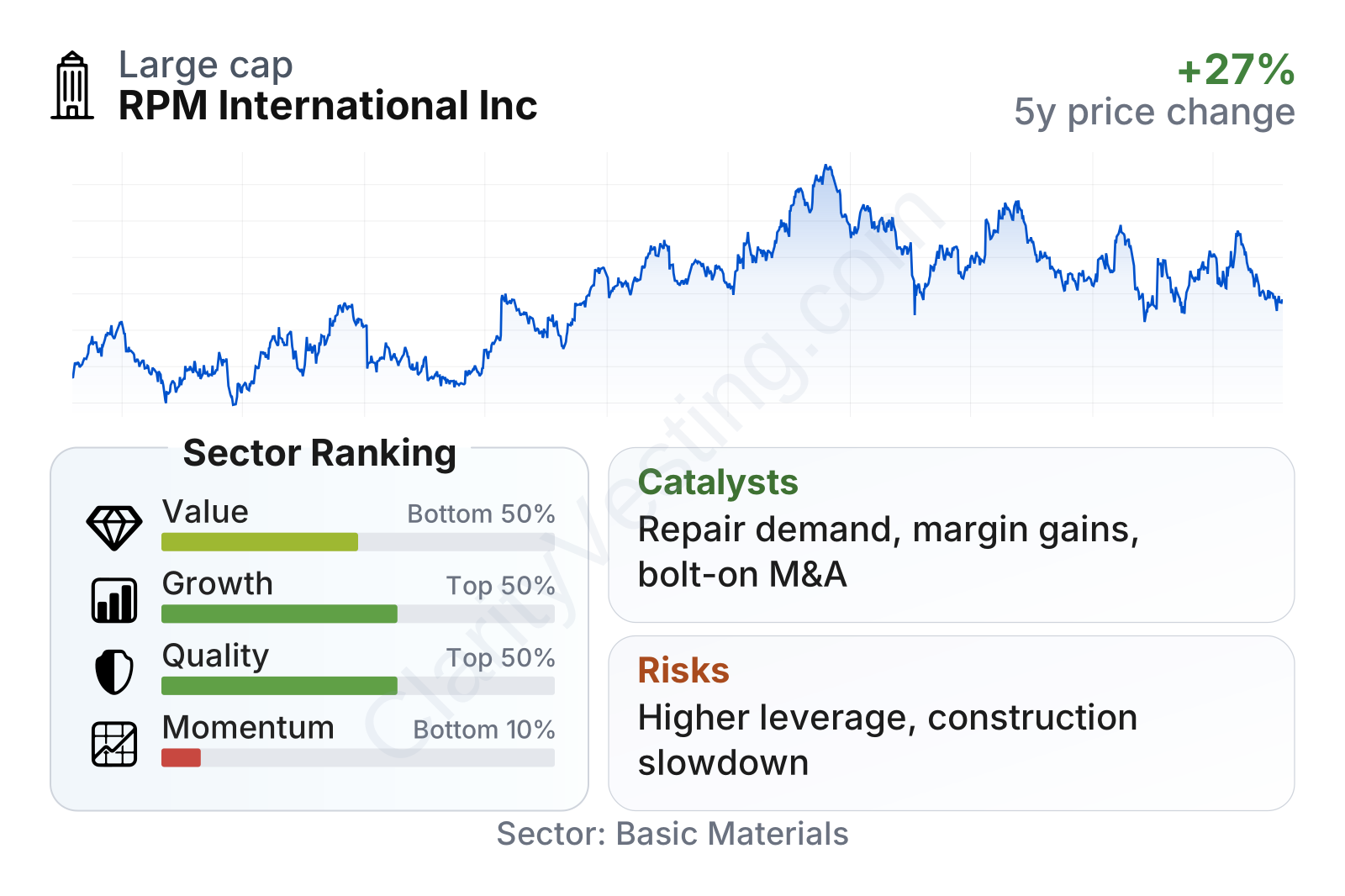
RPM is a mid-to-large specialty chemicals company with a stock that has been more volatile than a defensive consumer staple but not unusually extreme for an industrial-materials business. The overall profile is mixed: business quality and profitability metrics are generally above sector medians, growth is adequate rather than fast, valuation is not obviously cheap on traditional measures, and recent share-price momentum has been weak compared with much of the sector.
The table points to a company with solid returns on capital and assets, along with profit margins that remain above many peers. At the same time, leverage is clearly higher than sector norms, which tempers the quality profile. On valuation, RPM does not screen as a deep discount name: earnings and free-cash-flow measures are around the sector range, while price-to-book sits noticeably above typical peers.
Growth
RPM operates in markets that benefit from several durable themes: aging buildings and infrastructure, ongoing maintenance needs, demand for energy efficiency, tighter building-performance standards, and the long replacement cycle of roofs, sealants, coatings, and flooring systems. These are not hypergrowth markets, but they can produce steady expansion over long periods because repair and protection work cannot be delayed forever.
The company’s strategy also makes practical sense for long-term expansion. RPM has built a portfolio of specialized brands that often serve niche applications where performance matters more than price alone. That tends to support customer loyalty and allows the business to participate in both consumer and professional channels. Acquisitions have also been part of the playbook, giving RPM a way to add products and reach without depending entirely on internal development.
Recent revenue growth has reaccelerated after a softer stretch in 2024. The pattern suggests RPM is not a straight-line grower, but it has shown the ability to recover and return to positive sales growth. Its five-year revenue-per-share trend is close to the sector median, which fits the picture of a steady compounder rather than a rapid expansion company.
Cash generation is another important part of the growth case. Free cash flow has been uneven from year to year, which is common in a business affected by working capital swings, but the broader picture remains constructive. RPM still generates substantial cash, and that gives it room for dividends, bolt-on acquisitions, debt reduction, and operational investments.
A meaningful catalyst is continued demand for restoration and maintenance instead of full replacement. In periods when property owners delay large new projects, they often still spend on repair, sealing, waterproofing, and corrosion protection. Another possible tailwind is margin improvement from internal efficiency programs and pricing discipline, especially if raw-material inflation remains manageable. Recent company updates have also highlighted ongoing business transformation and productivity efforts, which could support earnings even if volume growth stays moderate.
Risks
This article is for informational purposes only and does not constitute financial advice. Some content is AI-generated. See Disclaimer


