Stock Analysis · REA Group Limited (RPGRF)
Overview
REA Group Limited operates digital property marketplaces, with its core business centered on online real estate advertising. Its best-known brand is realestate.com.au in Australia, where agents, developers, and other property industry participants pay to list homes, promote projects, buy advertising products, and subscribe to software and data services. The company also has mortgage broking and home finance operations, plus minority or controlling interests in property portal businesses in several international markets.
The business model is attractive because much of the revenue comes from recurring or repeat spending tied to property listings, agent marketing budgets, and software subscriptions. As the platform attracts more home seekers, agents gain stronger incentives to spend on premium products, which reinforces REA’s market position.
Based on recent annual reporting, revenue is mainly generated from the following areas:
- Australia residential: approximately 75% to 80% of group revenue. This includes residential property listings, depth and prominence upgrades, developer project marketing, and related advertising products.
- Financial Services: approximately 10% to 15%. This includes mortgage broking, home loans distribution, and related financial services activities, mainly through Mortgage Choice and other home finance offerings.
- India: approximately 5% to 10%. This comes primarily from REA India’s digital property platforms and related services.
- Commercial, data, and other: approximately 5%. This includes commercial property advertising, data products, media, and smaller adjacent services.
Over the last several years, the company has become even more digital-platform driven, with revenue rising faster than the physical cost base. That shows up in expanding profitability as higher-value products and software-like economics carry more weight in the mix.
The long-term pattern is notable: revenue has climbed from roughly A$1.4 billion to just above A$2.0 billion over four years, while operating income has increased even faster. Cost of revenue is very low relative to sales, which is typical of a marketplace platform and helps explain why margins are much stronger than most companies in the broader communication services sector.
Key Figures
| Metric | Value | Sector ⓘ |
|---|---|---|
| Date | Oct 03, 2026 | |
| Context | ||
| Sector | Communication Services | |
| Industry | Internet Content & Information | |
| Market Cap ⓘ | $16.29B | |
| Beta ⓘ | 0.68 | |
Value (Cheapness) | ||
| P/E Ratio ⓘ | 40.54 | 18.20 |
| FCF Yield ⓘ | 8.80% | 14.71% |
| Dividend Yield ⓘ | 2.39% | 2.86% |
| EBIT / EV ⓘ | N/A | 4.85% |
| PEG ⓘ | 0.76 | |
Growth (Business expansion) | ||
| Revenue Growth ⓘ | 6.10% | 5.50% |
| RPS Growth (5Y CAGR) ⓘ | 8.99% | 4.55% |
| EPS Growth (5Y CAGR) ⓘ | 17.33% | -18.01% |
| Margin Growth (5Y Trend) ⓘ | 9.47% | 1.32% |
| FCF Growth (5Y CAGR) ⓘ | N/A | 5.96% |
| DPS Growth (5Y CAGR) ⓘ | 15.57% | 5.09% |
Quality (Business durability) | ||
| ROIC (Latest) ⓘ | N/A | 8.64% |
| ROIC (5Y Median) ⓘ | 29.64% | 8.11% |
| Net Debt / EBIT (Latest) ⓘ | -0.16 | 1.92 |
| Net Debt / EBIT (5Y Median) ⓘ | -0.01 | 2.85 |
| Net Debt / EBITDA (Latest) ⓘ | -0.14 | 1.25 |
| Net Debt / Assets ⓘ | -9.94% | 18.77% |
| EBITDA / Interest ⓘ | 152.34 | 8.75 |
| Operating Margin (Latest) ⓘ | 45.66% | 15.58% |
| Operating Margin (5Y Median) ⓘ | 39.05% | 13.53% |
| Debt to Equity (Latest) ⓘ | 3.98% | 59.53% |
| Profit Margin (Latest) ⓘ | 27.90% | 8.78% |
| Free Cash Flow (Latest) ⓘ | $1.43B | |
Momentum (Price trend) | ||
| 3Y Return ⓘ | +38.47% | +43.39% |
| 12M Return (excl. last month) ⓘ | -17.39% | +1.92% |
| 6M Return ⓘ | +1.41% | +2.94% |
| Price vs. 200-Day MA ⓘ | +1.53% | +0.74% |
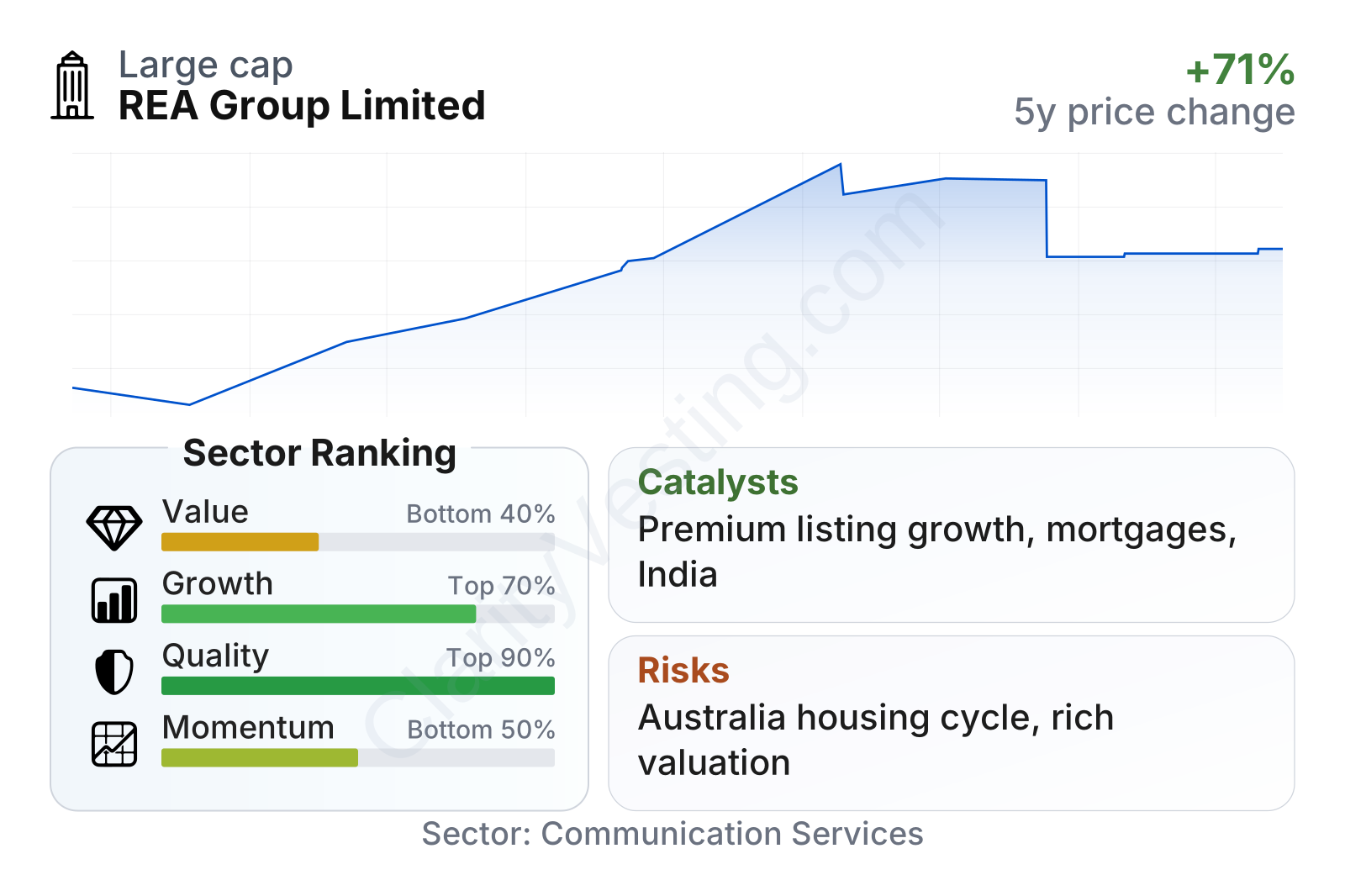
REA Group stands out most on business quality rather than cheapness. Profitability is unusually strong, with operating margin around the mid-40% range versus a sector median near the mid-teens, and profit margin also far above peers. The balance sheet is another strength: debt is very low, net cash metrics are slightly positive, and interest coverage is exceptionally high. Growth has also been solid over a multiyear period, especially in earnings and revenue per share. The weaker point is valuation, with the earnings multiple well above the sector median and cash flow yield below many peers, suggesting the market is already pricing in a premium for the company’s market position and margins. Share price momentum has been more mixed recently, even though the longer-term direction remains positive.
Growth
REA Group operates in a sector that still has room to expand over time: digital property search, agent marketing tools, housing-related data, and online mortgage distribution. Real estate activity itself is cyclical, but the structural shift toward digital advertising and online lead generation is already well established and continues to deepen. In mature markets, growth often comes less from adding first-time users and more from increasing monetization per listing, selling premium visibility products, and expanding into adjacent services such as mortgages, software, and data.
That strategy makes sense for REA because it already has scale, traffic, and brand recognition in Australia. A leading portal can convert audience attention into several layers of spending: listing fees, premium placement, developer marketing, display advertising, lead generation, and software subscriptions. Adding home loans and broking services extends the customer relationship beyond search, which could raise revenue per transaction over time if execution remains strong.
International operations are smaller, but they still matter as optional upside. India is the most visible growth market in the portfolio because online real estate penetration and housing digitization there are less mature than in Australia. That does not make it a near-term profit engine on the same level as the Australian business, but it can support a longer runway if scale improves.
A recent positive signal is that the company’s 2026 financial profile still shows revenue growth, very high margins, and strong free cash generation despite a more uneven property market backdrop. That combination suggests REA has pricing power and resilient customer demand for premium products. Another important catalyst is the potential for further monetization through agent software, data tools, and mortgage services, where the company can cross-sell to an already engaged property audience.
Risks
This article is for informational purposes only and does not constitute financial advice. Some content is AI-generated. See Disclaimer