Stock Analysis · Rapid7 Inc (RPD)
Overview
Rapid7 is a cybersecurity software company. Its products help organizations find security weaknesses, detect attacks, respond to incidents, and manage technology assets across cloud environments, on-premise systems, and employee devices. In simple terms, Rapid7 sells tools that help companies understand where they are exposed, monitor for threats, and act faster when something goes wrong.
The business has shifted over time toward a more unified, subscription-based platform. Rapid7’s main offerings include exposure management and vulnerability management, cloud security, threat detection and response, application security, and security operations tools. The company also provides security services such as managed detection and incident response support.
Based on company filings, most revenue comes from subscriptions rather than one-time software licenses or large service projects. Rapid7 reports revenue primarily as subscription revenue and services revenue.
- Subscription revenue: about 94% of 2025 revenue. This includes access to Rapid7’s security software platform, recurring product subscriptions, and cloud-delivered security capabilities such as vulnerability management, threat detection, cloud risk monitoring, and related modules.
- Services revenue: about 6% of 2025 revenue. This includes professional services, training, consulting, and certain incident response or advisory work tied to customer deployments and security operations.
The broad picture is that Rapid7 is now overwhelmingly a recurring-revenue software company. That is usually a positive feature for long-term business visibility, even if growth has recently slowed. Over the last several years, revenue expanded meaningfully, gross profit stayed high, and the company moved from sizable losses to modest profitability, but recent top-line momentum has weakened.
The operating profile shows a software business with strong gross margins and heavy spending on product development and go-to-market functions. The notable improvement is that Rapid7 turned operating profit positive in 2024 and stayed profitable in 2025, even though revenue growth cooled sharply.
Key Figures
| Metric | Value | Sector ⓘ |
|---|---|---|
| Date | Oct 31, 2026 | |
| Context | ||
| Sector | Technology | |
| Industry | Software - Infrastructure | |
| Market Cap ⓘ | $1.19B | |
| Beta ⓘ | 1.02 | |
Value (Cheapness) | ||
| P/E Ratio ⓘ | 56.77 | 29.73 |
| FCF Yield ⓘ | 11.83% | 3.96% |
| Dividend Yield ⓘ | N/A | 1.30% |
| EBIT / EV ⓘ | 2.24% | 2.90% |
| PEG ⓘ | 0.92 | |
Growth (Business expansion) | ||
| Revenue Growth ⓘ | -1.50% | 15.80% |
| RPS Growth (5Y CAGR) ⓘ | 8.10% | 8.54% |
| EPS Growth (5Y CAGR) ⓘ | 15.55% | -10.19% |
| Margin Growth (5Y Trend) ⓘ | N/A | 0.45% |
| FCF Growth (5Y CAGR) ⓘ | 33.94% | 9.80% |
| DPS Growth (5Y CAGR) ⓘ | N/A | 7.67% |
Quality (Business durability) | ||
| ROIC (Latest) ⓘ | 2.69% | 9.74% |
| ROIC (5Y Median) ⓘ | -8.35% | 8.31% |
| Net Debt / EBIT (Latest) ⓘ | 16.28 | 0.53 |
| Net Debt / EBIT (5Y Median) ⓘ | N/A | 0.46 |
| Net Debt / EBITDA (Latest) ⓘ | 6.90 | 0.29 |
| Net Debt / Assets ⓘ | 30.74% | 3.45% |
| EBITDA / Interest ⓘ | 7.63 | 13.54 |
| Operating Margin (Latest) ⓘ | 3.85% | 10.12% |
| Operating Margin (5Y Median) ⓘ | -10.38% | 8.50% |
| Debt to Equity (Latest) ⓘ | 488.88% | 35.18% |
| Profit Margin (Latest) ⓘ | 2.35% | 7.13% |
| Free Cash Flow (Latest) ⓘ | $140.28M | |
Momentum (Price trend) | ||
| 3Y Return ⓘ | -62.24% | +61.79% |
| 12M Return (excl. last month) ⓘ | -40.07% | +12.78% |
| 6M Return ⓘ | +194.31% | +7.85% |
| Price vs. 200-Day MA ⓘ | +87.16% | +5.43% |
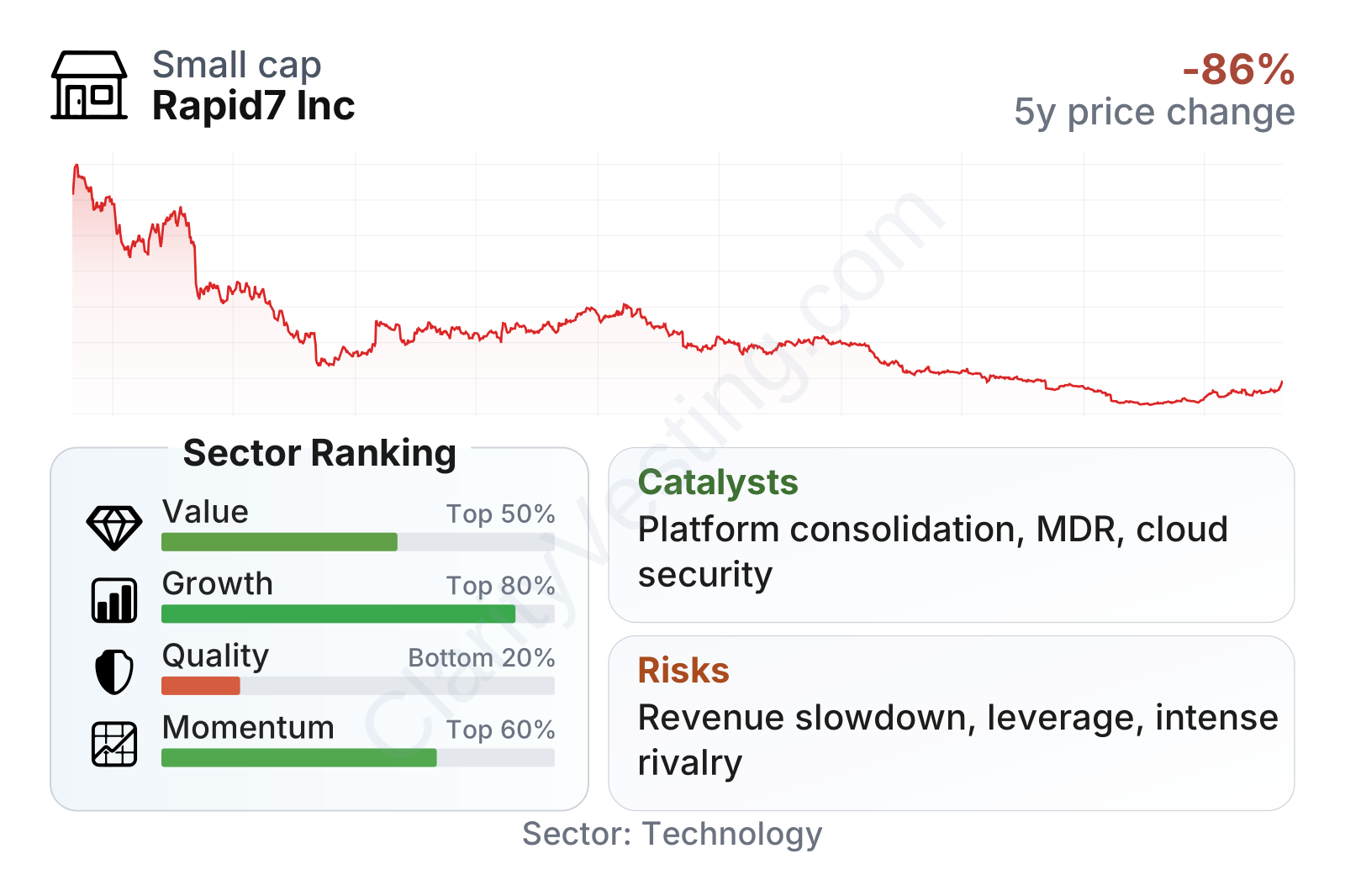
Rapid7 is now a small-cap cybersecurity software company after a very large stock-price decline from its 2021 peak. The latest factor snapshot is mixed. Growth and momentum are better than quality, while valuation looks split: the earnings multiple is above the sector median, but free cash flow yield is notably stronger than the median. That combination usually means the market is giving some credit for cash generation, while still questioning the durability of earnings quality and future growth.
Growth
Cybersecurity remains a structurally growing sector. The long-term demand drivers are still favorable: more cloud adoption, more connected devices, stricter regulation, rising ransomware activity, and the need to consolidate security tools. Most organizations are still dealing with a fragmented security stack, which creates room for vendors that can cover several needs through one platform.
Rapid7’s strategy fits that trend reasonably well. The company has built a platform that connects vulnerability management, exposure management, cloud security, and detection and response. That matters because many customers want fewer vendors and better integration between prevention and response. Rapid7 is not the largest player in cybersecurity, but it does compete in categories that remain strategically important.
The challenge is that revenue growth has decelerated materially. Year-over-year growth was above 30% in 2021 and 2022, then slowed into low double digits in 2023, mid-single digits in 2024, and turned slightly negative by the first half of 2026. That is a meaningful change. It suggests either tougher customer spending conditions, product competition, go-to-market execution issues, or a combination of all three.
Cash generation has held up better than revenue growth. Free cash flow improved strongly from 2022 through 2025 and remains clearly positive, although it has eased from its peak more recently. That is important because it shows Rapid7 has become more disciplined operationally, even during a slowdown. Over a longer period, free cash flow growth has been much stronger than the sector median, which stands out as one of the more constructive parts of the investment case.
A key catalyst for future growth is product consolidation within customer security budgets. If Rapid7 can prove that one platform can replace multiple point solutions, it may protect customer retention and support upselling. Another catalyst is demand for managed security operations, where companies lacking in-house security talent often outsource parts of monitoring and response. Rapid7’s mix of software and services gives it a way to address that need.
Recent company communications have also emphasized platform integration, AI-assisted workflows, cloud security, and exposure management. Those themes align with where enterprise security spending is going. The opportunity is real, but the company still needs to convert that positioning into clearer and more durable revenue acceleration.
Risks
This article is for informational purposes only and does not constitute financial advice. Some content is AI-generated. See Disclaimer


