Stock Analysis · Rockwell Automation Inc (ROK)
Overview
Rockwell Automation is an industrial technology company focused on factory automation. In simple terms, it helps manufacturers run plants more efficiently by combining hardware, software, and services. Its products and systems are used to control machines, monitor production, improve safety, collect operating data, and connect factory equipment with digital tools.
The company serves a wide range of industries, including automotive, life sciences, consumer packaged goods, warehousing, mining, energy, and semiconductor-related manufacturing. A large part of its appeal comes from selling not just equipment, but also software and services that can remain embedded in customer operations for many years.
Based on the company’s latest annual reporting structure, revenue mainly comes from two operating segments:
- Intelligent Devices: about 43% of revenue. This includes drives, motor control products, industrial components, sensing devices, and safety products used directly on the factory floor.
- Software & Control: about 31% of revenue. This includes control systems, visualization software, information software, and lifecycle-related software that help customers automate and optimize production.
- Lifecycle Services: about 26% of revenue. This includes consulting, maintenance, repair, cybersecurity, network services, and project implementation support tied to installed automation systems.
This mix matters because it gives Rockwell exposure to both equipment spending and recurring support activity. Over the last several years, revenue has moved up and down with industrial demand, but the business has kept a strong gross profit base, showing that customers still value its automation offering even during softer periods.
The long-term pattern shows a company that expanded revenue meaningfully from 2021 to 2023, then went through a demand slowdown in 2024 and 2025. Even so, gross profit remained relatively resilient, which suggests pricing power and a product mix that still supports attractive profitability.
Key Figures
| Metric | Value | Sector ⓘ |
|---|---|---|
| Date | Oct 03, 2026 | |
| Context | ||
| Sector | Industrials | |
| Industry | Specialty Industrial Machinery | |
| Market Cap ⓘ | $48.02B | |
| Beta ⓘ | 1.51 | |
Value (Cheapness) | ||
| P/E Ratio ⓘ | 40.33 | 22.45 |
| P/B Ratio ⓘ | 14.04 | 1.98 |
| FCF Yield ⓘ | 3.13% | 6.31% |
| Dividend Yield ⓘ | 1.26% | 1.96% |
| EBIT / EV ⓘ | 2.83% | 4.81% |
| PEG ⓘ | 1.91 | |
Growth (Business expansion) | ||
| Revenue Growth ⓘ | 7.90% | 9.10% |
| RPS Growth (5Y CAGR) ⓘ | 5.40% | 7.75% |
| EPS Growth (5Y CAGR) ⓘ | 0.11% | -13.59% |
| BVPS Growth (5Y CAGR) ⓘ | 15.61% | 6.22% |
| Margin Growth (5Y Trend) ⓘ | -3.61% | 0.72% |
| FCF Growth (5Y CAGR) ⓘ | 4.46% | 10.98% |
| DPS Growth (5Y CAGR) ⓘ | 5.33% | 9.48% |
Quality (Business durability) | ||
| ROIC (Latest) ⓘ | 17.03% | 10.92% |
| ROA (Latest) ⓘ | 10.77% | 5.41% |
| ROIC (5Y Median) ⓘ | 15.85% | 9.21% |
| ROA (5Y Median) ⓘ | 8.69% | 4.94% |
| Net Debt / EBIT (Latest) ⓘ | 2.16 | 2.07 |
| Net Debt / EBIT (5Y Median) ⓘ | 2.96 | 2.28 |
| Net Debt / EBITDA (Latest) ⓘ | 1.77 | 1.43 |
| Net Debt / Assets ⓘ | 28.26% | 19.27% |
| EBITDA / Interest ⓘ | 13.15 | 9.53 |
| Operating Margin (Latest) ⓘ | 16.16% | 10.50% |
| Operating Margin (5Y Median) ⓘ | 15.42% | 10.27% |
| Debt to Equity (Latest) ⓘ | 103.41% | 65.48% |
| Profit Margin (Latest) ⓘ | 13.39% | 6.62% |
| Free Cash Flow (Latest) ⓘ | $1.50B | |
Momentum (Price trend) | ||
| 3Y Return ⓘ | +59.97% | +58.56% |
| 12M Return (excl. last month) ⓘ | +25.24% | +15.63% |
| 6M Return ⓘ | +22.05% | +4.19% |
| Price vs. 200-Day MA ⓘ | +3.33% | +0.93% |
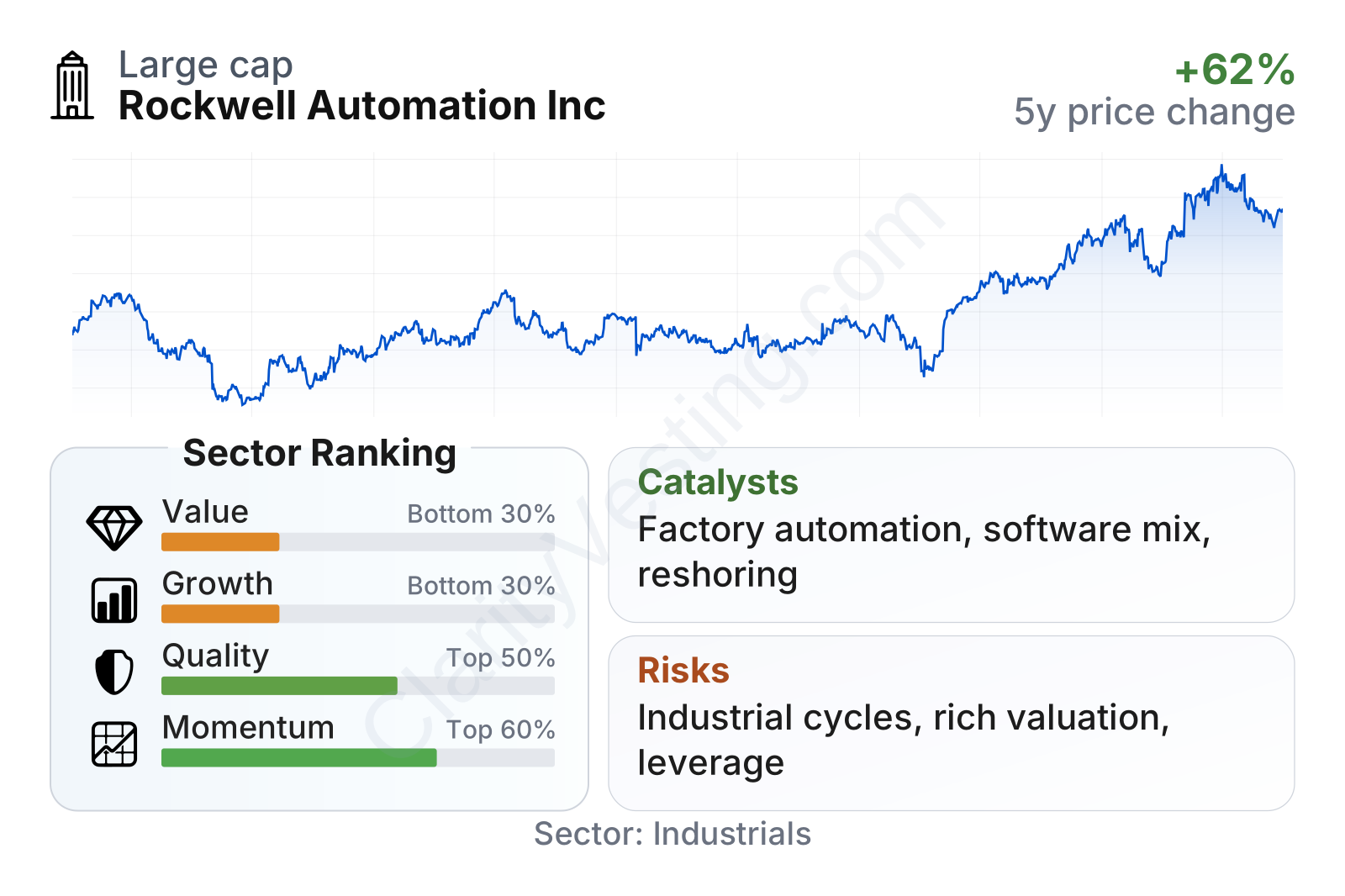
Rockwell Automation is a large industrial company with a market value in the tens of billions of dollars, but its share price has also been fairly volatile, reflected in a beta above 1.5. On profitability and returns on capital, it stands up well versus much of the industrial sector: operating margin, profit margin, return on assets, and return on invested capital are all stronger than typical peers. The weaker points are valuation and growth ranking. The stock trades at materially higher earnings and book multiples than sector norms, while recent growth measures are below many peers despite a recovery from the downturn.
Growth
Rockwell operates in a part of the industrial economy that still has a clear long-term growth runway. Manufacturers continue to automate production because labor is expensive, downtime is costly, and customers increasingly want more data from factory operations. Digital transformation in industry is not as visible as consumer technology, but it can be just as important. Factories need connected equipment, better control systems, predictive maintenance, and cybersecurity, all of which fit Rockwell’s portfolio.
The company’s strategy is broadly sensible for that environment. It is not relying only on selling boxes of hardware. It combines devices, control systems, software, and services, which makes customer relationships deeper and switching more difficult. That also gives it multiple ways to participate when customers modernize plants: from the first equipment purchase to software upgrades and ongoing support.
Recent revenue trends show a business that went through a sharp contraction after a very strong 2023, then returned to positive year-over-year growth. That kind of pattern is common in industrial automation, where customer orders can be lumpy and influenced by inventory corrections, capital spending cycles, and broader manufacturing sentiment. The important point is that growth has turned positive again, although not at a pace that clearly places Rockwell among the fastest-growing names in the sector.
Cash generation has been improving steadily, with trailing free cash flow now well above the level seen a few years ago. That is a constructive sign because free cash flow is what remains after operating needs and capital spending. For an industrial company, rising cash flow can support debt service, acquisitions, dividends, and internal investment without depending heavily on outside financing.
Several catalysts could support future expansion. Factory modernization remains a structural theme, especially in North America where Rockwell has a strong installed base. Demand from areas such as life sciences, data-center-related manufacturing, warehousing, and selected reshoring projects may also create opportunities. Another important angle is software and digital services: these activities can carry attractive margins and can deepen customer dependence on Rockwell’s systems.
Recent company communications have also highlighted collaboration around industrial software, digital engineering, and smart manufacturing tools. Those efforts matter because customers increasingly want complete solutions rather than isolated equipment. If Rockwell continues to convert its installed base into more software and services revenue, that could support a better growth profile than hardware alone.
Risks
This article is for informational purposes only and does not constitute financial advice. Some content is AI-generated. See Disclaimer