Stock Analysis · Gibraltar Industries Inc (ROCK)
Overview
Gibraltar Industries is a small industrial company focused on products and services tied to buildings, infrastructure, and renewable energy. Its businesses are organized around areas such as solar mounting systems, ventilation and roof-related products, mail and package solutions, and equipment used in residential and commercial construction. In practical terms, the company sells a mix of manufactured components and engineered systems that help buildings function better, last longer, and in some cases generate power.
The revenue base is diversified across several end markets, although the exact mix can shift year to year because project activity in solar can be uneven. Based on the company’s recent reporting structure and business descriptions, the main sources of revenue are approximately:
- Renewables: about 35% to 45% of revenue. This primarily includes solar racking, mounting systems, and related services for large-scale and distributed solar projects.
- Residential: about 25% to 35% of revenue. This includes ventilation products, roof and foundation-related items, rain dispersion products, and other components used in housing.
- Agtech and Infrastructure-related activities: about 15% to 25% of revenue combined, depending on project timing. These operations include controlled-environment growing solutions and products tied to infrastructure, logistics, and building-envelope applications.
Over the last several years, Gibraltar has shown a notable pattern: total revenue has moved down from its earlier peak, but profitability improved meaningfully through 2024 before weakening again more recently. That suggests management had some success in improving mix and costs, yet the business still remains exposed to cyclical demand and project timing.
The multi-year flow of revenue and earnings shows that sales declined from the 2022 range into 2025, while gross profit held up better than revenue for a period. That points to a favorable product mix and cost discipline earlier on, but the more recent pressure on earnings indicates that this improvement has become less stable.
Key Figures
| Metric | Value | Sector ⓘ |
|---|---|---|
| Date | Oct 17, 2026 | |
| Context | ||
| Sector | Industrials | |
| Industry | Building Products & Equipment | |
| Market Cap ⓘ | $1.21B | |
| Beta ⓘ | 1.24 | |
Value (Cheapness) | ||
| P/E Ratio ⓘ | 20.00 | 22.10 |
| P/B Ratio ⓘ | 1.29 | 1.97 |
| FCF Yield ⓘ | 3.53% | 6.38% |
| Dividend Yield ⓘ | N/A | 1.94% |
| EBIT / EV ⓘ | 4.50% | 4.79% |
| PEG ⓘ | 0.58 | |
Growth (Business expansion) | ||
| Revenue Growth ⓘ | 64.60% | 9.30% |
| RPS Growth (5Y CAGR) ⓘ | -1.68% | 7.81% |
| EPS Growth (5Y CAGR) ⓘ | -18.77% | -13.06% |
| BVPS Growth (5Y CAGR) ⓘ | 6.15% | 6.14% |
| Margin Growth (5Y Trend) ⓘ | 3.59% | 0.88% |
| FCF Growth (5Y CAGR) ⓘ | 117.87% | 11.01% |
| DPS Growth (5Y CAGR) ⓘ | 2.15% | 9.48% |
Quality (Business durability) | ||
| ROIC (Latest) ⓘ | 5.77% | 10.84% |
| ROA (Latest) ⓘ | -0.42% | 5.41% |
| ROIC (5Y Median) ⓘ | 9.76% | 9.38% |
| ROA (5Y Median) ⓘ | 6.94% | 4.95% |
| Net Debt / EBIT (Latest) ⓘ | 11.51 | 2.08 |
| Net Debt / EBIT (5Y Median) ⓘ | -0.09 | 2.27 |
| Net Debt / EBITDA (Latest) ⓘ | 8.10 | 1.39 |
| Net Debt / Assets ⓘ | 48.60% | 19.28% |
| EBITDA / Interest ⓘ | 4.87 | 9.58 |
| Operating Margin (Latest) ⓘ | 8.40% | 10.50% |
| Operating Margin (5Y Median) ⓘ | 11.03% | 10.29% |
| Debt to Equity (Latest) ⓘ | 153.72% | 65.48% |
| Profit Margin (Latest) ⓘ | -10.43% | 6.67% |
| Free Cash Flow (Latest) ⓘ | $42.68M | |
Momentum (Price trend) | ||
| 3Y Return ⓘ | -40.93% | +61.68% |
| 12M Return (excl. last month) ⓘ | -23.47% | +12.58% |
| 6M Return ⓘ | -0.10% | 0.00% |
| Price vs. 200-Day MA ⓘ | -13.12% | +0.02% |
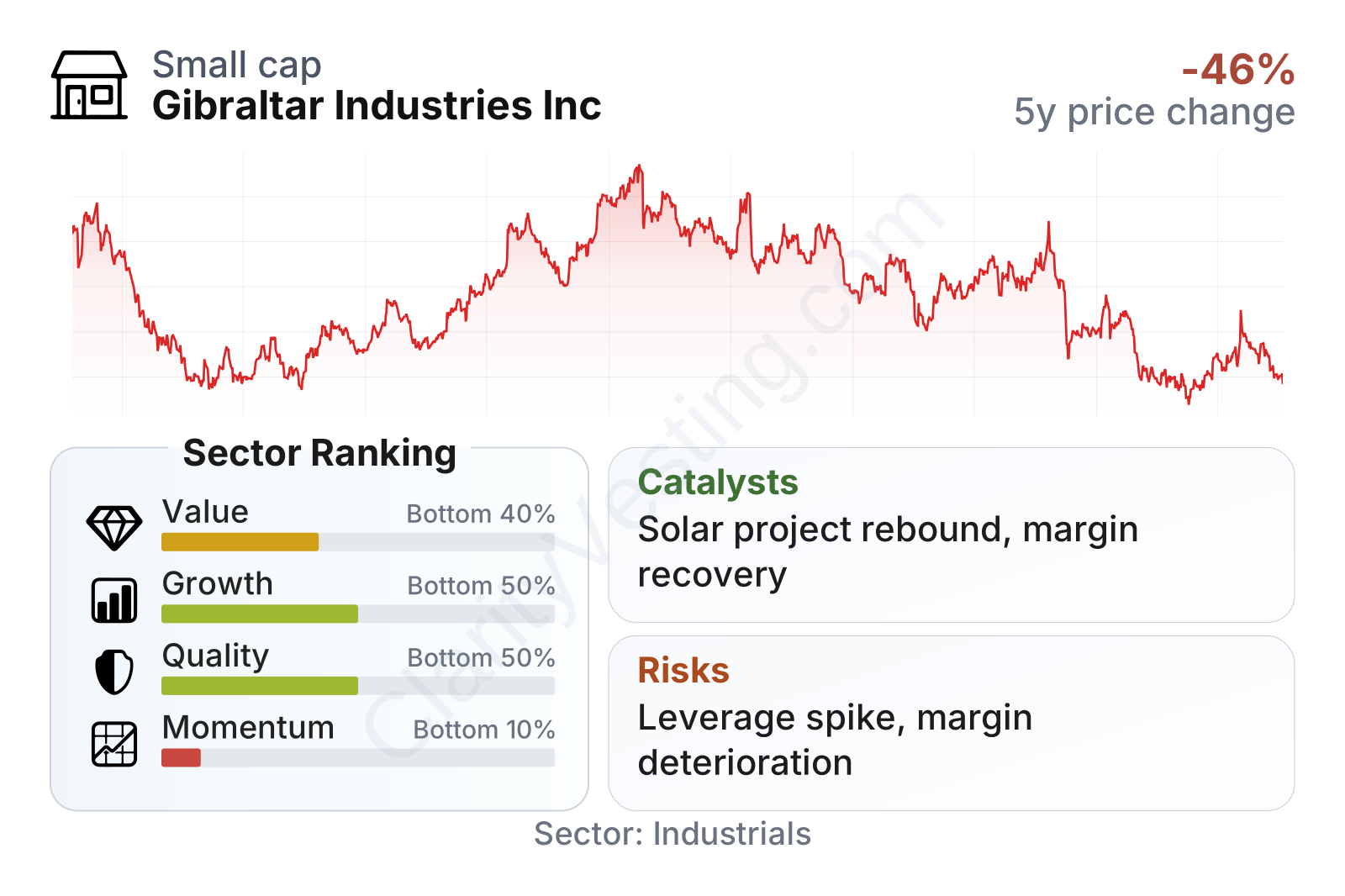
Gibraltar’s profile is mixed. On valuation measures, the shares trade somewhat below the sector median on earnings and book value, but not at a deep discount once weaker profitability and higher leverage are considered. Growth metrics are uneven: recent year-over-year revenue growth looks strong, yet longer-term per-share growth has been soft. Quality indicators also look weaker than the sector on a trailing basis, mainly because returns and margins have recently fallen while debt ratios have risen sharply. Market performance has been particularly weak, with the stock trailing much of the sector over one-, three-, and recent six-month periods.
Growth
Gibraltar operates in markets that still have credible long-term demand drivers. Solar deployment remains a structural growth area in the United States, supported by the ongoing buildout of domestic energy infrastructure and the need for grid diversification. Residential repair and remodeling is a steadier market than new-home construction alone, and building efficiency, weather resilience, and package-management needs continue to support demand for many of the company’s products.
The company’s strategy broadly makes sense for long-term expansion because it is centered on practical niches rather than commodity products alone. In solar, Gibraltar is not trying to be a panel manufacturer; it supplies the supporting hardware and systems needed to install projects. In building products, it participates in categories where compliance, durability, engineering, and distribution relationships matter. That can create more durable customer ties than simple price-based competition.
Recent revenue growth has become much more volatile than a simple long-term growth narrative would suggest. After a period of contraction through much of 2024 and parts of 2025, the latest year-over-year readings improved sharply. That rebound is encouraging, but it also shows how dependent parts of the company can be on project timing, especially in renewables.
Cash generation is another important piece of the picture. Free cash flow expanded significantly from 2022 into 2024, then cooled over the following periods but remained positive. For a manufacturer serving cyclical end markets, staying cash-generative through a less favorable stretch is a constructive sign, even if the recent level is well below its prior peak.
A meaningful catalyst is the continued need for solar balance-of-system equipment in North America. If utility-scale and distributed solar project activity improves, Gibraltar’s renewables segment could benefit disproportionately because larger projects can move revenue quickly. Another potential growth lever is operational execution: the company previously demonstrated that margin improvement is possible when product mix and cost control work in its favor.
Risks
This article is for informational purposes only and does not constitute financial advice. Some content is AI-generated. See Disclaimer


