Stock Analysis · Construction Partners Inc (ROAD)
Overview
Construction Partners, Inc. is a civil infrastructure company focused mainly on building and maintaining transportation networks. In simple terms, it helps pave, repair, and improve roads, highways, bridges, airport runways, and related infrastructure. Its operations are concentrated in the Sunbelt, especially in the southeastern United States, where population growth and ongoing public works spending support demand for road construction and maintenance.
The business is built around public infrastructure work, but it also serves private customers. The company’s model combines contracting services with ownership of key production assets such as hot-mix asphalt plants, aggregates sites, liquid asphalt terminals, and paving crews. That vertical integration matters because it gives the company more control over materials, scheduling, and execution.
Based on company disclosures, revenue is primarily generated from civil construction activities tied to transportation infrastructure. A practical breakdown is as follows:
- Public infrastructure projects: approximately 75% to 85% of revenue. This includes state departments of transportation, local governments, and other public agencies funding highways, streets, bridges, and airport-related work.
- Private and commercial projects: approximately 15% to 25% of revenue. This includes site development, commercial paving, residential development support, and other privately funded projects.
- Materials and related internal supply activities: a smaller share of reported external revenue, but strategically important. These include hot-mix asphalt, aggregates, and liquid asphalt used both on company projects and, in some cases, sold to third parties.
Over the last several years, the company has also expanded through acquisitions, which has increased its geographic footprint and deepened its position in local markets. The financial flow of the business shows a company that has been scaling quickly: revenue, gross profit, and operating income have all moved materially higher, although interest expense has also climbed as expansion has been financed partly with debt.
Key Figures
| Metric | Value | Sector ⓘ |
|---|---|---|
| Date | Oct 24, 2026 | |
| Context | ||
| Sector | Industrials | |
| Industry | Engineering & Construction | |
| Market Cap ⓘ | $4.79B | |
| Beta ⓘ | 0.93 | |
Value (Cheapness) | ||
| P/E Ratio ⓘ | 33.09 | 22.29 |
| P/B Ratio ⓘ | 4.59 | 1.98 |
| FCF Yield ⓘ | 3.67% | 6.26% |
| Dividend Yield ⓘ | N/A | 1.92% |
| EBIT / EV ⓘ | 3.47% | 4.83% |
| PEG ⓘ | 1.57 | |
Growth (Business expansion) | ||
| Revenue Growth ⓘ | 28.20% | 9.30% |
| RPS Growth (5Y CAGR) ⓘ | 30.35% | 7.76% |
| EPS Growth (5Y CAGR) ⓘ | 43.32% | -13.17% |
| BVPS Growth (5Y CAGR) ⓘ | 20.17% | 6.13% |
| Margin Growth (5Y Trend) ⓘ | 4.60% | 0.74% |
| FCF Growth (5Y CAGR) ⓘ | N/A | 10.79% |
| DPS Growth (5Y CAGR) ⓘ | N/A | 9.41% |
Quality (Business durability) | ||
| ROIC (Latest) ⓘ | 6.88% | 10.75% |
| ROA (Latest) ⓘ | 4.16% | 5.41% |
| ROIC (5Y Median) ⓘ | 7.91% | 9.37% |
| ROA (5Y Median) ⓘ | 4.23% | 4.95% |
| Net Debt / EBIT (Latest) ⓘ | 7.29 | 2.04 |
| Net Debt / EBIT (5Y Median) ⓘ | 5.36 | 2.27 |
| Net Debt / EBITDA (Latest) ⓘ | 4.26 | 1.39 |
| Net Debt / Assets ⓘ | 49.75% | 19.27% |
| EBITDA / Interest ⓘ | 3.89 | 9.58 |
| Operating Margin (Latest) ⓘ | 7.09% | 10.49% |
| Operating Margin (5Y Median) ⓘ | 5.82% | 10.30% |
| Debt to Equity (Latest) ⓘ | 181.75% | 64.82% |
| Profit Margin (Latest) ⓘ | 4.10% | 6.67% |
| Free Cash Flow (Latest) ⓘ | $175.56M | |
Momentum (Price trend) | ||
| 3Y Return ⓘ | +122.47% | +67.77% |
| 12M Return (excl. last month) ⓘ | -29.33% | +12.05% |
| 6M Return ⓘ | -31.08% | 0.00% |
| Price vs. 200-Day MA ⓘ | -24.19% | +0.67% |
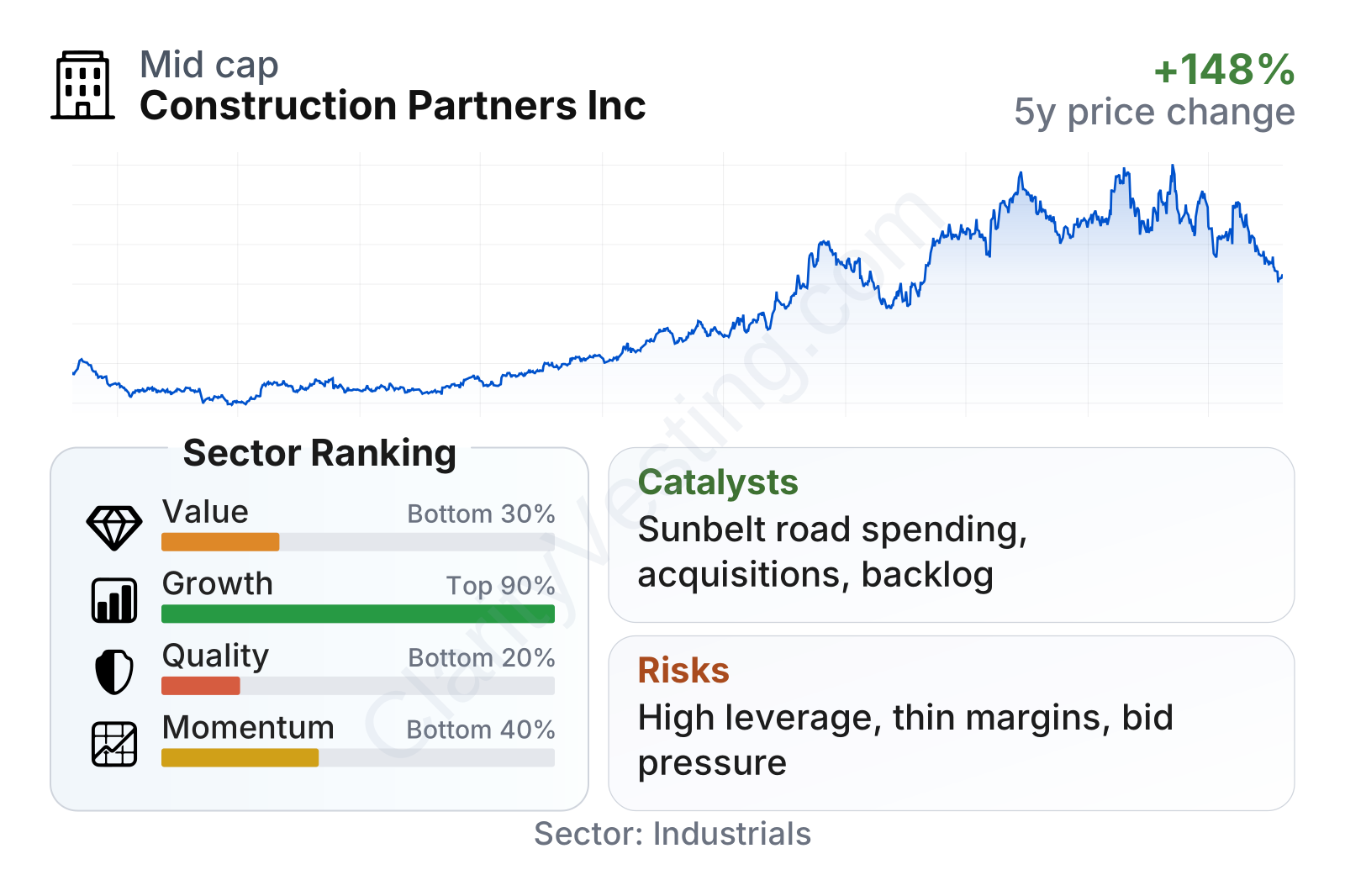
Construction Partners is now a mid-sized public company with a market value above $5 billion and a stock that has been less volatile than the broader market, as indicated by a beta below 1. The stock’s longer-term share-price performance has been strong, but the more recent trend has cooled, with the shares trading below their 200-day average and recent returns lagging much of the sector.
The metrics table points to a clear split in the company profile. Growth stands out near the top of the sector, with revenue, earnings per share, and book value per share all expanding much faster than the typical industrial peer. At the same time, value and quality measures are weaker. The stock trades at a premium on earnings and book value, while profitability, returns on capital, and leverage look less favorable than sector norms.
Growth
Construction Partners operates in a part of the market with supportive long-term demand. Road repair, resurfacing, and expansion are not optional expenses forever; states and municipalities eventually have to maintain transportation networks. The company’s focus on the Sunbelt adds another growth angle because many of its markets are benefiting from population inflows, business relocations, and suburban development. Those trends typically create more wear on roads and a greater need for new transportation capacity.
Its strategy also appears coherent. Rather than trying to become a national giant all at once, the company has been building density in regional markets where scale can improve plant utilization, bidding discipline, and logistics. That approach can be effective in road construction because local presence, relationships, and access to asphalt production often matter more than headline size alone.
Revenue growth has remained unusually strong for an engineering and construction business. Recent year-over-year growth has stayed well above the sector median, and the multi-year record suggests this is not just a one-quarter spike. Part of that expansion comes from acquisitions, but the pace is still notable because it has been sustained through multiple periods rather than appearing as a single jump.
Cash generation has improved meaningfully. Free cash flow was negative earlier in the cycle but has turned decisively positive and moved higher over time. That shift matters because it suggests recent growth is beginning to translate into actual cash rather than only accounting earnings. For a construction company, stronger free cash flow can support equipment investment, plant upgrades, acquisitions, and eventual balance-sheet repair.
A major external catalyst is multi-year U.S. infrastructure spending, especially transportation funding that flows through state and local agencies. Construction Partners’ end markets are directly tied to that spending stream. In addition, the company has continued expanding its footprint through acquisitions and new plant capacity, which can create cross-selling opportunities and higher internal material usage. Recent company updates have also highlighted backlog growth and geographic expansion, both of which point to a sizable pipeline of future work if execution remains solid.
Risks
This article is for informational purposes only and does not constitute financial advice. Some content is AI-generated. See Disclaimer


