Stock Analysis · Renew Energy Global PLC (RNW)
Overview
ReNew Energy Global PLC is a large renewable power company focused mainly on India. It develops, owns, and operates utility-scale wind and solar projects, and it also has businesses tied to clean energy services and newer energy transition areas. In simple terms, the company signs long-term contracts to supply electricity, builds the projects, and then earns recurring revenue as those assets generate power over many years.
Its business model is built around contracted cash flows rather than merchant power exposure alone. That matters because long-term power purchase agreements can make revenue more visible than in many other energy businesses. ReNew has also been expanding beyond basic power generation into transmission-linked projects, battery storage, and corporate clean-energy solutions, which broadens its role in India’s decarbonization buildout.
Based on company disclosures, the main sources of revenue are centered on electricity sales and closely related activities. Approximate revenue mix can be described as follows:
- Sale of power: about 85% to 95% of revenue in most years. This is the core business and includes electricity generated from utility-scale wind and solar assets sold under long-term contracts.
- Sale of renewable energy certificates, grid and related income, and other operating revenue: roughly 5% to 10%. This includes items tied to renewable attributes, grid-related receipts, and other operating activities associated with power assets.
- Engineering, procurement, and construction or project-related services and miscellaneous income: generally 0% to 5%. This is a smaller and less stable contribution than power sales.
The broad financial picture has improved meaningfully over the last few fiscal years. Revenue has risen strongly, operating income has expanded, and net income has turned positive after earlier losses. At the same time, the company remains capital-intensive, so stronger operating performance does not automatically translate into strong free cash flow.
The business has scaled up quickly, with revenue rising from the low hundreds of millions of dollars a few years ago to well above $1 billion recently. Operating profitability also looks robust at the asset level, but financing costs remain an important part of the overall picture for shareholders.
Key Figures
| Metric | Value | Sector ⓘ |
|---|---|---|
| Date | Nov 21, 2026 | |
| Context | ||
| Sector | Utilities | |
| Industry | Utilities - Renewable | |
| Market Cap ⓘ | $2.53B | |
| Beta ⓘ | 1.19 | |
Value (Cheapness) | ||
| P/E Ratio ⓘ | 18.29 | 17.21 |
| P/B Ratio ⓘ | N/A | 1.97 |
| FCF Yield ⓘ | -17.43% | -0.81% |
| Dividend Yield ⓘ | N/A | 3.67% |
| EBIT / EV ⓘ | 8.39% | 5.78% |
| PEG ⓘ | N/A | |
Growth (Business expansion) | ||
| Revenue Growth ⓘ | 28.20% | 8.30% |
| RPS Growth (5Y CAGR) ⓘ | 26.23% | 3.61% |
| EPS Growth (5Y CAGR) ⓘ | N/A | -2.03% |
| BVPS Growth (5Y CAGR) ⓘ | -1.05% | 4.29% |
| Margin Growth (5Y Trend) ⓘ | 16.22% | 3.68% |
| FCF Growth (5Y CAGR) ⓘ | N/A | -8.99% |
| DPS Growth (5Y CAGR) ⓘ | N/A | 4.70% |
Quality (Business durability) | ||
| ROIC (Latest) ⓘ | 6.60% | 6.37% |
| ROA (Latest) ⓘ | 1.18% | 3.14% |
| ROIC (5Y Median) ⓘ | 4.11% | 5.97% |
| ROA (5Y Median) ⓘ | 0.42% | 2.74% |
| Net Debt / EBIT (Latest) ⓘ | 10.06 | 7.15 |
| Net Debt / EBIT (5Y Median) ⓘ | 12.00 | 7.25 |
| Net Debt / EBITDA (Latest) ⓘ | 7.34 | 4.42 |
| Net Debt / Assets ⓘ | 71.66% | 38.03% |
| EBITDA / Interest ⓘ | 1.67 | 4.57 |
| Operating Margin (Latest) ⓘ | 53.12% | 20.06% |
| Operating Margin (5Y Median) ⓘ | 57.02% | 19.99% |
| Debt to Equity (Latest) ⓘ | 581.88% | 137.61% |
| Profit Margin (Latest) ⓘ | 8.39% | 10.90% |
| Free Cash Flow (Latest) ⓘ | -$441.55M | |
Momentum (Price trend) | ||
| 3Y Return ⓘ | +6.83% | +47.60% |
| 12M Return (excl. last month) ⓘ | -9.84% | +6.07% |
| 6M Return ⓘ | +17.61% | 0.00% |
| Price vs. 200-Day MA ⓘ | +13.15% | +1.40% |
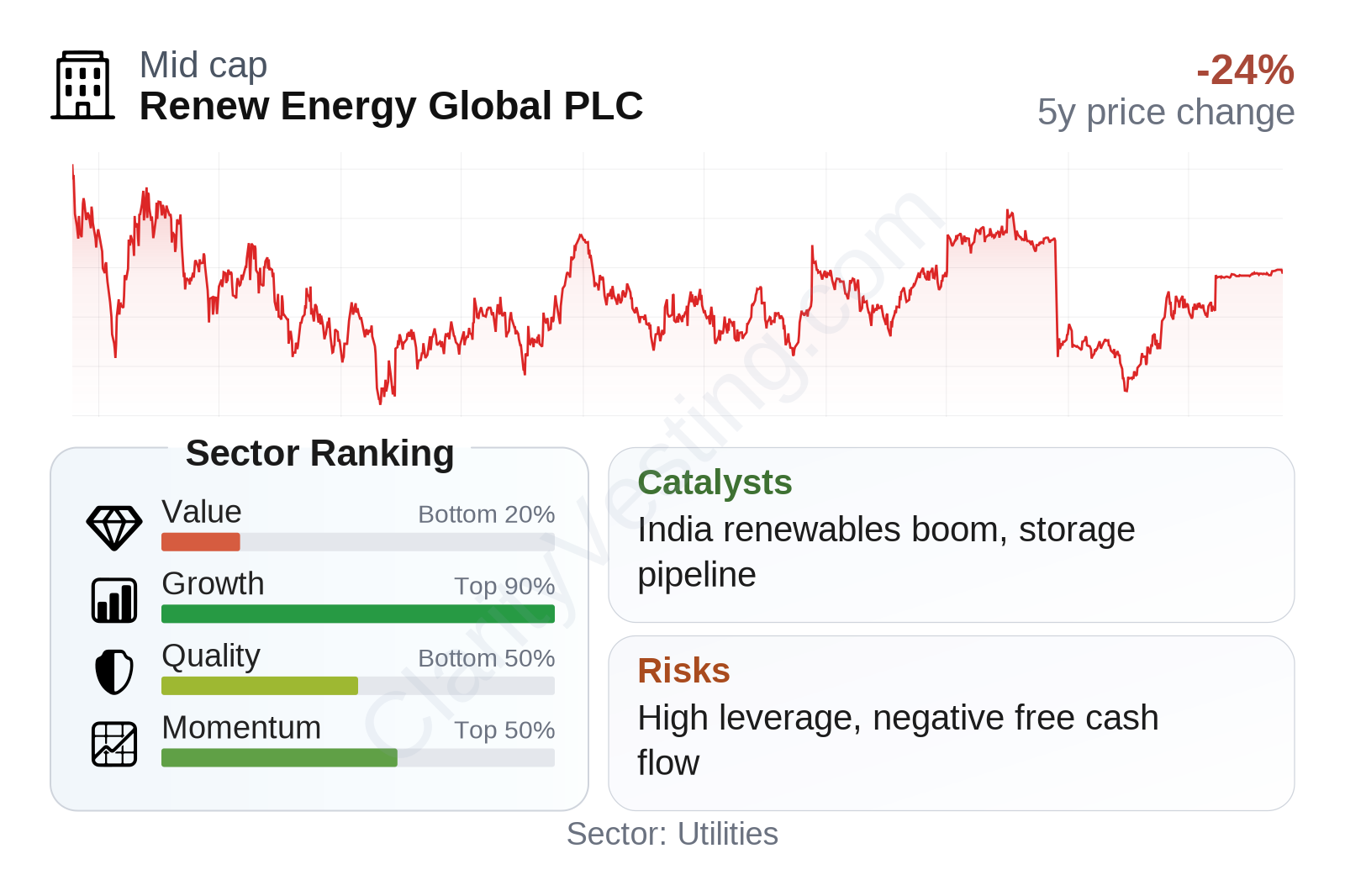
ReNew stands out much more on growth than on balance-sheet strength or conventional value measures. Revenue growth is well ahead of the sector median, and margin trends at the operating level have been favorable. However, free cash flow remains deeply negative, leverage is far above sector norms, and profitability after interest costs is still less impressive than operating margins alone suggest. The share price has recovered over the last several months, but its longer-term path has been uneven.
With a market value around the mid-cap range and a beta a bit above 1, the stock has shown moderate sensitivity to market moves. The company’s valuation does not look extremely stretched on earnings alone, but that single metric needs to be viewed alongside high debt and ongoing funding needs.
Growth
ReNew operates in a sector with strong long-term tailwinds. India remains one of the world’s largest growth markets for electricity demand, and the country is pushing hard to increase renewable generation, strengthen grid infrastructure, and support storage capacity. That creates a large addressable market for companies able to secure land, permits, equipment, financing, and long-term customers at scale.
ReNew’s strategy broadly fits that opportunity. It has built a large portfolio across wind and solar, and it has increasingly positioned itself in higher-value areas such as hybrid projects, round-the-clock clean power, and storage-linked offerings. These categories matter because they can help renewable generation become more reliable and more useful for both utilities and large commercial customers.
Revenue per share has risen sharply over the last five fiscal years, showing that the company has not only added projects but has also expanded at a pace that outstripped dilution. That is an encouraging signal for a developer-owner model, especially in a capital-heavy industry where share issuance can sometimes absorb much of the business growth.
One important nuance is that growth has not yet translated into sustained positive free cash flow. That is not unusual for a renewable infrastructure platform that is still investing heavily, but it does mean the growth profile depends on continued access to funding and disciplined project execution. A business can look very strong on revenue and operating margin while still remaining financially stretched if expansion absorbs most of the cash generated.
Recent company updates have continued to emphasize capacity additions, a deep project pipeline, and progress in storage and decarbonization solutions. Those are meaningful catalysts because grid-connected renewables with storage are becoming strategically more valuable in India. ReNew’s scale, operating history, and relationships with utilities and large customers could help it capture a larger share of this next phase than smaller developers.
Another potential opportunity comes from the broader shift in customer demand. More corporations are looking for clean power procurement, not only state utilities. If that market continues to deepen, ReNew could benefit from a broader customer mix and potentially better project economics in selected segments.
Risks
This article is for informational purposes only and does not constitute financial advice. Some content is AI-generated. See Disclaimer