Stock Analysis · Renasant Corporation (RNST)
Overview
Renasant Corporation is a regional banking company based in the southeastern United States. Through Renasant Bank and its subsidiaries, it provides traditional banking services such as deposits, loans, treasury management, and wealth-related services for individuals, businesses, and public-sector clients. Its footprint is centered in Mississippi, Tennessee, Alabama, Georgia, and neighboring markets, which places the company in faster-growing Sun Belt areas where population and business activity have generally been stronger than the national average.
Like most regional banks, Renasant makes most of its money from the spread between what it earns on loans and securities and what it pays on deposits and other funding. It also generates a meaningful stream of fees from services that are less tied to interest rates, which helps diversify results.
Based on the company’s recent annual disclosures, revenue is mainly split across the following sources:
- Net interest income: about 70% to 80% of total revenue. This is the core banking business: interest collected on commercial, real estate, consumer, and mortgage loans, plus securities income, minus interest paid on deposits and borrowings.
- Noninterest income: about 20% to 30% of total revenue. This includes mortgage banking revenue, wealth management and trust fees, service charges on deposit accounts, interchange and card fees, insurance commissions, and other customer-related fees.
- Within noninterest income, mortgage banking and wealth or insurance activities are usually among the more visible contributors, although the exact ranking can shift from quarter to quarter depending on loan demand, refinancing activity, and housing conditions.
Over the last several years, total revenue has moved higher overall, but costs tied to funding and interest expense also rose sharply as rates increased. That means the company has grown its top line, yet not all of that increase has turned into profit at the same pace.
The long-term pattern shows a bigger revenue base than a few years ago, but also much heavier interest expense and operating costs. In other words, scale has improved, while margin conversion has been more uneven.
Key Figures
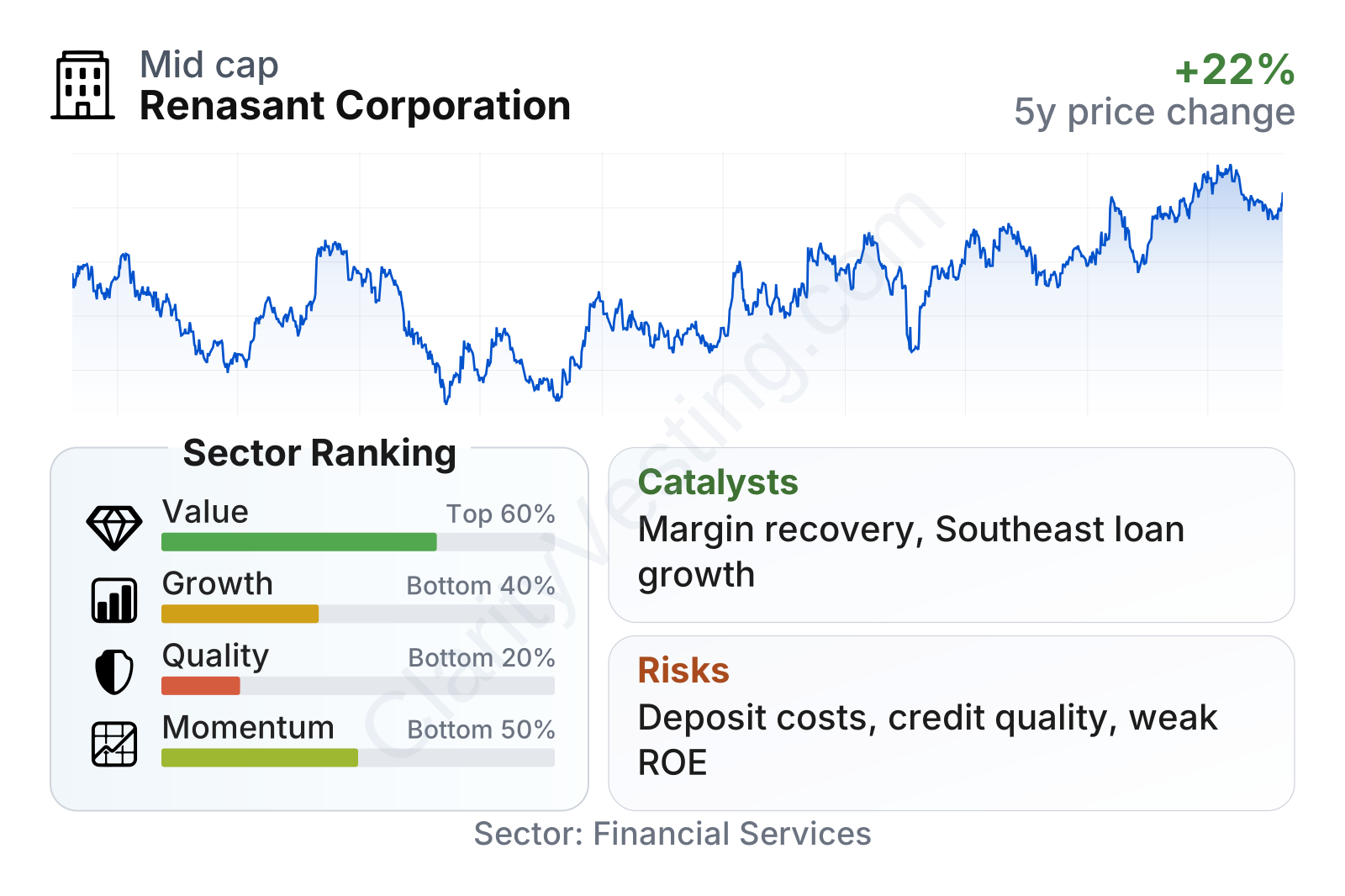
The share price has been volatile, which is normal for regional banks given their sensitivity to interest rates, credit conditions, and confidence in deposit stability. The broader direction since 2023 has improved, but the path has not been smooth.
| Metric | Value | Sector ⓘ |
|---|---|---|
| Date | Oct 24, 2026 | |
| Context | ||
| Sector | Financial Services | |
| Industry | Banks - Regional | |
| Market Cap ⓘ | $3.68B | |
| Beta ⓘ | 1.03 | |
Value (Cheapness) | ||
| P/E Ratio ⓘ | 11.93 | 12.46 |
| P/B Ratio ⓘ | 1.00 | 1.25 |
| FCF Yield ⓘ | 10.25% | 9.82% |
| Dividend Yield ⓘ | 2.28% | 2.94% |
| EBIT / EV ⓘ | 4.40% | 8.11% |
| PEG ⓘ | 1.79 | |
Growth (Business expansion) | ||
| Revenue Growth ⓘ | 45.30% | 9.10% |
| RPS Growth (5Y CAGR) ⓘ | 5.33% | 12.31% |
| EPS Growth (5Y CAGR) ⓘ | -11.85% | -6.97% |
| BVPS Growth (5Y CAGR) ⓘ | 1.04% | 5.02% |
| Margin Growth (5Y Trend) ⓘ | -16.33% | -4.00% |
| FCF Growth (5Y CAGR) ⓘ | 18.12% | 4.71% |
| DPS Growth (5Y CAGR) ⓘ | -1.75% | 8.92% |
Quality (Business durability) | ||
| ROIC (Latest) ⓘ | 2.83% | 9.18% |
| ROE (Latest) ⓘ | 8.16% | 13.93% |
| ROA (Latest) ⓘ | 1.17% | 1.57% |
| ROIC (5Y Median) ⓘ | 5.56% | 7.80% |
| ROE (5Y Median) ⓘ | 6.53% | 12.15% |
| ROA (5Y Median) ⓘ | 0.98% | 1.28% |
| Net Debt / EBIT (Latest) ⓘ | 1.34 | 1.02 |
| Net Debt / EBIT (5Y Median) ⓘ | -0.36 | 0.72 |
| Net Debt / EBITDA (Latest) ⓘ | 1.27 | 0.88 |
| Operating Margin (Latest) ⓘ | 13.79% | 22.30% |
| Operating Margin (5Y Median) ⓘ | 23.60% | 24.50% |
| Debt to Equity (Latest) ⓘ | 28.72% | 59.34% |
| Profit Margin (Latest) ⓘ | 29.56% | 26.42% |
| Free Cash Flow (Latest) ⓘ | $377.59M | |
Momentum (Price trend) | ||
| 3Y Return ⓘ | +85.01% | +95.73% |
| 12M Return (excl. last month) ⓘ | +8.54% | +17.30% |
| 6M Return ⓘ | +5.73% | +6.07% |
| Price vs. 200-Day MA ⓘ | +4.39% | +5.36% |
Renasant looks mixed on the latest snapshot. Valuation is somewhat below the sector median on earnings and book value, which suggests the market is not assigning a premium multiple. Revenue growth has been strong recently, but longer-term growth and profitability metrics remain weaker than many peers. Quality measures such as return on equity and return on assets are also below sector medians, while leverage appears manageable with debt-to-equity lower than the typical regional bank in the group.
Growth
Renasant operates in a sector that is mature, but its geography matters. Regional banking is not a high-growth industry in the way software or semiconductors can be, yet banks serving expanding metropolitan areas in the Southeast can still compound steadily through loan growth, deposit gathering, and market-share gains. That is the more relevant lens for Renasant: not industry disruption, but whether it can deepen relationships in attractive local markets and turn that into better earnings power.
The company’s strategy is sensible for that environment. Renasant focuses on community and commercial banking, where local relationships, treasury services, and cross-selling can create stickier customers than purely transactional retail banking. Fee businesses such as wealth management, insurance, and mortgage banking also help broaden revenue beyond plain lending. That matters because a bank that relies too heavily on spread income can see profits swing sharply when funding costs rise.
Earnings per share have been positive and fairly resilient over time, but not consistently upward. The recent pattern shows that Renasant has been able to stay profitable through changing rate conditions, yet it has not produced the kind of smooth earnings compounding that would clearly separate it from stronger regional-bank peers.
Book value per share, a key balance-sheet measure for banks, improved meaningfully through 2024 before pulling back in 2025. That combination suggests the franchise has been building capital over time, but not in a straight line. For a long-term view, stable growth in book value is important because it supports lending capacity, loss absorption, and the value backing the shares.
A practical catalyst is the interest-rate cycle. If deposit costs stabilize or ease faster than asset yields reset lower, net interest margin could improve. Another catalyst is execution on fee income and operating efficiency: stronger mortgage activity, insurance production, wealth management growth, or better expense control could lift profitability without requiring unusually fast balance-sheet growth. The company has also used acquisitions in the past to expand its footprint, so integration and scale benefits remain part of the growth framework when opportunities appear.
Recent company updates have also pointed to continued loan and deposit franchise development in its core markets. For a bank of this size, disciplined expansion in commercial relationships can matter more than dramatic headline growth, because small changes in funding mix and credit quality can have an outsized effect on returns.
Risks
This article is for informational purposes only and does not constitute financial advice. Some content is AI-generated. See Disclaimer


