Stock Analysis · Renishaw PLC (RNSHY)
Overview
Renishaw PLC is a British precision engineering company that designs and manufactures high-accuracy measurement, calibration, and motion-control equipment. Its products are used where manufacturers need to measure extremely small tolerances or control machine movements very precisely. That makes Renishaw relevant to industries such as semiconductor production, industrial automation, aerospace, automotive, electronics, scientific research, and healthcare.
The business is best known for metrology systems used on machine tools and in factories, but it also has exposure to additive manufacturing and medical technology. In simple terms, Renishaw helps customers make parts more accurately, inspect them more reliably, and automate production with better feedback from sensors and software.
Based on the company’s annual reporting structure, revenue mainly comes from the following activities:
- Manufacturing metrology and industrial automation tools: approximately 75% to 85% of revenue. This includes machine tool probes, coordinate measuring machine products, encoders, calibration systems, Raman spectroscopy instruments, and related software and services.
- Analytical instruments and precision measurement systems: a smaller but meaningful share, roughly 10% to 20%. This includes spectroscopy and high-end measurement systems used in labs, research, and specialized industrial applications.
- Healthcare and neurosurgery-related products: generally a low share, roughly 0% to 10%. This includes surgical robotics and neurosurgical planning products, though this segment has historically been much smaller than the core industrial business.
Geographically, Renishaw is highly international, with sales spread across Europe, Asia, and the Americas. That broad footprint reduces dependence on one country, but it also ties results to global factory spending and electronics demand.
The flow of the business over recent years shows a useful pattern: revenue has been broadly stable to slightly rising, but profitability has narrowed as costs have increased faster than sales. Gross profit and operating profit remain solid, yet margins have come under pressure, which is an important theme for understanding the company today.
Key Figures
| Metric | Value | Sector ⓘ |
|---|---|---|
| Date | Oct 03, 2026 | |
| Context | ||
| Sector | Technology | |
| Industry | Scientific & Technical Instruments | |
| Market Cap ⓘ | $3.54B | |
| Beta ⓘ | 1.13 | |
Value (Cheapness) | ||
| P/E Ratio ⓘ | 20.95 | 29.95 |
| FCF Yield ⓘ | N/A | 4.22% |
| Dividend Yield ⓘ | 3.37% | 1.30% |
| EBIT / EV ⓘ | 1.96% | 2.83% |
| PEG ⓘ | N/A | |
Growth (Business expansion) | ||
| Revenue Growth ⓘ | 21.10% | 15.80% |
| RPS Growth (5Y CAGR) ⓘ | 5.98% | 8.55% |
| EPS Growth (5Y CAGR) ⓘ | -18.92% | -11.72% |
| Margin Growth (5Y Trend) ⓘ | -4.44% | 0.39% |
| FCF Growth (5Y CAGR) ⓘ | -4.88% | 9.72% |
| DPS Growth (5Y CAGR) ⓘ | 52.74% | 7.73% |
Quality (Business durability) | ||
| ROIC (Latest) ⓘ | N/A | 9.36% |
| ROIC (5Y Median) ⓘ | 12.23% | 8.32% |
| Net Debt / EBIT (Latest) ⓘ | N/A | 0.50 |
| Net Debt / EBIT (5Y Median) ⓘ | N/A | 0.46 |
| Net Debt / EBITDA (Latest) ⓘ | N/A | 0.28 |
| Net Debt / Assets ⓘ | N/A | 3.44% |
| EBITDA / Interest ⓘ | N/A | 12.67 |
| Operating Margin (Latest) ⓘ | N/A | 9.81% |
| Operating Margin (5Y Median) ⓘ | 19.50% | 8.50% |
| Debt to Equity (Latest) ⓘ | N/A | 33.33% |
| Profit Margin (Latest) ⓘ | 14.58% | 7.15% |
| Free Cash Flow (Latest) ⓘ | N/A | |
Momentum (Price trend) | ||
| 3Y Return ⓘ | +6.35% | +49.46% |
| 12M Return (excl. last month) ⓘ | +2.19% | +16.51% |
| 6M Return ⓘ | 0.00% | +24.29% |
| Price vs. 200-Day MA ⓘ | +0.96% | +4.74% |
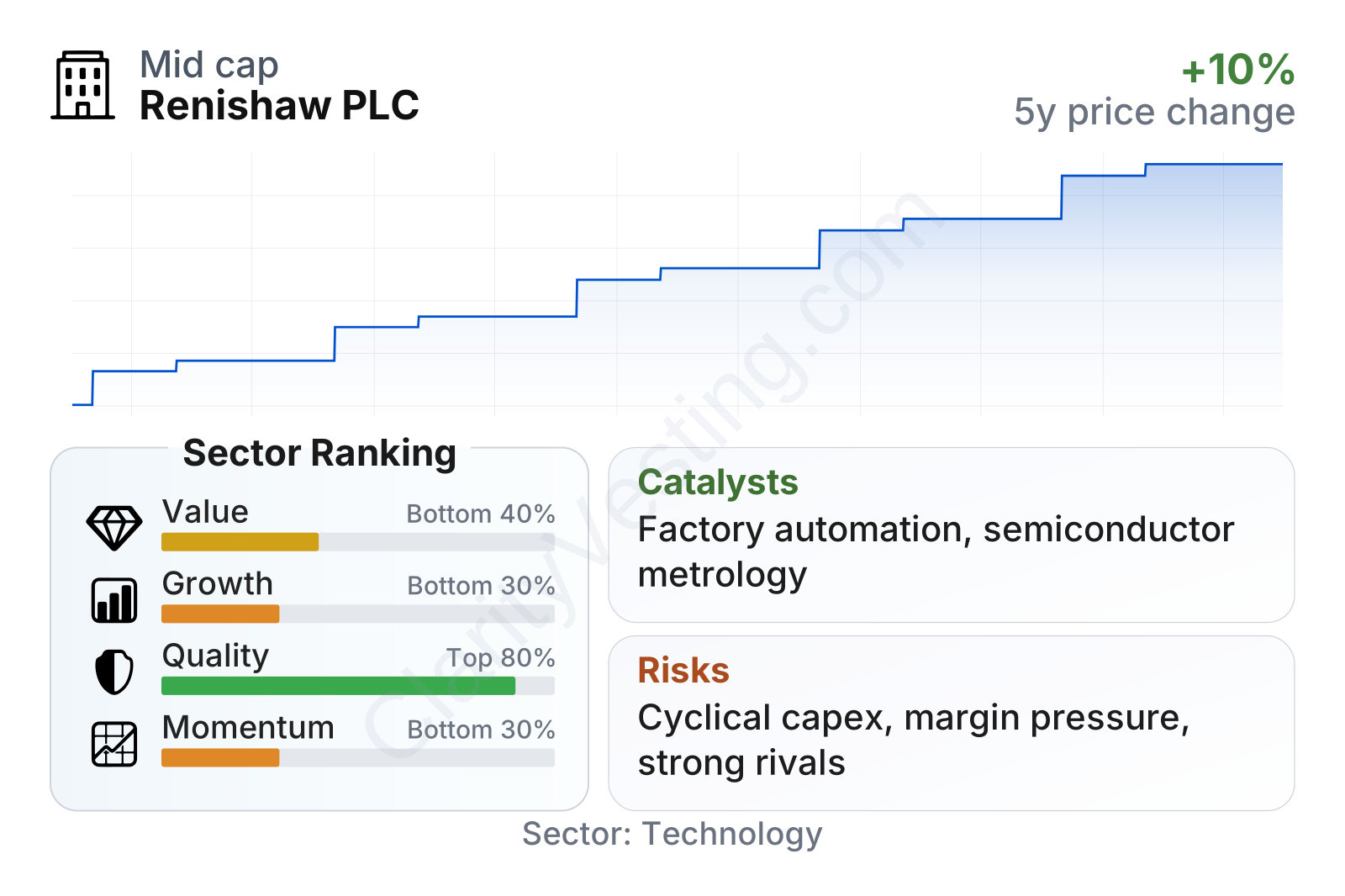
Renishaw is a mid-sized technology and industrial instrumentation company. The share price history shown here looks unusually steady over several years, which suggests the U.S. listing is relatively illiquid and may not fully reflect day-to-day market pricing as actively as larger stocks. That makes business fundamentals more useful than short-term trading signals.
The quality profile stands out more positively than the growth and momentum profiles. Profit margin is well above the sector median, and the long-term median operating margin has also been stronger than many peers. Balance sheet risk appears limited, with leverage metrics better than the sector norm, which is important in a cyclical industrial business.
By contrast, growth metrics are mixed. Recent year-over-year revenue growth has been healthy, but the five-year trends in earnings, free cash flow, and margin direction have been weaker than the broader sector. The valuation picture is also mixed rather than clearly cheap: the earnings multiple is below the sector median, and the dividend yield is above it, but operating earnings relative to enterprise value do not look especially strong.
Growth
Renishaw operates in markets with credible long-term demand drivers. Precision measurement is becoming more important as manufacturing shifts toward tighter tolerances, higher automation, and more complex components. Semiconductor equipment, advanced electronics, aerospace components, and electric vehicle production all require better measurement and process control. These are supportive industry conditions for the company’s core products.
The strategy also makes industrial sense. Renishaw focuses on high-value, technically demanding niches rather than low-cost volume products. That approach can support pricing power, customer loyalty, and a defensible market position when customers care more about reliability and performance than about the lowest upfront price. The company also benefits from recurring follow-on demand through upgrades, replacement parts, calibration, software, and service tied to installed equipment.
One of the clearest catalysts is ongoing factory automation. As manufacturers try to reduce scrap, improve throughput, and run machines with less human intervention, in-process measurement and closed-loop control become more valuable. Renishaw’s probing systems, encoders, and calibration tools fit directly into that trend.
A second catalyst is semiconductor and advanced electronics manufacturing, where precision requirements are particularly demanding. Even if demand in these end markets moves in cycles, the long-term technical direction favors more accurate metrology and motion systems.
A third area to watch is additive manufacturing and specialized healthcare technologies. These are smaller contributors today, but they can still matter strategically because they widen the company’s addressable market and add optionality beyond traditional machine tools.
Recent operating progress appears more uneven than transformational. Revenue has edged upward over the last several years, but cost inflation and operating expense growth have absorbed much of that benefit. So the opportunity is not simply top-line expansion; it is also whether management can convert future demand into stronger margins and cash generation.
Risks
This article is for informational purposes only and does not constitute financial advice. Some content is AI-generated. See Disclaimer