Stock Analysis · Renault SA (RNLSY)
Overview
Renault is a French auto manufacturer that designs, produces, and sells passenger cars and light commercial vehicles. Its portfolio includes the Renault brand for mainstream vehicles, Dacia for value-oriented cars, Alpine for sports models, and Mobilize for mobility and financing-related services. The group also has a long history of industrial partnerships, most notably with Nissan and Mitsubishi, and it remains active in electric vehicles, software-enabled cars, and hybrid powertrains.
Revenue mainly comes from vehicle-related activities, with a meaningful but smaller contribution from financing and mobility services. Based on Renault’s recent annual reporting structure, the business mix can be summarized approximately as follows:
- Automotive: about 85% to 90% — vehicle sales, parts, after-sales services, and related industrial activities across Renault, Dacia, Alpine, and light commercial vehicles.
- Sales Financing: about 10% to 15% — retail and dealer financing, leasing, and other financial services, mainly through the group’s financing operations.
- Mobility and other activities: small — newer services linked to mobility, energy, and specialized solutions, still limited compared with the core vehicle business.
Renault’s business profile has shifted in recent years from chasing volume toward improving product mix, pricing discipline, and cash generation. That matters because automakers often look stronger during high unit sales cycles, but long-term resilience usually depends more on margins, model mix, and balance sheet control than on pure delivery numbers.
Revenue has risen meaningfully from 2021 through 2025, and gross profit also expanded over most of that period. However, the latest yearly flow also shows that profit conversion became much weaker in 2025, with a sharp deterioration between gross profit and operating income. That suggests the key debate is no longer whether Renault can sell cars, but whether it can turn those sales into durable earnings.
Key Figures
| Metric | Value | Sector ⓘ |
|---|---|---|
| Date | Oct 03, 2026 | |
| Context | ||
| Sector | Consumer Cyclical | |
| Industry | Auto Manufacturers | |
| Market Cap ⓘ | $8.65B | |
| Beta ⓘ | 0.82 | |
Value (Cheapness) | ||
| P/E Ratio ⓘ | 7.97 | 17.04 |
| P/B Ratio ⓘ | 0.45 | 1.61 |
| FCF Yield ⓘ | 36.64% | 9.02% |
| Dividend Yield ⓘ | 8.61% | 2.75% |
| EBIT / EV ⓘ | N/A | 6.69% |
| PEG ⓘ | 0.81 | |
Growth (Business expansion) | ||
| Revenue Growth ⓘ | 9.40% | 5.60% |
| RPS Growth (5Y CAGR) ⓘ | 8.65% | 9.04% |
| EPS Growth (5Y CAGR) ⓘ | N/A | -17.44% |
| BVPS Growth (5Y CAGR) ⓘ | -8.29% | 5.73% |
| Margin Growth (5Y Trend) ⓘ | -19.23% | -0.26% |
| FCF Growth (5Y CAGR) ⓘ | 26.31% | 4.91% |
| DPS Growth (5Y CAGR) ⓘ | -6.69% | 10.48% |
Quality (Business durability) | ||
| ROIC (Latest) ⓘ | -5.69% | 12.38% |
| ROA (Latest) ⓘ | -8.50% | 5.54% |
| ROIC (5Y Median) ⓘ | 1.14% | 10.63% |
| ROA (5Y Median) ⓘ | 0.60% | 5.44% |
| Net Debt / EBIT (Latest) ⓘ | N/A | 2.16 |
| Net Debt / EBIT (5Y Median) ⓘ | 19.78 | 2.31 |
| Net Debt / EBITDA (Latest) ⓘ | N/A | 1.52 |
| Net Debt / Assets ⓘ | 41.52% | 21.74% |
| EBITDA / Interest ⓘ | N/A | 9.06 |
| Operating Margin (Latest) ⓘ | -5.47% | 9.12% |
| Operating Margin (5Y Median) ⓘ | 3.41% | 9.56% |
| Debt to Equity (Latest) ⓘ | 352.05% | 76.18% |
| Profit Margin (Latest) ⓘ | 1.58% | 5.30% |
| Free Cash Flow (Latest) ⓘ | $3.17B | |
Momentum (Price trend) | ||
| 3Y Return ⓘ | -16.98% | +11.77% |
| 12M Return (excl. last month) ⓘ | -7.56% | +0.61% |
| 6M Return ⓘ | -3.68% | +1.32% |
| Price vs. 200-Day MA ⓘ | -11.58% | -3.47% |
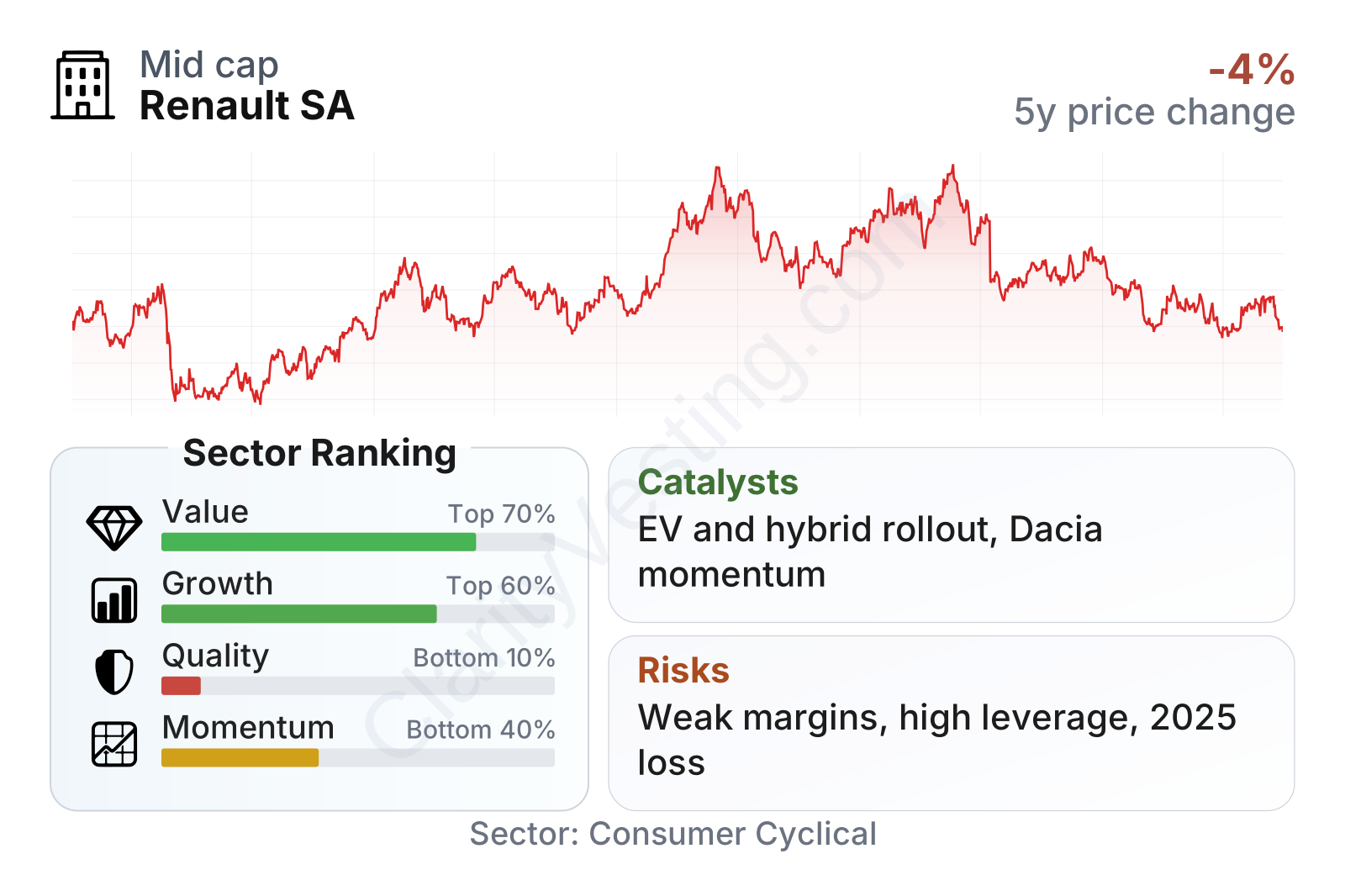
Renault currently sits in a mixed position. On valuation measures, it looks inexpensive relative to much of the auto sector, with a low earnings multiple, a very low price-to-book ratio, and a notably high free cash flow yield. The dividend yield is also well above the sector median. Growth metrics are more balanced: recent revenue growth has been ahead of the sector median, and free cash flow has improved strongly over five years, but longer-term margin and book value trends are weaker. The biggest concern is quality. Profitability and returns on capital rank near the bottom of the sector, while leverage is high. Market performance has also lagged over the last year and over three years, which shows that the market has remained cautious despite apparently cheap headline multiples.
Growth
The auto industry is in a meaningful transition rather than a simple expansion phase. Long-term demand is supported by vehicle replacement, electrification, software features, and tighter emissions rules, especially in Europe. Renault is active in all of these areas, which keeps it exposed to relevant growth themes even though the sector itself is highly cyclical and capital-intensive.
Renault’s strategy has a logical industrial basis. Management has emphasized value over volume, focusing on higher-margin models, stronger pricing, cost discipline, and a more selective approach to fleet sales. The company has also pushed deeper into hybrid and electric vehicles while using Dacia as a strong value brand and Alpine as a higher-image growth platform. That brand architecture gives Renault broader coverage than some European peers: mainstream, budget, sport, and financing under one group.
A major long-term catalyst is electrification in Europe. Renault has been one of the earlier European manufacturers in battery electric vehicles, and it is also leaning on hybrids to serve customers not yet ready to move fully electric. Another catalyst is the company’s continued model renewal cycle, especially in compact vehicles and commercial vans, where brand loyalty and fleet relationships can support recurring demand. Its financing operations can also help sustain sales by making vehicles more accessible to customers and dealers.
Recent reporting also shows that top-line momentum has remained positive over the last few years, even if earnings quality has become more volatile. That combination suggests Renault still has product and market relevance, but the next phase depends on restoring better profitability rather than simply adding sales.
Another point to watch is Renault’s evolving partnership structure. The reshaped relationship with Nissan has given Renault more strategic flexibility than in the past. It has also pursued separate structures for electric and combustion activities, which reflects a practical attempt to manage two technology transitions at once. If execution improves, that flexibility could become a meaningful advantage.
Risks
This article is for informational purposes only and does not constitute financial advice. Some content is AI-generated. See Disclaimer