Stock Analysis · Ramelius Resources Ltd (RMLRF)
Overview
Ramelius Resources Ltd is an Australian gold producer and developer. The company operates gold mines and processing assets in Western Australia and earns most of its money by selling gold produced from its own operations. For a long-term reader, this is fundamentally a single-commodity mining business: results depend mainly on how much gold it produces, what it costs to produce each ounce, and the market price of gold.
Its revenue base is relatively straightforward. Based on recent annual reporting and operating disclosures, the business is overwhelmingly tied to gold sales, with only limited contribution from by-products or other minor items.
- Gold sales: approximately more than 95% of revenue. This includes doré or refined gold sold from the company’s producing assets in Western Australia.
- Other mining-related revenue: approximately less than 5% of revenue. This can include minor by-product credits, treatment-related items, or other operating receipts that are not the core earnings engine.
Operationally, Ramelius has built a portfolio around mines such as Mt Magnet, Edna May, and Marda, while also using acquisitions and project development to refresh mine life. That matters because gold miners constantly need to replace depleted reserves. In simple terms, Ramelius is not just selling a product; it is continually trying to sustain and extend the number of ounces it can economically mine in future years.
The business has also become much larger than it was a few years ago. Revenue expanded sharply through fiscal 2025 before easing in fiscal 2026, while profitability remained well above sector norms. That pattern suggests a company that has already benefited from stronger production and a favorable gold price backdrop, even if year-to-year mining results remain uneven.
The multi-year income profile shows a major improvement from modest earnings earlier in the cycle to very strong operating profits in 2024 and 2025. Fiscal 2026 still appears profitable, but with lower net income than the prior year, which underlines how quickly results can move in mining when grades, volumes, costs, or one-off items shift.
Key Figures
| Metric | Value | Sector ⓘ |
|---|---|---|
| Date | Oct 17, 2026 | |
| Context | ||
| Sector | Basic Materials | |
| Industry | Gold | |
| Market Cap ⓘ | $4.85B | |
| Beta ⓘ | 1.23 | |
Value (Cheapness) | ||
| P/E Ratio ⓘ | 51.40 | 16.90 |
| P/B Ratio ⓘ | 1.20 | 1.65 |
| FCF Yield ⓘ | 18.53% | 5.76% |
| Dividend Yield ⓘ | 2.27% | 2.13% |
| EBIT / EV ⓘ | 21.64% | 6.30% |
| PEG ⓘ | 2.80 | |
Growth (Business expansion) | ||
| Revenue Growth ⓘ | -4.40% | 11.10% |
| RPS Growth (5Y CAGR) ⓘ | -5.85% | 4.49% |
| EPS Growth (5Y CAGR) ⓘ | 50.32% | -13.47% |
| BVPS Growth (5Y CAGR) ⓘ | 25.77% | 5.51% |
| Margin Growth (5Y Trend) ⓘ | 42.36% | -1.54% |
| FCF Growth (5Y CAGR) ⓘ | 114.60% | 0.37% |
| DPS Growth (5Y CAGR) ⓘ | 26.73% | 6.08% |
Quality (Business durability) | ||
| ROIC (Latest) ⓘ | N/A | 9.26% |
| ROA (Latest) ⓘ | 17.57% | 4.91% |
| ROIC (5Y Median) ⓘ | 17.89% | 7.70% |
| ROA (5Y Median) ⓘ | 5.69% | 3.86% |
| Net Debt / EBIT (Latest) ⓘ | -0.49 | 1.40 |
| Net Debt / EBIT (5Y Median) ⓘ | -1.35 | 1.70 |
| Net Debt / EBITDA (Latest) ⓘ | -0.33 | 0.95 |
| Net Debt / Assets ⓘ | -10.83% | 13.69% |
| EBITDA / Interest ⓘ | 107.10 | 12.34 |
| Operating Margin (Latest) ⓘ | 48.51% | 13.20% |
| Operating Margin (5Y Median) ⓘ | 31.85% | 11.80% |
| Debt to Equity (Latest) ⓘ | 2.02% | 40.56% |
| Profit Margin (Latest) ⓘ | 11.51% | 6.43% |
| Free Cash Flow (Latest) ⓘ | $897.86M | |
Momentum (Price trend) | ||
| 3Y Return ⓘ | +157.68% | +68.89% |
| 12M Return (excl. last month) ⓘ | +10.22% | +30.21% |
| 6M Return ⓘ | -10.61% | -4.16% |
| Price vs. 200-Day MA ⓘ | -5.49% | -1.27% |
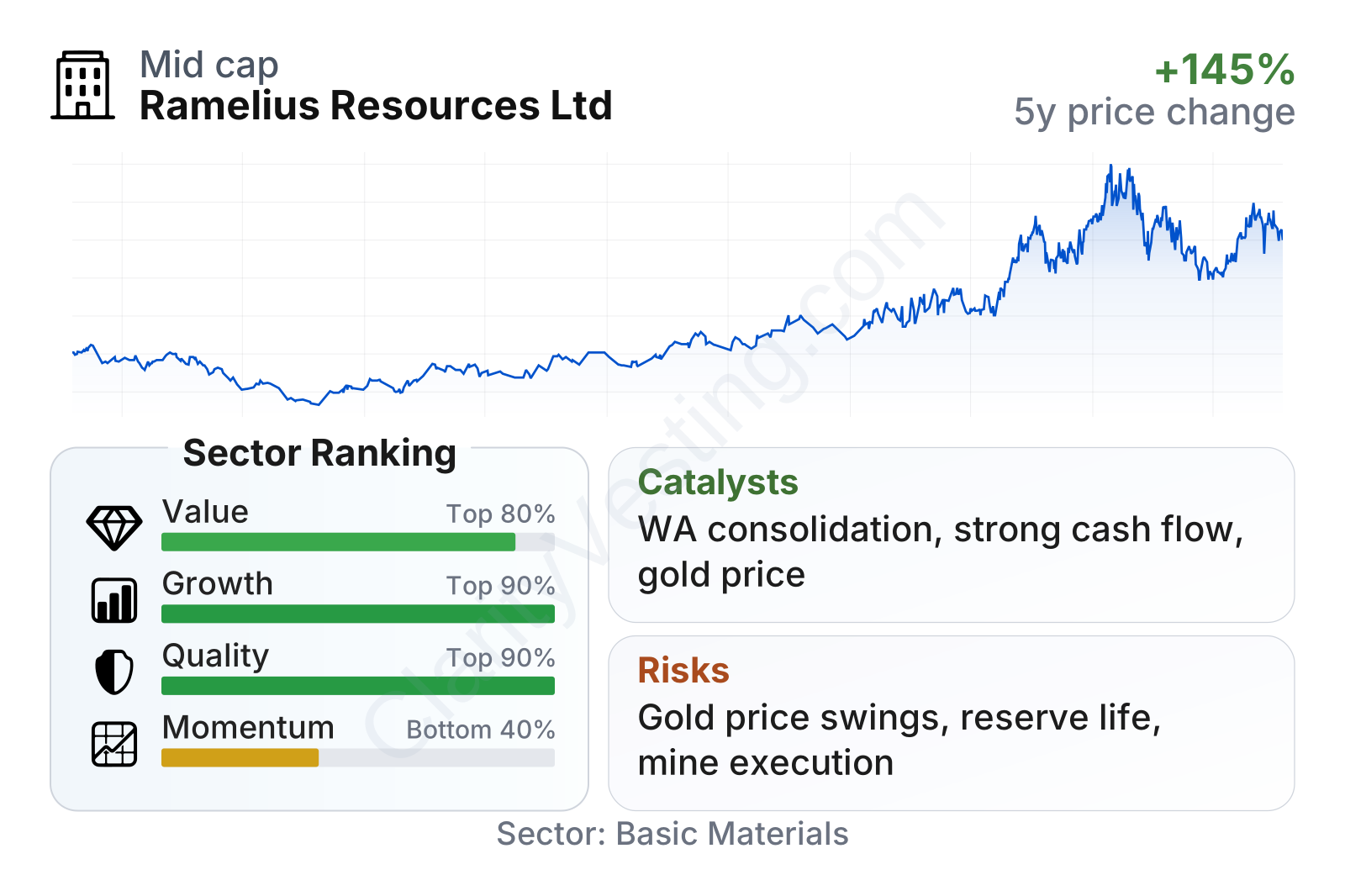
Ramelius stands out on quality and growth measures relative to much of the gold sector, supported by strong returns on assets, very high operating margins, and an unusually clean balance sheet. The value picture is mixed: earnings-based multiples look elevated, but cash-flow-based measures are much stronger than sector norms. That combination usually means the market is recognizing the company’s profitability, while traditional P/E can be distorted by the cyclical nature of mining earnings.
The share price history shows a strong re-rating over the last several years, although with visible pullbacks along the way. That is typical for gold producers: the market often reacts not only to profits, but also to reserve replacement, mine plans, and changes in the gold price.
Growth
Gold remains a relevant long-term sector because it serves several roles at once: jewelry demand, central-bank reserve accumulation, portfolio hedging, and a perceived store of value during inflation or geopolitical stress. Ramelius does not operate in a high-volume structural growth industry like software, but it does operate in a sector that can see long upcycles when gold prices remain strong and producers execute well.
For Ramelius specifically, the growth case depends less on broad industry expansion and more on execution. A gold miner grows by increasing production, extending mine life, adding reserves, improving recovery rates, lowering unit costs, and making acquisitions that fit existing infrastructure. Ramelius has used that playbook for several years, building a broader operating base across Western Australia and trying to feed processing plants efficiently from multiple ore sources.
A major positive is cash generation. Free cash flow expanded sharply over the last reported periods, giving the company more flexibility to fund development, pursue acquisitions, pay dividends, or simply preserve balance-sheet strength. For a miner, strong free cash flow is especially important because new ounces are expensive to replace.
The recent free cash flow trend points to a business that has been converting favorable operating conditions into real liquidity rather than only accounting profits. Combined with low leverage, that gives Ramelius room to act when weaker peers may be more constrained.
Recent corporate developments also matter. Ramelius has been active in portfolio shaping and consolidation efforts in Western Australian gold, including moves that can increase scale and deepen its project pipeline. For long-term analysis, that is a meaningful catalyst because scale can improve mine planning, plant utilization, and regional optionality. In mining, a company with processing infrastructure and a wider ore inventory often has more strategic flexibility than a single-asset operator.
Risks
This article is for informational purposes only and does not constitute financial advice. Some content is AI-generated. See Disclaimer


