Stock Analysis · Suncrete Inc (RMIX)
Overview
Suncrete Inc, traded under the RMIX symbol, operates in building materials with a focus on ready-mix concrete and related construction products. In practical terms, the company supplies basic materials used in commercial buildings, infrastructure, industrial projects, and residential construction. Its business is tied closely to local construction activity because concrete is expensive to transport over long distances, which makes regional plant networks and delivery logistics especially important.
The company’s revenue base is primarily connected to concrete production and delivery. Public company materials indicate that ready-mix concrete is the core business, while related activities can include aggregates, concrete pumping, and other construction-material services depending on market footprint and operating mix. Based on the company’s business profile and industry structure, the revenue mix is best understood as follows:
- Ready-mix concrete: the dominant source of sales, typically the large majority of revenue. This includes batching and delivering concrete to job sites.
- Aggregates and raw materials: a smaller contribution where applicable, including stone, sand, and gravel used in concrete production.
- Other services and products: may include concrete pumping, freight-related services, or ancillary construction-material offerings, depending on location and customer demand.
For long-term analysis, the key point is that Suncrete is not a high-tech or highly diversified business. It is a cyclical, asset-heavy operator whose performance depends on plant utilization, input costs, local pricing power, and construction demand. That can create meaningful upside when end markets are healthy, but it also makes results sensitive to downturns and execution quality.
The operating flow shows a business that was profitable in 2023 but much weaker by 2025, with earnings slipping into a small loss. That contrast matters: it suggests the recent equity market enthusiasm is being driven more by expectations of future improvement than by consistently strong current profitability.
Key Figures
| Metric | Value | Sector ⓘ |
|---|---|---|
| Date | Oct 17, 2026 | |
| Context | ||
| Sector | Basic Materials | |
| Industry | Building Materials | |
| Market Cap ⓘ | $1.26B | |
| Beta ⓘ | 0.72 | |
Value (Cheapness) | ||
| P/E Ratio ⓘ | 33.00 | 16.90 |
| P/B Ratio ⓘ | 2,427.27 | 1.65 |
| FCF Yield ⓘ | -0.73% | 5.76% |
| Dividend Yield ⓘ | N/A | 2.13% |
| EBIT / EV ⓘ | N/A | 6.30% |
| PEG ⓘ | N/A | |
Growth (Business expansion) | ||
| Revenue Growth ⓘ | 146.20% | 11.10% |
| RPS Growth (5Y CAGR) ⓘ | N/A | 4.49% |
| EPS Growth (5Y CAGR) ⓘ | N/A | -13.47% |
| BVPS Growth (5Y CAGR) ⓘ | 133.63% | 5.51% |
| Margin Growth (5Y Trend) ⓘ | N/A | -1.54% |
| FCF Growth (5Y CAGR) ⓘ | N/A | 0.37% |
| DPS Growth (5Y CAGR) ⓘ | N/A | 6.08% |
Quality (Business durability) | ||
| ROIC (Latest) ⓘ | N/A | 9.26% |
| ROA (Latest) ⓘ | -2.42% | 4.91% |
| ROIC (5Y Median) ⓘ | N/A | 7.70% |
| ROA (5Y Median) ⓘ | N/A | 3.86% |
| Net Debt / EBIT (Latest) ⓘ | N/A | 1.40 |
| Net Debt / EBIT (5Y Median) ⓘ | N/A | 1.70 |
| Net Debt / EBITDA (Latest) ⓘ | 0.05 | 0.95 |
| Net Debt / Assets ⓘ | 29.38% | 13.69% |
| EBITDA / Interest ⓘ | N/A | 12.34 |
| Operating Margin (Latest) ⓘ | N/A | 13.20% |
| Operating Margin (5Y Median) ⓘ | N/A | 11.80% |
| Debt to Equity (Latest) ⓘ | 65.39% | 40.56% |
| Profit Margin (Latest) ⓘ | -13.60% | 6.43% |
| Free Cash Flow (Latest) ⓘ | -$9.20M | |
Momentum (Price trend) | ||
| 3Y Return ⓘ | N/A | +68.89% |
| 12M Return (excl. last month) ⓘ | N/A | +30.21% |
| 6M Return ⓘ | N/A | -4.16% |
| Price vs. 200-Day MA ⓘ | N/A | -1.27% |
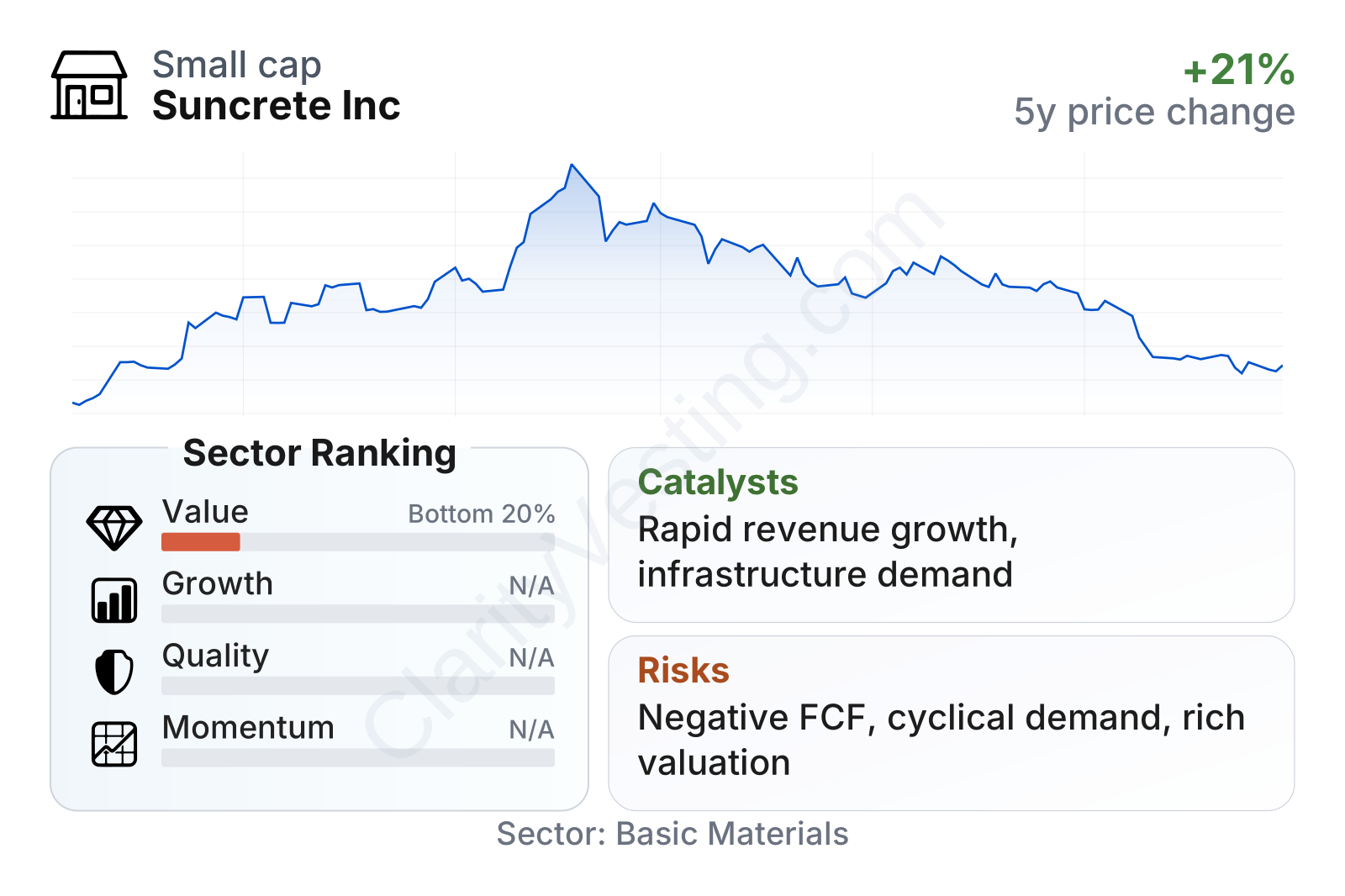
Suncrete is a small-cap building materials company with a stock that has moved sharply higher in a short period, while still showing a relatively low beta. In the latest metrics, valuation looks demanding versus the broader materials sector: earnings multiples are above sector norms, free cash flow is negative, and the stock ranks in the lower end of the sector on value measures.
Growth indicators are unusually strong on a year-over-year basis, especially revenue growth and book value expansion, which points to a business going through a major change in scale. At the same time, quality indicators are mixed. Net debt relative to EBITDA looks modest, but debt to equity is above the sector median, profit margin is negative, return on assets is negative, and free cash flow remains below zero. Put simply, the balance sheet does not look overstretched on every measure, but the company has not yet translated recent expansion into durable profitability.
Growth
Suncrete operates in a sector with steady long-term relevance rather than explosive structural growth. Concrete remains essential for roads, warehouses, data centers, manufacturing sites, energy facilities, and housing. Demand tends to follow construction cycles, public infrastructure spending, and regional population and industrial development. That means the sector can grow over time, but usually in uneven waves rather than in a straight line.
The most notable growth feature in Suncrete’s current profile is the scale of its recent revenue expansion. A year-over-year increase well above the sector median suggests the company has either added significant capacity, expanded into new markets, benefited from acquisitions, or captured stronger pricing and volume than peers. In a localized materials business, that can matter because fixed assets become more efficient as volumes rise. If management can keep utilization high and protect price discipline, revenue growth can eventually convert into stronger margins.
There is also a reasonable strategic logic behind a regional concrete operator building density. The more plants, dispatch capacity, and customer relationships a company has in a market, the harder it becomes for a smaller rival to compete on service reliability. In this industry, proximity and logistics can be a real edge. Concrete has a short usable life after mixing, so being close to customers is not just convenient; it is central to the business model.
A broader sector catalyst is the ongoing need for infrastructure renewal and nonresidential construction in the United States. Public works, manufacturing reshoring, and large project pipelines can support demand for aggregates and concrete over multiple years. If Suncrete is positioned in regions benefiting from those trends, the company could see stronger order activity than a purely housing-exposed operator.
Still, the important question is not whether sales can grow, but whether growth becomes profitable. The recent profile suggests expansion has been real, yet margins and cash generation have lagged. For a long-term view, that makes the next phase more important than the last one: the company now needs to demonstrate that a larger revenue base can produce consistent earnings and cash flow.
Risks
This article is for informational purposes only and does not constitute financial advice. Some content is AI-generated. See Disclaimer


