Stock Analysis · RHI Magnesita N.V (RMGNF)
Overview
RHI Magnesita N.V. is a global producer of refractory products, systems, and services. Refractories are heat-resistant materials used to line industrial equipment that operates at very high temperatures, such as steel furnaces, cement kilns, glass tanks, and non-ferrous metal smelters. In simple terms, the company sells the materials that help heavy industries keep their high-temperature operations running safely and efficiently.
The business is closely tied to essential industrial production, especially steel. That makes RHI Magnesita less exposed to consumer trends and more exposed to activity in basic materials and infrastructure-related manufacturing. The company also combines product sales with on-site service, engineering support, recycling, and raw material sourcing, which helps it play a broader role than a simple materials supplier.
Based on the company’s annual reporting structure, revenue is mainly generated from the following end markets:
- Steel: approximately 65% to 75% of revenue. This is the core business and includes refractory products and service solutions used in integrated steel plants and electric arc furnaces.
- Industrial businesses: approximately 25% to 35% of revenue. This includes cement and lime, non-ferrous metals, glass, energy, chemicals, and other high-temperature industrial applications.
Geographically, the company operates across Europe, the Americas, India, China, and the rest of Asia, with production sites, raw material assets, and service networks spread across multiple regions. That broad footprint matters because refractory supply depends on local service capability, logistics, and access to magnesite and other mineral inputs.
The financial picture over the last several years shows a business with multi-billion-dollar annual revenue, but also one facing pressure from costs, financing expense, and softer profitability more recently. Revenue climbed strongly from 2021 through 2023, then eased in 2024 and 2025, while net income declined more sharply than sales. That pattern suggests pricing and volume held up better than final profit, but margin pressure increased lower down the income statement.
The operating profile shows a company that still produces solid gross profit, but with a narrower profit cushion than a few years ago. Interest expense has also risen compared with 2021, which makes debt management and operating discipline especially important.
Key Figures
| Metric | Value | Sector ⓘ |
|---|---|---|
| Date | Oct 03, 2026 | |
| Context | ||
| Sector | Industrials | |
| Industry | Metal Fabrication | |
| Market Cap ⓘ | $1.99B | |
| Beta ⓘ | 1.50 | |
Value (Cheapness) | ||
| P/E Ratio ⓘ | 12.58 | 22.45 |
| P/B Ratio ⓘ | 2.26 | 1.98 |
| FCF Yield ⓘ | N/A | 6.31% |
| Dividend Yield ⓘ | 4.28% | 1.96% |
| EBIT / EV ⓘ | 7.02% | 4.81% |
| PEG ⓘ | N/A | |
Growth (Business expansion) | ||
| Revenue Growth ⓘ | -4.90% | 9.10% |
| RPS Growth (5Y CAGR) ⓘ | 7.00% | 7.75% |
| EPS Growth (5Y CAGR) ⓘ | N/A | -13.59% |
| BVPS Growth (5Y CAGR) ⓘ | 5.50% | 6.22% |
| Margin Growth (5Y Trend) ⓘ | -2.82% | 0.72% |
| FCF Growth (5Y CAGR) ⓘ | N/A | 10.98% |
| DPS Growth (5Y CAGR) ⓘ | 4.36% | 9.48% |
Quality (Business durability) | ||
| ROIC (Latest) ⓘ | N/A | 10.92% |
| ROA (Latest) ⓘ | N/A | 5.41% |
| ROIC (5Y Median) ⓘ | 7.63% | 9.21% |
| ROA (5Y Median) ⓘ | 3.70% | 4.94% |
| Net Debt / EBIT (Latest) ⓘ | N/A | 2.07 |
| Net Debt / EBIT (5Y Median) ⓘ | 3.84 | 2.28 |
| Net Debt / EBITDA (Latest) ⓘ | N/A | 1.43 |
| Net Debt / Assets ⓘ | 32.98% | 19.27% |
| EBITDA / Interest ⓘ | N/A | 9.53 |
| Operating Margin (Latest) ⓘ | N/A | 10.50% |
| Operating Margin (5Y Median) ⓘ | 9.24% | 10.27% |
| Debt to Equity (Latest) ⓘ | N/A | 65.48% |
| Profit Margin (Latest) ⓘ | 3.38% | 6.62% |
| Free Cash Flow (Latest) ⓘ | N/A | |
Momentum (Price trend) | ||
| 3Y Return ⓘ | -17.61% | +58.56% |
| 12M Return (excl. last month) ⓘ | +5.18% | +15.63% |
| 6M Return ⓘ | +5.18% | +4.19% |
| Price vs. 200-Day MA ⓘ | +3.47% | +0.93% |
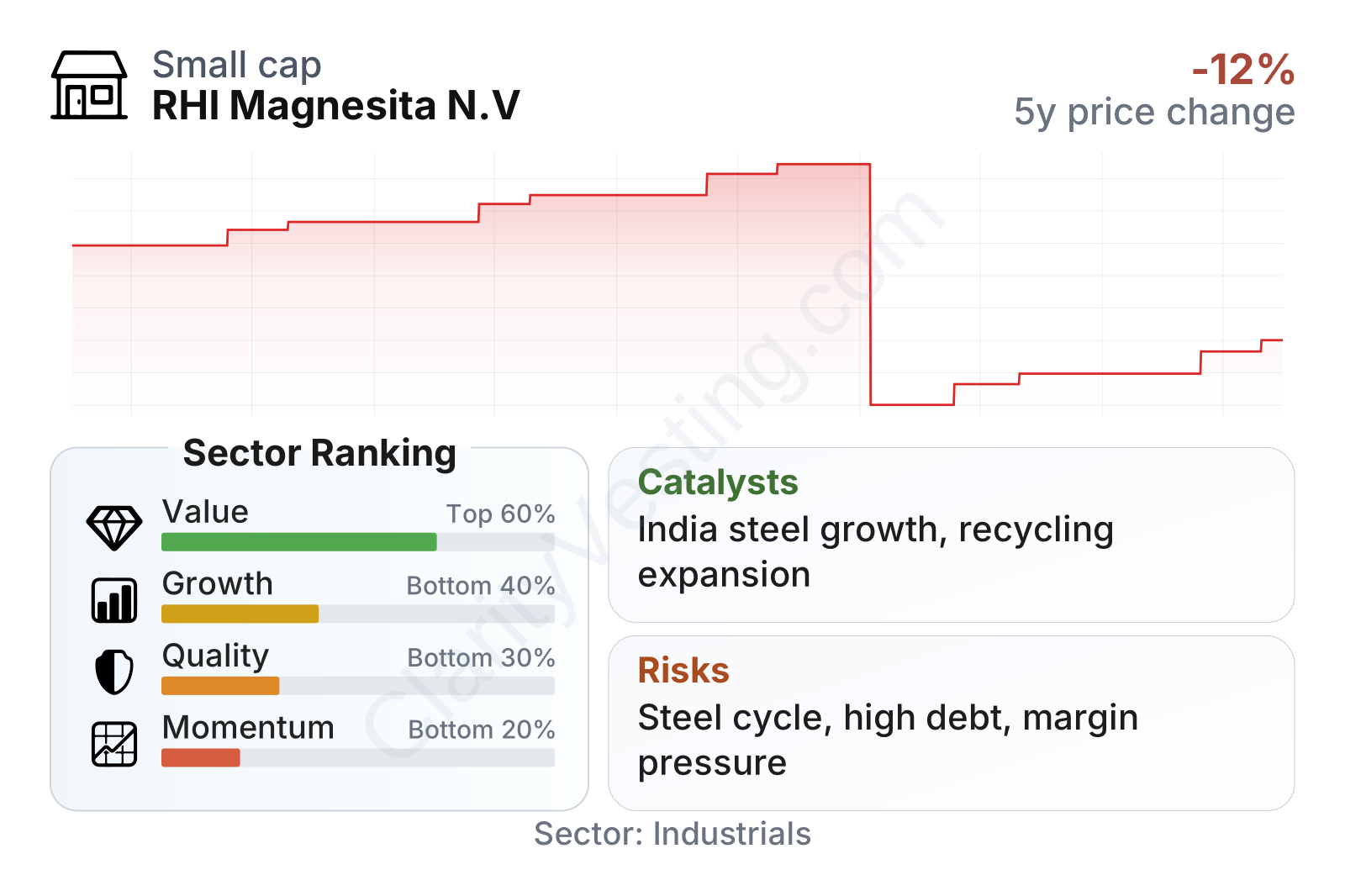
RHI Magnesita sits in the mid-cap range and its share price behavior has been more volatile than the broader market, as reflected by a beta above 1.5. On valuation, earnings-based pricing looks comparatively restrained, with a P/E well below the sector median, while the dividend yield is notably above the sector median. Enterprise-value-based earnings measures also look stronger than the sector midpoint, which points to some underlying operating earning power relative to the current market value.
The weaker side of the profile is growth and quality. Recent revenue growth is negative, long-term growth has been positive but not exceptional, and margins have trended down over the last five years. Profitability measures also sit below many sector peers, while leverage appears heavier than the typical company in the group. Share-price momentum has been soft over three years, even though the stock has shown some stabilization more recently and is trading modestly above its long-term average.
Growth
RHI Magnesita operates in a sector that is not a fast-growth industry in the usual technology sense, but it serves markets that remain structurally necessary. Steel, cement, glass, and non-ferrous metals are core industrial activities, and all require refractory materials. This gives the company exposure to long-lived industrial demand rather than short product cycles. For long-term analysis, the more important question is not whether refractories are a booming market, but whether RHI Magnesita can grow through market share, service intensity, recycling, and geographic expansion.
That strategy broadly makes sense. Refractories are critical in customer operations, and failure can be extremely costly for steelmakers and other manufacturers. This gives established suppliers room to build sticky customer relationships through technical support, on-site service, digital monitoring, and full-system solutions. RHI Magnesita has also emphasized vertical integration into raw materials and recycling. Those steps can strengthen supply security, support margins, and help customers lower waste and emissions.
Another meaningful growth angle is the shift in steelmaking methods. Electric arc furnace production, which uses scrap steel and electricity rather than traditional blast furnaces, is gaining relevance in many regions as decarbonization efforts progress. Refractory needs do not disappear in that transition; they change by process and application. A supplier with broad technical know-how across steelmaking routes can benefit as customers update plants and production mixes.
India remains one of the most important long-term opportunities. The country continues to invest in steel capacity and infrastructure, and RHI Magnesita has expanded its local position over time. A strong presence in a faster-growing steel market can help offset slower conditions in Europe. Recycling is another notable catalyst, since recycled refractory material can lower raw material dependence and align with customers’ environmental targets while potentially improving cost efficiency.
Recent business developments have reinforced those themes: management has continued to emphasize operational efficiency, recycling capacity, and growth in higher-value service offerings. None of these are likely to transform the company overnight, but together they support a practical long-term path for expansion in a mature industrial niche.
Risks
This article is for informational purposes only and does not constitute financial advice. Some content is AI-generated. See Disclaimer