Stock Analysis · ResMed Inc (RMD)
Overview
ResMed is a medical technology company focused on sleep health, breathing disorders, and care delivered outside the hospital. Its best-known products are devices used to treat obstructive sleep apnea, especially CPAP and related mask systems. The company also sells equipment for people with chronic respiratory conditions and provides software platforms that help medical providers, home-care organizations, and nursing facilities manage patients more efficiently.
Its business is attractive because it combines recurring hardware replacement demand with software and digital monitoring. A patient using a sleep apnea device typically needs masks, tubing, and other accessories replaced regularly, which can support repeat sales over time. ResMed also connects many of its devices to cloud-based systems, making therapy monitoring and patient follow-up easier for clinicians and durable medical equipment providers.
Based on recent annual reporting, revenue is concentrated in sleep and respiratory care, with software representing a smaller but strategically important piece. The main revenue sources can be summarized as follows:
- Sleep and respiratory care devices and masks: about 85% to 90%. This includes CPAP, bilevel devices, ventilators, masks, and related accessories used mainly for sleep apnea and other breathing conditions.
- Software as a service and out-of-hospital care platforms: about 10% to 15%. This includes business software and digital tools for home medical equipment providers, sleep labs, home health, and care facilities.
- Geographically, sales are split across the Americas, Europe, and Asia-Pacific, with the Americas generally representing the largest share.
Over the last several years, the business has shown a favorable pattern: revenue has continued to rise, while gross profit and operating income have expanded faster than operating expenses. That points to improving scale rather than growth bought at the expense of profitability.
Key Figures
| Metric | Value | Sector ⓘ |
|---|---|---|
| Date | Oct 17, 2026 | |
| Context | ||
| Sector | Healthcare | |
| Industry | Medical Instruments & Supplies | |
| Market Cap ⓘ | $34.07B | |
| Beta ⓘ | 0.75 | |
Value (Cheapness) | ||
| P/E Ratio ⓘ | 23.22 | 24.79 |
| P/B Ratio ⓘ | 5.33 | 3.08 |
| FCF Yield ⓘ | 8.48% | 3.15% |
| Dividend Yield ⓘ | 1.02% | 1.94% |
| EBIT / EV ⓘ | 6.12% | 0.57% |
| PEG ⓘ | 1.29 | |
Growth (Business expansion) | ||
| Revenue Growth ⓘ | 8.60% | 7.45% |
| RPS Growth (5Y CAGR) ⓘ | 12.30% | 8.61% |
| EPS Growth (5Y CAGR) ⓘ | N/A | -17.81% |
| BVPS Growth (5Y CAGR) ⓘ | 18.51% | 3.72% |
| Margin Growth (5Y Trend) ⓘ | 6.29% | -0.62% |
| FCF Growth (5Y CAGR) ⓘ | 70.52% | 1.04% |
| DPS Growth (5Y CAGR) ⓘ | 9.45% | 6.77% |
Quality (Business durability) | ||
| ROIC (Latest) ⓘ | 21.66% | 3.24% |
| ROA (Latest) ⓘ | 17.64% | 3.01% |
| ROIC (5Y Median) ⓘ | 20.78% | 4.60% |
| ROA (5Y Median) ⓘ | 15.87% | 1.89% |
| Net Debt / EBIT (Latest) ⓘ | -0.33 | 1.34 |
| Net Debt / EBIT (5Y Median) ⓘ | 0.48 | 1.84 |
| Net Debt / EBITDA (Latest) ⓘ | -0.30 | 1.00 |
| Net Debt / Assets ⓘ | -7.18% | 5.45% |
| EBITDA / Interest ⓘ | 43.42 | 9.64 |
| Operating Margin (Latest) ⓘ | 34.01% | 9.27% |
| Operating Margin (5Y Median) ⓘ | 28.12% | 7.38% |
| Debt to Equity (Latest) ⓘ | 12.54% | 28.58% |
| Profit Margin (Latest) ⓘ | 26.95% | 3.59% |
| Free Cash Flow (Latest) ⓘ | $2.89B | |
Momentum (Price trend) | ||
| 3Y Return ⓘ | +76.64% | +42.80% |
| 12M Return (excl. last month) ⓘ | -14.50% | +18.50% |
| 6M Return ⓘ | +6.49% | +7.57% |
| Price vs. 200-Day MA ⓘ | +8.08% | +5.12% |
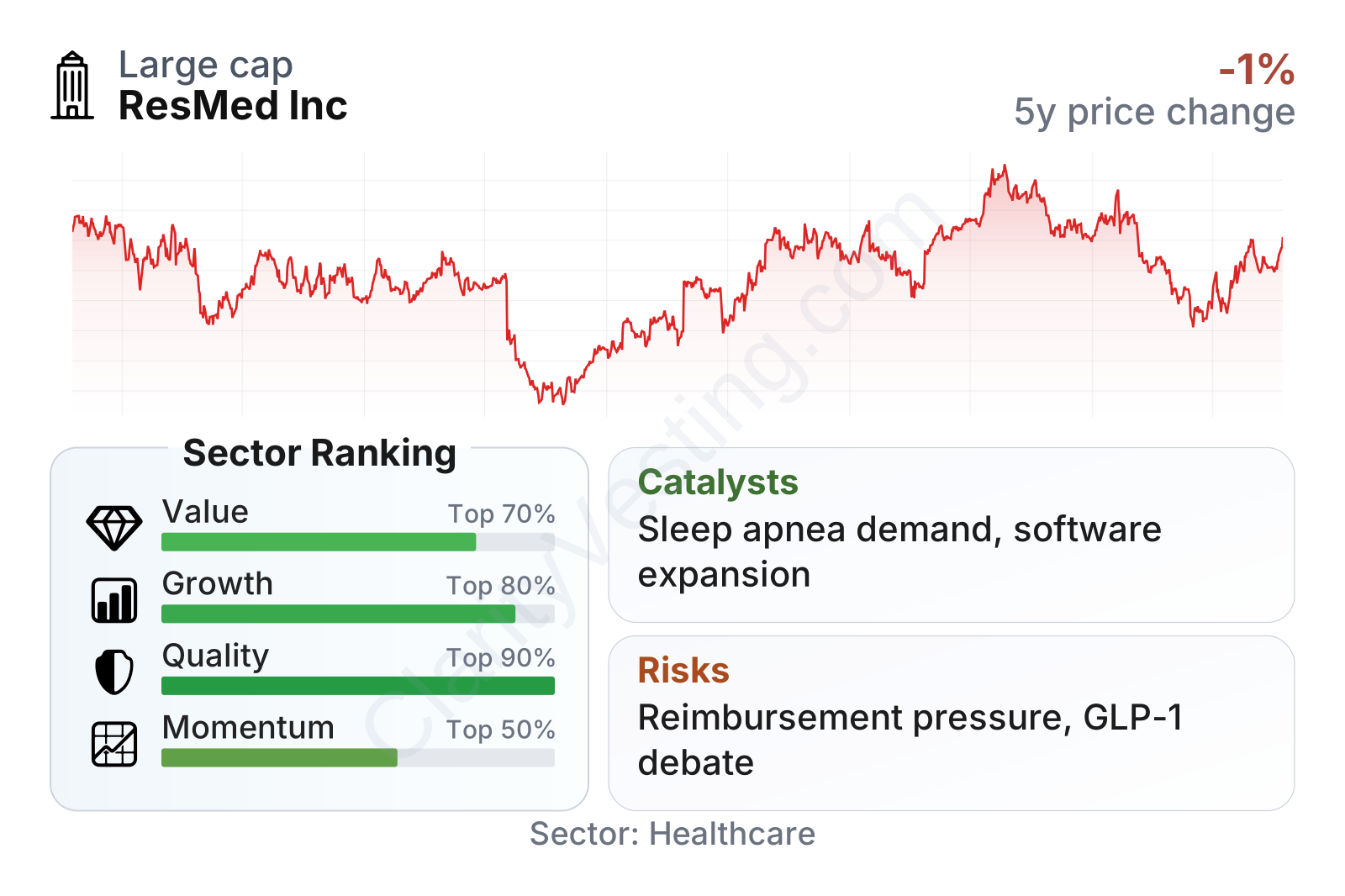
ResMed is a large healthcare company with a relatively low beta of 0.75, which suggests its share price has historically moved less sharply than the broader market. In the latest factor view, quality stands out the most: returns on capital and assets are far above the sector median, margins are unusually strong for medical equipment, and leverage is low. Growth also ranks well, supported by solid revenue expansion and a very strong multi-year rise in free cash flow. On valuation, the picture is more mixed: the earnings multiple is close to the sector median, but the price-to-book ratio remains clearly higher, reflecting the market’s willingness to pay for the company’s profitability and consistency.
Growth
ResMed operates in a healthcare segment with durable long-term demand drivers. Sleep apnea remains underdiagnosed in many countries, obesity trends increase the number of patients at risk, and aging populations support demand for respiratory care and care delivered at home. These are not short-lived themes. They create a broad base for continued device adoption, ongoing replacement purchases, and wider use of connected care software.
The company’s strategy also fits this market well. ResMed is not only selling devices; it is building an ecosystem around diagnosis, treatment, compliance monitoring, and workflow software. That matters because healthcare providers increasingly want integrated solutions that reduce administrative work and improve patient follow-up. A business model that combines hardware, masks, recurring consumables, and software can be more resilient than one built on one-time equipment sales alone.
Recent revenue growth has normalized from the unusually strong surge seen after industry supply disruptions, but it is still running at a healthy high-single-digit to low-double-digit pace. That is slightly better than the sector median and suggests ResMed is still gaining from favorable market conditions rather than simply benefiting from a one-off rebound.
Cash generation has improved sharply over the last few years. Free cash flow has climbed from a modest level in 2022 to well above $1.5 billion more recently, which strengthens financial flexibility. That can support research and development, acquisitions, shareholder returns, and internal investment without putting pressure on the balance sheet.
A notable catalyst in recent years has been market share opportunity created by disruption at a major competitor in sleep therapy. Even though that effect fades over time, it helped ResMed deepen relationships with providers and patients. More recently, the company has continued to emphasize product launches, digital adoption, and expansion of its software platforms, all of which can support growth beyond the initial share-shift tailwind.
Another issue the market has watched closely is the rise of GLP-1 weight-loss drugs. In simple terms, some investors feared these treatments could eventually reduce sleep apnea device demand by lowering obesity rates. ResMed has pushed back on that idea, arguing that diagnosis rates remain low, many patients still need therapy, and better screening may actually broaden treatment volumes. At this stage, the company’s operating results have continued to show growth rather than demand erosion.
Risks
This article is for informational purposes only and does not constitute financial advice. Some content is AI-generated. See Disclaimer


