Stock Analysis · Rocket Companies Inc (RKT)
Overview
Rocket Companies is a U.S. consumer finance platform best known for home lending through Rocket Mortgage. The company combines mortgage origination, mortgage servicing, title and closing services, real estate search tools, and personal finance technology under one brand family. Its main goal is to make borrowing and home-related transactions more digital, faster, and easier for consumers.
The business still depends primarily on the housing and mortgage market. Based on recent company reporting, revenue is concentrated in mortgage banking activities, with servicing and other platform activities providing additional support. In simple terms, Rocket earns money when it helps originate mortgages, when it services loans after closing, and when it provides related services across the home-buying process.
The main revenue sources can be summarized as follows:
- Mortgage origination and gain on sale income: approximately 55% to 70% of revenue in recent periods. This includes fees and gains generated when Rocket originates mortgages and sells or transfers them into the secondary market.
- Mortgage servicing income: approximately 20% to 35%. This comes from collecting payments, managing escrow, and administering loans for investors, plus changes in the value of mortgage servicing rights.
- Other revenue streams: approximately 5% to 15%. This includes title, closing, appraisal, personal finance, and other technology-enabled services tied to the homeownership ecosystem.
Rocket’s broader model matters because mortgage origination can be highly cyclical, while servicing revenue is usually steadier and can become more valuable when interest rates stay elevated and refinancing activity slows. Over the last several years, the company has been shifting from a pure mortgage lender into a more diversified home finance platform, although mortgages remain the economic core.
The long-term operating pattern has been volatile. Revenue surged during the low-rate boom, then dropped sharply as rates rose and refinancing collapsed, and later began recovering. Expenses have also been adjusted over time, but profits have remained uneven, showing how sensitive the company is to mortgage market conditions.
The multi-year flow of revenue and expenses shows a business that went through a sharp post-boom reset. Revenue and operating income fell heavily after 2021, turned negative at the operating level in 2023, and improved again in 2024 and 2025, but net income remained thin. That pattern highlights both Rocket’s scale and the cyclicality built into its model.
Key Figures
| Metric | Value | Sector ⓘ |
|---|---|---|
| Date | Oct 24, 2026 | |
| Context | ||
| Sector | Financial Services | |
| Industry | Mortgage Finance | |
| Market Cap ⓘ | $33.17B | |
| Beta ⓘ | 2.25 | |
Value (Cheapness) | ||
| P/E Ratio ⓘ | N/A | 12.46 |
| P/B Ratio ⓘ | 1.42 | 1.25 |
| FCF Yield ⓘ | -2.33% | 9.82% |
| Dividend Yield ⓘ | N/A | 2.94% |
| EBIT / EV ⓘ | 3.19% | 8.11% |
| PEG ⓘ | 0.53 | |
Growth (Business expansion) | ||
| Revenue Growth ⓘ | 91.90% | 9.10% |
| RPS Growth (5Y CAGR) ⓘ | -54.73% | 12.31% |
| EPS Growth (5Y CAGR) ⓘ | N/A | -6.97% |
| BVPS Growth (5Y CAGR) ⓘ | 28.96% | 5.02% |
| Margin Growth (5Y Trend) ⓘ | -38.22% | -4.00% |
| FCF Growth (5Y CAGR) ⓘ | N/A | 4.71% |
| DPS Growth (5Y CAGR) ⓘ | -5.43% | 8.92% |
Quality (Business durability) | ||
| ROIC (Latest) ⓘ | 3.38% | 9.18% |
| ROE (Latest) ⓘ | 2.91% | 13.93% |
| ROA (Latest) ⓘ | 1.00% | 1.57% |
| ROIC (5Y Median) ⓘ | 4.95% | 7.80% |
| ROE (5Y Median) ⓘ | 4.43% | 12.15% |
| ROA (5Y Median) ⓘ | 0.13% | 1.28% |
| Net Debt / EBIT (Latest) ⓘ | 15.41 | 1.02 |
| Net Debt / EBIT (5Y Median) ⓘ | 6.92 | 0.72 |
| Net Debt / EBITDA (Latest) ⓘ | 12.14 | 0.88 |
| Operating Margin (Latest) ⓘ | 20.19% | 22.30% |
| Operating Margin (5Y Median) ⓘ | 12.36% | 24.50% |
| Debt to Equity (Latest) ⓘ | 140.92% | 59.34% |
| Profit Margin (Latest) ⓘ | 4.60% | 26.42% |
| Free Cash Flow (Latest) ⓘ | -$773.37M | |
Momentum (Price trend) | ||
| 3Y Return ⓘ | +68.56% | +95.73% |
| 12M Return (excl. last month) ⓘ | -35.72% | +17.30% |
| 6M Return ⓘ | -23.32% | +6.07% |
| Price vs. 200-Day MA ⓘ | -21.67% | +5.36% |
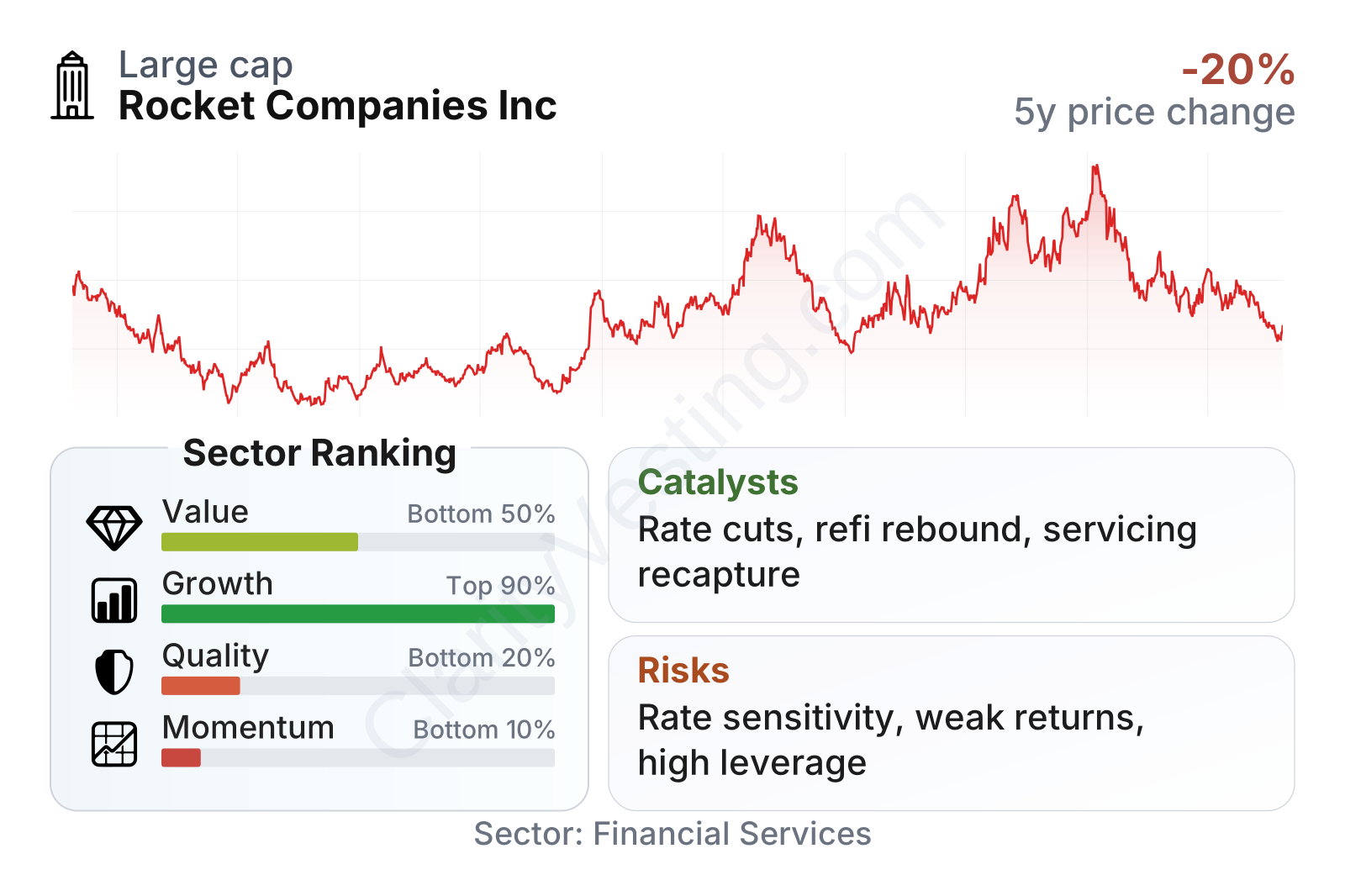
Rocket is a large company in mortgage finance, but its market behavior has been much more volatile than the broader financial sector, reflected in a beta above 2. The overall factor picture is mixed: growth ranks very high versus the sector, while quality, value, and momentum rank weakly. That combination usually points to a company coming out of a difficult cycle, with improving business activity but still-limited profitability and a stock that has not fully regained market confidence.
The share price history also reflects this pattern. After a deep decline from 2021 into 2022, the stock experienced rebounds but remained unstable, with meaningful swings tied to interest-rate expectations and housing market sentiment rather than a smooth long-term upward trend.
Growth
Rocket operates in a very large market, but not a simple high-growth one. Mortgage finance grows over time with housing demand, home turnover, household formation, and inflation in home values, yet it is highly sensitive to interest rates. That means Rocket’s growth profile depends less on a constantly expanding market and more on gaining share, improving conversion through technology, cross-selling services, and being ready when refinancing or purchase demand recovers.
The company’s strategy is logical for long-term expansion. It has built a consumer-facing digital brand, a large servicing portfolio, and a broader ecosystem around the home transaction. That ecosystem approach matters because customer acquisition in mortgages is expensive. If Rocket can capture more of the title, closing, search, and personal finance relationship, it can spread marketing costs across more services and deepen repeat customer ties.
Another important pillar is scale. Rocket has historically been one of the largest retail mortgage originators in the United States. In a weak market, scale can help absorb fixed technology, compliance, and marketing costs better than smaller rivals. If industry volumes recover, larger operators can often grow earnings faster than revenue because much of the infrastructure is already in place.
Earnings per share illustrate the cycle clearly: very strong profitability during the earlier housing boom was followed by losses and then a return to modest positive earnings. The recent pattern suggests stabilization rather than a fully mature rebound. For long-term analysis, the key question is not whether earnings are back, but whether they can become consistently stronger in a more normal mortgage market.
Book value per share has moved unevenly, which is common for financial businesses exposed to valuation changes and capital structure shifts. Even with that volatility, the longer-term trend in the available metrics suggests that underlying capital per share has improved over time. That gives Rocket some balance-sheet support as it works through a cyclical recovery.
A meaningful catalyst is any decline in mortgage rates that improves affordability and refinancing activity. A more active housing market could lift both loan volume and related service revenue. Rocket has also emphasized artificial intelligence, automation, and platform integration in its public communications, which could support efficiency and customer conversion if execution is strong. Recent company announcements around product expansion, platform partnerships, and its integrated homeownership offerings point to a business positioning itself for the next demand upswing rather than simply waiting for rates to fall.
Risks
This article is for informational purposes only and does not constitute financial advice. Some content is AI-generated. See Disclaimer


