Stock Analysis · Rentokil Initial plc (RKLIF)
Overview
Rentokil Initial plc is a global business services company best known for pest control. It helps homes, restaurants, offices, factories, healthcare sites, and public buildings prevent or solve pest problems, improve hygiene, and protect property. The company operates across North America, Europe, Asia-Pacific, Latin America, and other international markets, with a broad service network built around recurring visits, local technicians, and long customer relationships.
Its business mix is now heavily centered on pest control, especially after the Terminix acquisition expanded its presence in the United States. Hygiene and wellbeing services remain part of the portfolio, but they are much smaller than the core pest business. Based on recent annual reporting, revenue is broadly concentrated as follows:
- Pest Control: approximately 80% to 85% of revenue. This includes residential and commercial pest prevention, termite services, rodent control, and related inspection and monitoring work.
- Hygiene & Wellbeing: approximately 10% to 15% of revenue. This covers washroom services, air care, hand hygiene, and workplace wellbeing products and support.
- Other categories, including specialist services: approximately 3% to 7% of revenue, depending on classification and reporting period.
Geographically, North America has become the largest contributor, with Europe and the rest of the world making up the balance. That matters because the U.S. market is both large and fragmented, which gives Rentokil room to keep growing through local branch expansion, pricing, and smaller acquisitions.
The business model is attractive in simple terms: pest control is usually non-discretionary, many contracts are recurring, and customers often prefer established providers because service reliability and compliance matter more than finding the very lowest price.
The company’s revenue expanded strongly over the past several years, and operating profit also increased, although net profit has been more uneven because financing costs and integration effects have taken a larger share of earnings than before.
Key Figures
| Metric | Value | Sector ⓘ |
|---|---|---|
| Date | Oct 24, 2026 | |
| Context | ||
| Sector | Industrials | |
| Industry | Specialty Business Services | |
| Market Cap ⓘ | $12.25B | |
| Beta ⓘ | 0.45 | |
Value (Cheapness) | ||
| P/E Ratio ⓘ | 37.46 | 22.29 |
| P/B Ratio ⓘ | 1.78 | 1.98 |
| FCF Yield ⓘ | 10.17% | 6.26% |
| Dividend Yield ⓘ | 2.10% | 1.92% |
| EBIT / EV ⓘ | 10.44% | 4.83% |
| PEG ⓘ | 1.31 | |
Growth (Business expansion) | ||
| Revenue Growth ⓘ | 6.70% | 9.30% |
| RPS Growth (5Y CAGR) ⓘ | 15.11% | 7.76% |
| EPS Growth (5Y CAGR) ⓘ | -45.24% | -13.17% |
| BVPS Growth (5Y CAGR) ⓘ | 33.77% | 6.13% |
| Margin Growth (5Y Trend) ⓘ | 0.89% | 0.74% |
| FCF Growth (5Y CAGR) ⓘ | 18.12% | 10.79% |
| DPS Growth (5Y CAGR) ⓘ | 13.29% | 9.41% |
Quality (Business durability) | ||
| ROIC (Latest) ⓘ | N/A | 10.75% |
| ROA (Latest) ⓘ | 5.70% | 5.41% |
| ROIC (5Y Median) ⓘ | 6.98% | 9.37% |
| ROA (5Y Median) ⓘ | 3.31% | 4.95% |
| Net Debt / EBIT (Latest) ⓘ | 2.39 | 2.04 |
| Net Debt / EBIT (5Y Median) ⓘ | 4.66 | 2.27 |
| Net Debt / EBITDA (Latest) ⓘ | 1.41 | 1.39 |
| Net Debt / Assets ⓘ | 24.85% | 19.27% |
| EBITDA / Interest ⓘ | 5.72 | 9.58 |
| Operating Margin (Latest) ⓘ | 12.46% | 10.49% |
| Operating Margin (5Y Median) ⓘ | 12.78% | 10.30% |
| Debt to Equity (Latest) ⓘ | 110.37% | 64.82% |
| Profit Margin (Latest) ⓘ | 6.70% | 6.67% |
| Free Cash Flow (Latest) ⓘ | $1.25B | |
Momentum (Price trend) | ||
| 3Y Return ⓘ | -29.61% | +67.77% |
| 12M Return (excl. last month) ⓘ | +18.64% | +12.05% |
| 6M Return ⓘ | -40.44% | 0.00% |
| Price vs. 200-Day MA ⓘ | -27.86% | +0.67% |
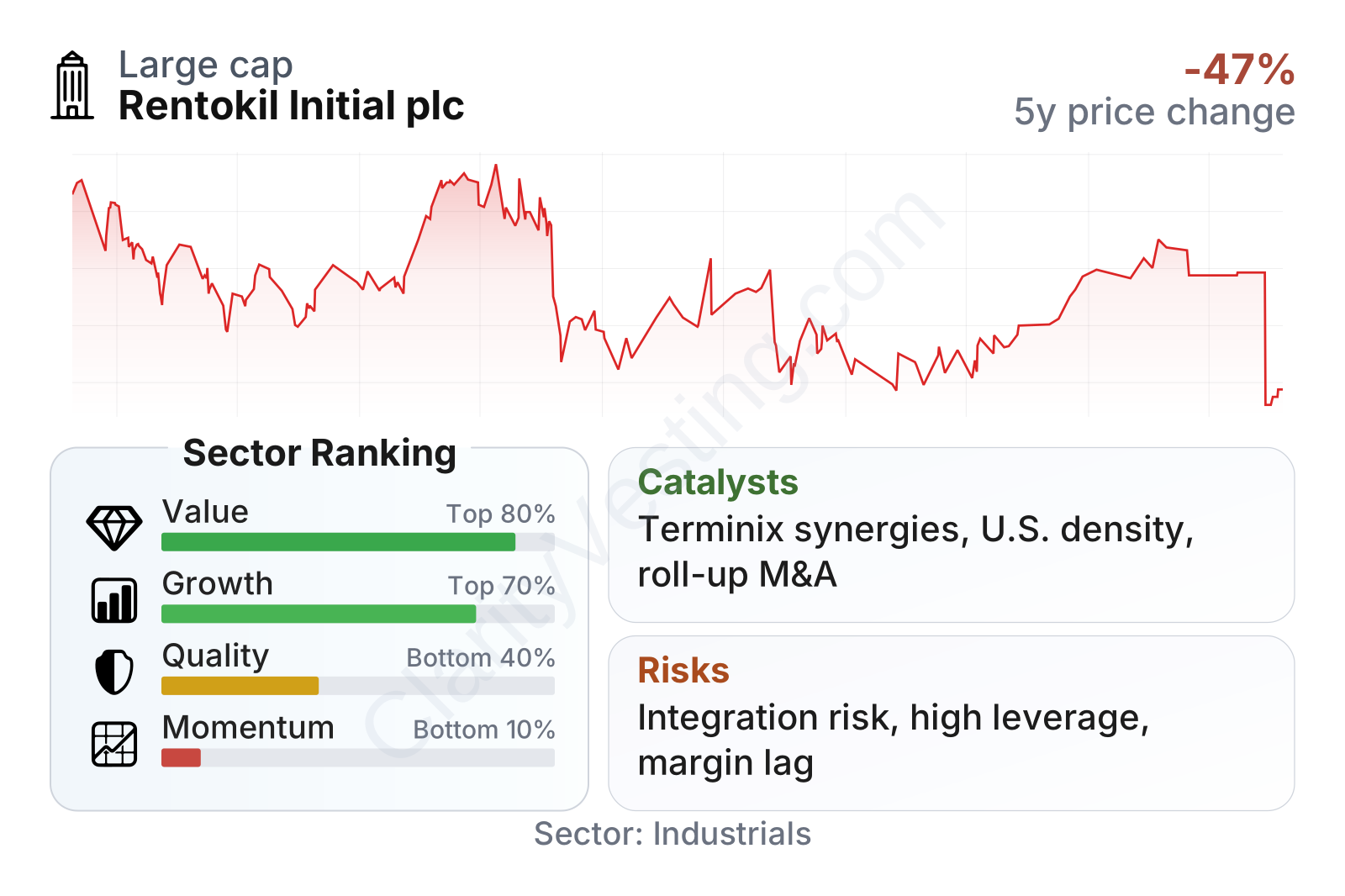
Rentokil is a large global operator with a market value in the low tens of billions of dollars and a relatively low beta, which means its share price has historically moved less than the broader market. On valuation and cash generation, the picture is mixed but interesting: the earnings multiple is above the sector median, yet free cash flow yield and EBIT relative to enterprise value look stronger than many peers. Growth indicators are generally solid over a five-year view, especially for revenue per share, free cash flow, and dividends, while quality indicators are less convincing because leverage is elevated and returns on invested capital have trailed many companies in the sector. Market momentum remains weak over multi-year and recent six-month periods, even after a partial recovery from earlier lows.
Growth
Pest control is a structurally resilient industry. Demand is supported by urbanization, food safety rules, hospitality standards, public health requirements, climate-related pest spread, and the simple fact that infestations are recurring problems rather than one-time purchases. This does not make the sector high-growth in every year, but it does create a durable base of repeat business.
Rentokil’s strategy is straightforward and largely coherent for long-term expansion: build density in local markets, keep adding commercial accounts, cross-sell hygiene services where relevant, and use acquisitions to deepen scale. The Terminix deal was the largest recent move and materially increased the company’s U.S. footprint. If integrated well, that combination can improve route density, purchasing power, technician utilization, and national-account coverage.
Recent growth has been positive, though not spectacular by sector standards in the latest year. The more important point is that the longer-term trend still shows meaningful expansion in revenue per share and free cash flow. That suggests the company has not relied only on headline sales growth; it has also been building a larger earnings and cash platform over time.
A notable catalyst is the company’s ability to keep consolidating a fragmented industry. Pest control remains a field where many local and regional operators can be acquired and integrated into a larger network. Rentokil has experience doing this, and scale matters because route efficiency, technician training, digital monitoring, brand recognition, and large customer relationships all improve when a company gets bigger.
Another potential opportunity comes from digital pest monitoring and data-led service delivery. Large commercial clients increasingly want traceability, faster response times, and compliance support. Rentokil’s scale gives it room to spread those investments across a big customer base.
Recent company communications have also pointed to ongoing integration progress and synergy capture from prior acquisitions. For a business of this type, successful execution here could matter more than a single new product launch, because cost discipline and density gains can lift margins across a very large installed base.
Risks
This article is for informational purposes only and does not constitute financial advice. Some content is AI-generated. See Disclaimer


