Stock Analysis · Rocket Lab USA Inc (RKLB)
Overview
Rocket Lab USA is a space company focused on launching small satellites, building spacecraft components, and developing larger systems for government and commercial customers. In simple terms, it is not just a rocket launcher. The company now operates across more of the space value chain: it can help customers get satellites into orbit, supply the hardware that goes inside those satellites, and increasingly deliver complete space systems.
This broader model matters because launch services alone can be unpredictable and lower margin at this stage of the industry. Rocket Lab has been expanding into space systems, software, satellite subsystems, and defense-related contracts so that its business does not depend only on how many rockets fly in a given quarter.
Based on recent company reporting, revenue is mainly split between two operating segments.
- Space Systems: about 70% to 80% of revenue — This is the larger business. It includes satellite components, reaction wheels, solar power systems, radios, flight software, structures, separation systems, and increasingly more integrated spacecraft and mission solutions for civil, defense, and commercial customers.
- Launch Services: about 20% to 30% of revenue — This includes Electron launches for small satellites, mission management, integration services, and work related to launch operations. It also reflects the company’s efforts around future launch capacity, including Neutron development, although development spending itself weighs on profitability more than it contributes to current revenue.
The company’s revenue mix has gradually shifted toward space systems, which helps smooth out the natural volatility of launch cadence. At the same time, Rocket Lab keeps launch as a strategic capability because reliable access to space can strengthen customer relationships and support higher-value contracts.
The financial flow over the last several years shows a clear pattern: revenue has scaled rapidly, gross profit has improved meaningfully, but research and development spending has also climbed sharply. That combination is typical of a company trying to move from a niche launch provider into a broader space infrastructure platform.
Key Figures
| Metric | Value | Sector ⓘ |
|---|---|---|
| Date | Oct 24, 2026 | |
| Context | ||
| Sector | Industrials | |
| Industry | Aerospace & Defense | |
| Market Cap ⓘ | $32.55B | |
| Beta ⓘ | 2.94 | |
Value (Cheapness) | ||
| P/E Ratio ⓘ | N/A | 22.29 |
| P/B Ratio ⓘ | 9.68 | 1.98 |
| FCF Yield ⓘ | -1.14% | 6.26% |
| Dividend Yield ⓘ | N/A | 1.92% |
| EBIT / EV ⓘ | -0.43% | 4.83% |
| PEG ⓘ | N/A | |
Growth (Business expansion) | ||
| Revenue Growth ⓘ | 62.00% | 9.30% |
| RPS Growth (5Y CAGR) ⓘ | 69.43% | 7.76% |
| EPS Growth (5Y CAGR) ⓘ | -22.70% | -13.17% |
| BVPS Growth (5Y CAGR) ⓘ | 20.39% | 6.13% |
| Margin Growth (5Y Trend) ⓘ | N/A | 0.74% |
| FCF Growth (5Y CAGR) ⓘ | N/A | 10.79% |
| DPS Growth (5Y CAGR) ⓘ | N/A | 9.41% |
Quality (Business durability) | ||
| ROIC (Latest) ⓘ | -6.13% | 10.75% |
| ROA (Latest) ⓘ | -5.16% | 5.41% |
| ROIC (5Y Median) ⓘ | -18.97% | 9.37% |
| ROA (5Y Median) ⓘ | -17.89% | 4.95% |
| Net Debt / EBIT (Latest) ⓘ | N/A | 2.04 |
| Net Debt / EBIT (5Y Median) ⓘ | N/A | 2.27 |
| Net Debt / EBITDA (Latest) ⓘ | N/A | 1.39 |
| Net Debt / Assets ⓘ | -47.66% | 19.27% |
| EBITDA / Interest ⓘ | N/A | 9.58 |
| Operating Margin (Latest) ⓘ | -23.98% | 10.49% |
| Operating Margin (5Y Median) ⓘ | -59.31% | 10.30% |
| Debt to Equity (Latest) ⓘ | 3.83% | 64.82% |
| Profit Margin (Latest) ⓘ | -21.51% | 6.67% |
| Free Cash Flow (Latest) ⓘ | -$371.14M | |
Momentum (Price trend) | ||
| 3Y Return ⓘ | +1212.22% | +67.77% |
| 12M Return (excl. last month) ⓘ | +46.24% | +12.05% |
| 6M Return ⓘ | -38.05% | 0.00% |
| Price vs. 200-Day MA ⓘ | -33.67% | +0.67% |
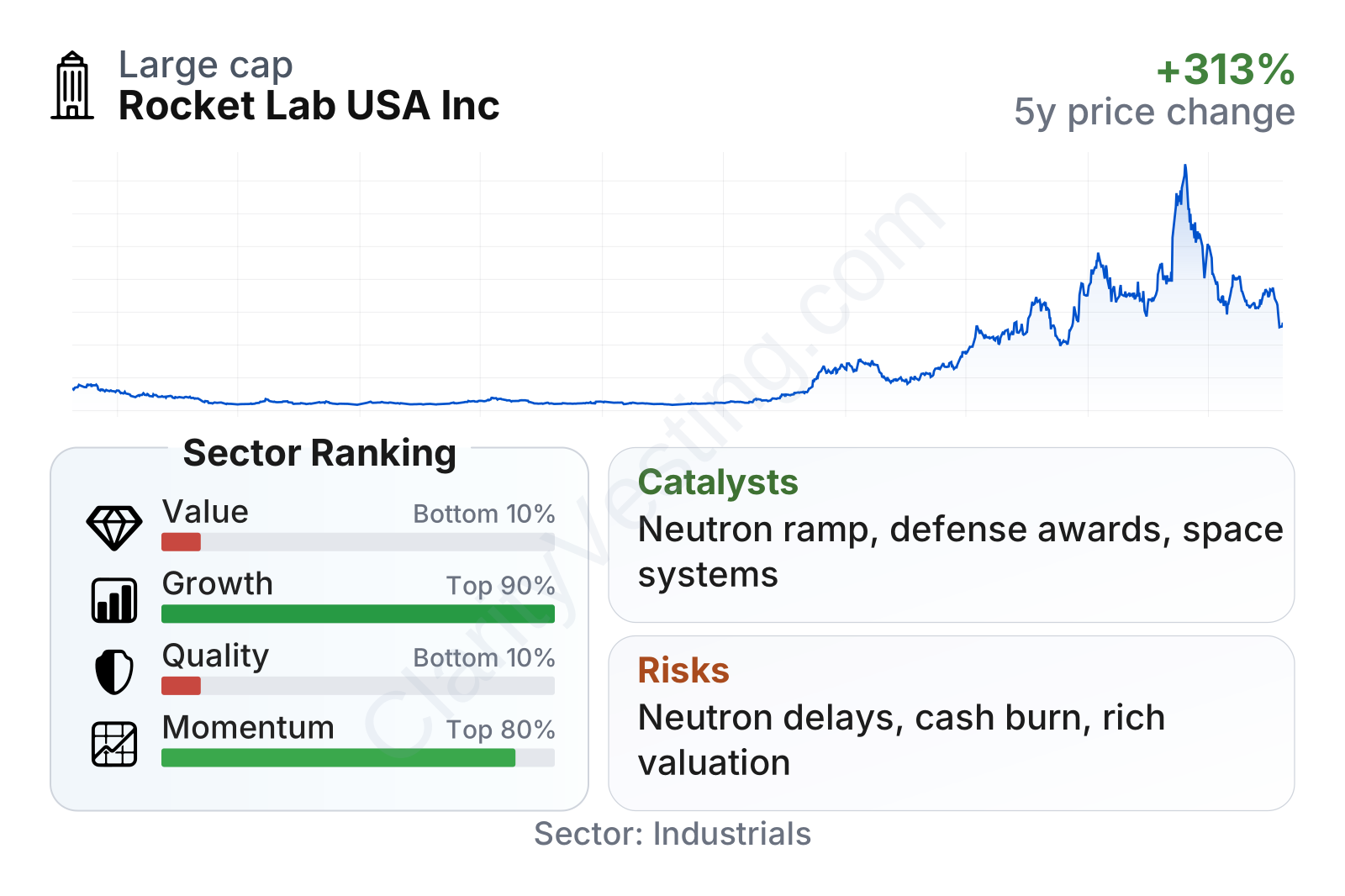
Rocket Lab stands out for very strong growth and strong share-price momentum relative to most aerospace and defense companies, but that strength comes with weaker profitability and a rich valuation profile. The company is now a large-cap name by market value for a business that still produces negative earnings, negative free cash flow, and negative operating returns. Balance-sheet leverage, however, looks unusually low for the sector, which gives it more flexibility than many industrial peers while it continues to invest.
Growth
Rocket Lab operates in a sector with attractive long-term demand drivers. Governments want more resilient space infrastructure, defense customers are spending more on national security space, and commercial demand continues to expand in areas such as Earth observation, communications, navigation, and in-space services. In that environment, companies that can provide not only launches but also spacecraft hardware and mission systems are positioned to capture a larger share of spending.
Rocket Lab’s strategy is coherent with that opportunity. Instead of relying on one product, it is building a layered model: regular small launches with Electron, higher-value components and satellite systems through Space Systems, and future expansion into medium-lift launch with Neutron. If execution remains on track, that approach could deepen customer relationships and increase revenue per mission.
The revenue trend remains one of the clearest positives. Year-over-year growth has frequently run far above the industry median, and recent periods still show expansion well beyond normal aerospace rates. That suggests Rocket Lab is winning business in a market that is growing, while also benefiting from a broader product portfolio than it had a few years ago.
The tradeoff is that growth is still consuming cash. Free cash flow remains deeply negative and has worsened as Rocket Lab funds development programs, especially Neutron and other expansion efforts. For long-term analysis, this means the company is still in a buildout phase rather than a harvest phase. The key question is not whether growth exists, but whether today’s spending creates durable economics later.
One of the strongest potential catalysts is Neutron, Rocket Lab’s planned medium-lift rocket. Electron has established the company as a credible launch operator in small payloads, but Neutron could move Rocket Lab into a much larger addressable market that includes national security, constellation deployment, and more complex missions. A successful ramp there would materially expand its strategic relevance.
Another major opportunity comes from government and defense work. Space is increasingly tied to national security, missile warning, communications resilience, and tactical intelligence. Rocket Lab’s end-to-end offering, including spacecraft subsystems and mission support, fits well with that procurement trend. Recent contract wins and continued participation in U.S. defense and civil space programs reinforce the idea that the company is becoming more than a niche launcher.
Risks
This article is for informational purposes only and does not constitute financial advice. Some content is AI-generated. See Disclaimer